Anyone who believes in Britain's membership of the European Union should stand up and be heard
As ever with Europe, there is an appearance of flux while so much essentially remains the same. When will pro-Europeans start to make their case?

Here we go again. Europe. Europe. Europe. We are pro-Europe, but realistic about Europe. We are realistic about Europe, that’s why we are Eurosceptic. We are Eurosceptic, but want to stay in. We are Eurosceptic and want to get out. On it goes, the never-ending dance. Parties are destroyed. Prime Ministers fall. The dance goes on.
Many of the moves are deceptive and calculated partly to deceive. Ed Miliband’s speech to the Confederation of British Industry yesterday and his interview in The Sunday Telegraph was quite a solo performance, showing that he has acquired some artful guile from the New Labour era. The Sunday Telegraph’s columnist Matthew d’Ancona saw Miliband’s stance as a potential “Clause Four” moment, signifying a historic shift away from Labour’s pro-European stance.
Yet take a step back, to what New Labour used to call the “big picture” and not much has changed at all. Miliband and the shadow Chancellor, Ed Balls, were never intoxicated by “Europe”. I recall very early in the New Labour era Miliband observing to me, astutely, that for the likes of Tony Blair and Peter Mandelson “Europe” had become a historic cause because they had turned their backs on more familiar left-of-centre objectives. Meanwhile, Balls was the key figure in persuading Gordon Brown to drop his enthusiasm for the euro and then preventing Blair from seeking to join the eurozone. Both were and are pragmatically pro-EU.
In power and indeed in opposition so was Tony Blair. Ignore the party’s many tonal changes and it becomes clear that pragmatic support for membership of the EU has been Labour’s position since 1983. Sometimes, because of the changing mood music around Europe, it has helped Labour’s leadership to stress that it is passionately pro-EU, and at other times to highlight its support for reform, sometimes both. Neil Kinnock won his only UK poll in the 1988 European elections, fighting on a strong pro-EU platform against a very Eurosceptic and silly campaign fought by the Conservatives.
Volcanic
By the time Tony Blair became leader in 1994, being “pro-Europe” brought him close to many business leaders alarmed by the frenzied, unrealistic Euroscepticism of the divided Conservative government. But Blair played games, too, absurdly deploying a British bulldog during the 1997 election campaign and writing in The Sun how he loved the pound. In power, his government was confused, pragmatic, sometimes bravely principled and occasionally opportunistic in relation to Europe. Probably, a Miliband-led government would be similar.
For the Conservatives there is always a volcanic eruption waiting to occur. Nothing has changed since the 1990s. Yesterday, the former shadow Home Secretary, David Davis, put forward the case for two referendums. His argument was characteristically ingenious and would probably bring about the Conservative party’s collapse. Davis suggested a first referendum should be held in this parliament to give Cameron a mandate for fundamental renegotiation.
The proposal is clever because the voters’ backing for a renegotiation would probably be overwhelming and would mean the first referendum would not directly pose the explosive question “In or Out?”. But Cameron would not prevail in a negotiation that required fundamental change. As the mischievous Davis knows, the logical outcome of his two-referendum proposal is withdrawal.
This is not the position of Messrs Cameron, Hague and Osborne, the three most senior Tory figures in the Cabinet. The triumph of Euroscepticism within the Conservative party can be measured by a comparison with the senior figures when the Tories were last in power. Then Heseltine, Clarke and Hurd held some sway. But the difference between then and now is limited. The current trio want, at least, to stay in the EU.
Cameron and Osborne can be flaky, changing their stance on a whole range of issues since they acquired the leadership. Hague is more mature, no longer troubled by personal ambition and having been exposed to the electoral downsides of Euroscepticism when he led his party to catastrophic defeat in 2001. Still, in theory, they all want to stay in and must have calculated that it is in their electoral interests to maintain such a position.
Nick Clegg, the most natural European in British politics has observed with growing alarm that the trio has an entirely different worldview from him. Europe is a policy area where there is an unbridgeable divide. But also note that, in practice and with good cause, Clegg supports Cameron’s negotiating stance on the EU budget and has supported specific examples of Cameron’s playing tough. The Labour leadership, with more experience of the EU from the perspective of government than any opposition, also knows that, beyond the game-playing, Cameron will do well to come back from the endless negotiations with a freeze.
Irony
While everything appears to be in flux, quite a lot stays the same. At the top of the three main parties are leaders who support Britain’s continued membership, and would take an expedient approach in power. Once, it was Labour that was split over membership. Margaret Thatcher fumed and yet signed up to every EU treaty. Tony Blair did less fuming yet angered the other EU countries, not least over Iraq. Cameron, like Harold Wilson, has to keep more than one eye on his party.
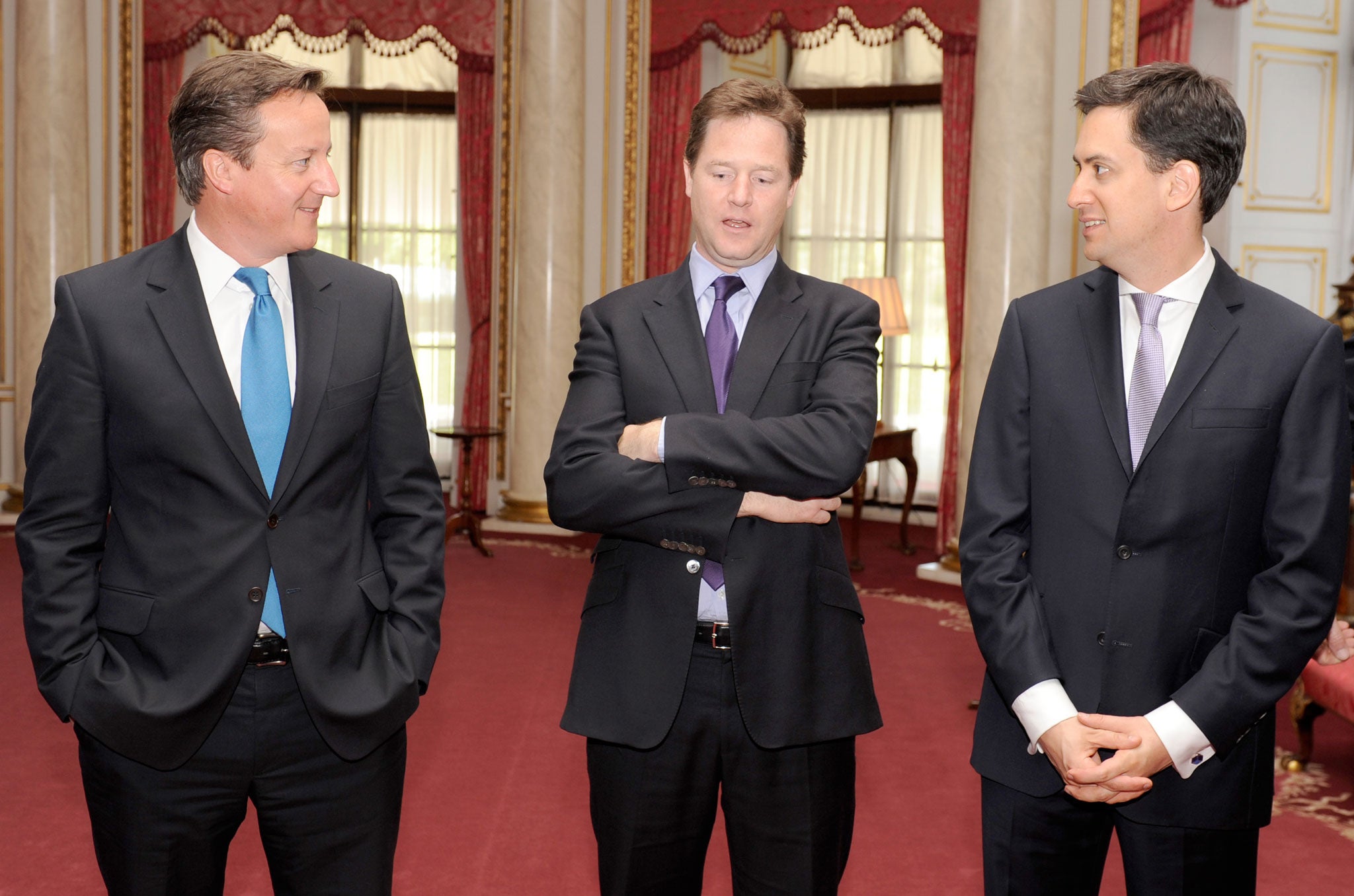
The differences now are that still-powerful newspapers are Eurosceptic as another referendum looms amid economic crisis – a dangerous combination. Miliband and Clegg might be more “internationalist” by instinct compared with Cameron but the three leaders have common cause. It is one of the zany ironies of Europe that the equivalent domestic alliance of Blair, Charles Kennedy, Ken Clarke and Michael Heseltine was never called upon to campaign for Europe. The much more unlikely combination of Cameron, Hague, Osborne, Miliband and Clegg might have to do so. They need to start putting the case with clarity, all of them from their different perspectives.
Miliband suggests we risk sleepwalking out of Europe. He is only half right. The journey will be noisy and destroy at least one party. Those who support Britain’s membership need to get noisy, too.
Join our commenting forum
Join thought-provoking conversations, follow other Independent readers and see their replies
Comments