As Rupert Murdoch's mother well knew, a good innings means more than just sticking around
What constitutes a fulfilling life?
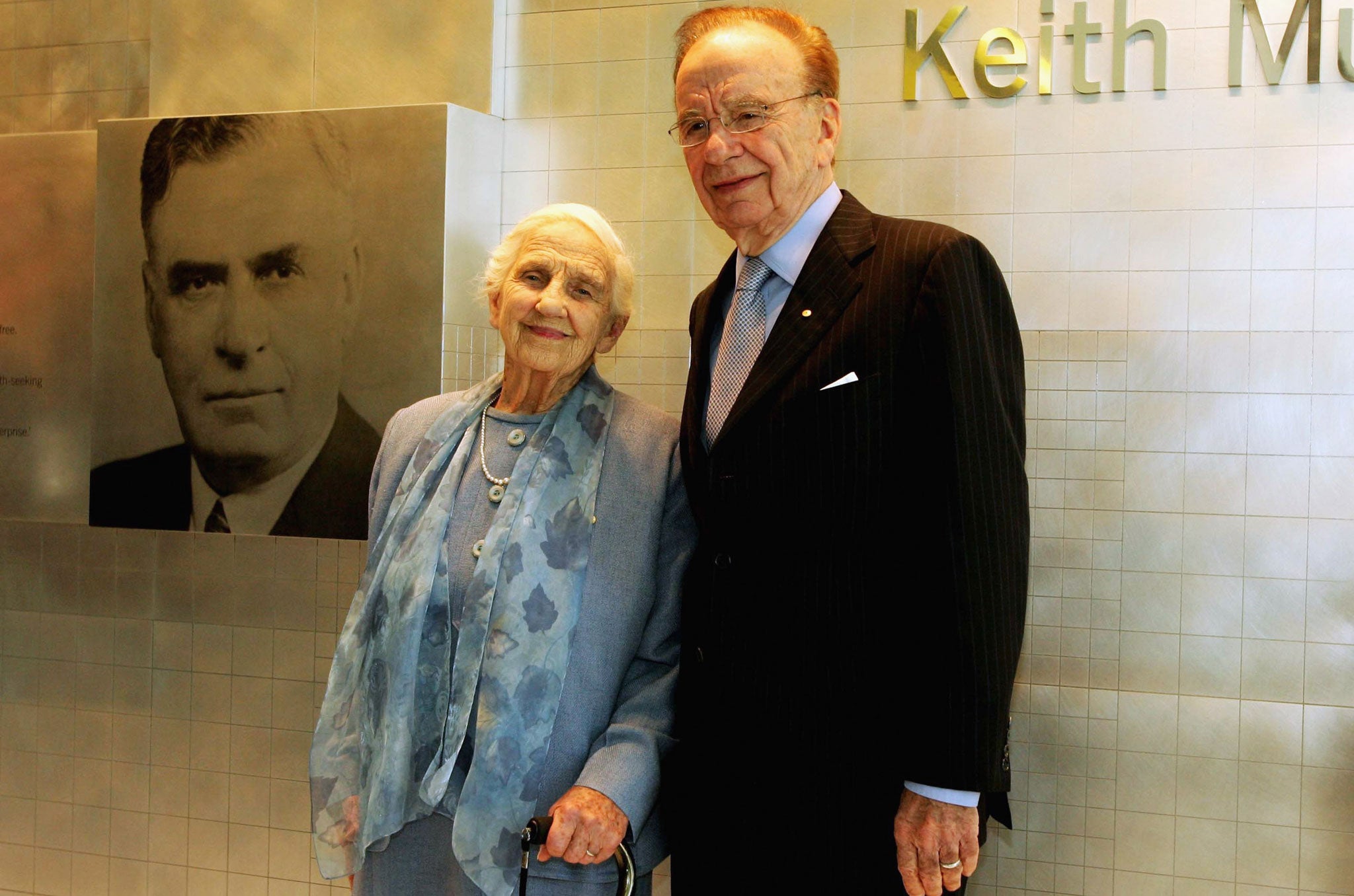
Rupert Murdoch's mother died on 5 December, aged 103. It was not an event that excited much comment in all the press, but those newspapers owned by the Dirty Digger carried respectful obituary notices.
She was obviously a spirited old lady, who, said the obituarists admiringly, at the age of 99 won a case brought against her by the Australian Tax Office on a multimillion-dollar sum which she had inherited. "Rupert Murdoch remained close to his mother throughout her life, even when his UK or US bases kept them physically far apart," said one article. There is every reason to suppose she was much given to charitable works, as all the obituaries recorded. It was left to Andrew Neil, former editor of The Sunday Times, to decree that she had had a "good innings".
It's an interesting concept, the "good innings". I am sure that Dame Elisabeth filled "the unforgiving minute, with sixty seconds' worth of distance run" – as in Kipling's If. The tactless thing about the phrase, of course, is that it implies that those who use the cliché agree with Life's Great Umpire in finding the Deceased definitely Out.
From your own point of view, and of those who love you – if there are any of them still left when you pass your 100th birthday, things might seem very different. I first warmed to Carmen Callil, the famously hot-tempered publisher, whom I had not then met, when someone told me that a colleague had walked into her office to find her in tears on the telephone. "Why, what's the matter?" he had asked. Carmen said, "I've just heard that Rebecca West is dead." "But," said the other tactlessly, "she was 90". "What FUCKING difference does that make?" screamed Carmen, hurling a large book across the room. Good reply.
Dread
Some of the friends who caused me the most grief by dying were 90 – and one was 100. The length, or indeed the quality, of the "innings" seemed curiously irrelevant. One just did not want the conversation with them to stop. By saying someone had a good innings, you think it was obviously time for them to go back to the pavilion.
As we view our own death, of course, the whole matter is a bit different. Most of us dread death, at least some of the time, even more than we dread the tedium, fear and humiliations of the geriatric ward. So we construct artificial lists of things we need to do before our name is called. There is a whole genre of newspaper article/website/party game, asking what are the 50 things you most want to do before you die.
I usually find these lists a real puzzle – people say they wish they'd visited all seven continents, or learnt how to abseil. Why? If they had wanted to do anything that badly, they would surely have done it. Needless to say, these questions do not occur to the young, but to the "active retired" who are beginning to feel useless. Hence the number of people given an hour in a hot-air balloon or at the controls of an aeroplane for their 65th or 70th birthday. Such "ambitions", of course, would not enrich the quality of your "innings" one way or the other. Pascal's view that all human ills spring from our inability to sit still in a room comes to mind. Hobbies are what people do who do not have lives.
More poignant are those lists of negative regrets. Not "I wish I'd visited Antarctica", but "I wish I'd worked less hard", or "I wish I'd stayed in touch with my friends" – two such quotes, in an article I read recently, from a palliative-care nurse in a hospice, who counselled the dying and heard their regrets as they approached the end. I suppose in such circumstances the absolute pointlessness of regret is part of what makes it so painful.
John Betjeman was asked on telly when he was wheelchair-bound with Parkinson's whether he had any major regrets about life and said that he wished he had had more sex. It was a wonderful one-liner for telly, but like many of his comments, it leaves one a bit baffled. Was he expressing an emotion that anyone, as they enter old age, could possibly have had? Whereas the jazz pianist Eubie Blake's (1887-1983) immortal words, though zany and illogical, do make a sort of sense: "If I'd known I was gonna live this long, I'd have looked after myself better."
None of this answers the question, what constitutes a good innings? What's "good" about the innings? The length? The quality of existence? John Keats died aged 25, yet his Letters are among the wisest things ever written, his poems, particularly those written in 1819, will live for ever, and although his death seems like an everlasting tragedy, you can't feel the life was not full and complete. Length of days might even have made him into a paunchy old bore, making wish-lists inside his head about South American countries unvisited, or languages unlearnt.
The pitiful example of Gulliver's Travels remains authoritative. Gulliver came to the land of Laputa where there was a rare race of people called the Struldbrugs, incapable of dying. When he first heard about them, he imagined that they would have benefited from their longevity by acquiring wisdom with their years. Alas, he discovers that "when they came to Fourscore Years, they had not only the Follies and Infirmities of other old Men, but many more which arose from the dreadful Prospect of never dying. They were not only opinionative, peevish, covetous, morose, vain, talkative; but uncapable of Friendship and dead to all natural Affection... Envy and impotent Desires are their prevailing Passions...".
Into a corner
No geriatric nurse, no clergyman visiting the elderly and housebound in his parish, no one contemplating the characters (largely) of relatives over 80, can fail to recognise what Swift was writing about. We all know that those very old people who remain lovable – those who make us scream "What fucking difference does that make?" when we are told they have had a good innings – are very, very rare. Most old people outlive their own charm.
Eager as some of the active retired among us might be, to start ticking off their "wish list"– of visiting South America, taking part in a bungee-jump or experimenting with bisexuality – the very fact that they consider this a way of bringing fulfilment to life suggests a depressing failure to get the point – whatever the point might once have been.
In a similar way, I was depressed when I read the most common regrets expressed to the counsellor in the hospice included: "I wish I'd had the courage to be true to myself and not live the life which others expected of me." Surely, living the life expected of you by parents, colleagues, wives, husbands, children is a virtue in itself, not the reverse, and the idea that there is some other you, a "true" you, gesticulating wildly to be let out, is a fantasy.
The truth is, that while we might be prepared to pat others on their dying heads and tell their relatives that they had a good innings, very few of us recognise when we should go back to the Pavilion. The average age is creeping up in all the countries of the secular West. The reasons adduced for this are a better diet, and the decline in smoking. I am not convinced. I wonder whether the reason is that, in the absence of the old social and religious conventions, which taught us to subdue the ego, we are now all egomaniacs who think we should live for ever.
I wonder whether we live so long because we have forgotten that knack, still known to the other animals on the planet, of going into a corner to die?
Join our commenting forum
Join thought-provoking conversations, follow other Independent readers and see their replies
Comments