Call off the search for the real Dark Lady. Shakespeare wasn’t Shakespeare. And I’m not me
Even sophisticated readers can forget the difference between literature and life

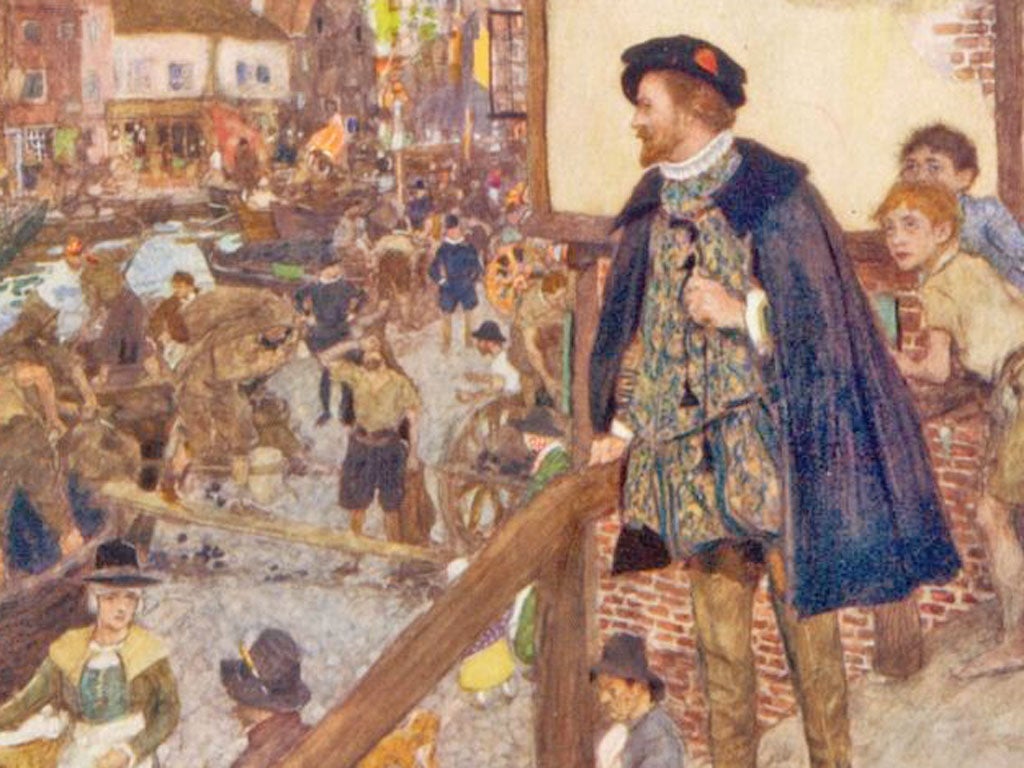
Lovers of Shakespeare’s sonnets – and who that reads this paper isn’t? – will be relieved to learn that the identity of the Dark Lady, supposed addressee of the final 24, has been uncovered.
No, not Aemilia Bassano, poetess and lover of Lord Hunsdon who was a patron of the Lord Chamberlain’s Men for whom Shakespeare wrote and whose mistress, therefore, by the febrile logic of biographical scholarship, he would not have been able to keep his hands off. Nor was she Lucy Negro, the Clerkenwell whore, sometimes called Black Luce but always referred to as “notorious” – a prime candidate, by the same scholastic logic, for the reason that Shakespeare was often in Clerkenwell.
In the minds of literary biographers, a poet has only to have strolled down a street in early evening for the likelihood to arise of his having sired a family of eight there. Let him have come within half a mile of another man’s mistress, whether strumpet, versifier or both, and the chances of his not having had carnal relations with her are minimal. Grant but a tenth of the suppositions made about his sex life and you can see why in Sonnet 110 Shakespeare berated himself for having gone “here and there” and made himself “a motley to the view”.
But don’t forget that Sonnet 110 predates the Dark Lady sequence and must have been addressed either to the Earl of Pembroke or the Earl of Southampton, though why it couldn’t equally have been addressed to Hunsdon, preparatory to Shakespeare’s nabbing his concubine, or even John Greene, who kept a disorderly house in Cow Lane, Clerkenwell, which Shakespeare was bound to have passed on his way to meeting Black Luce, I don’t know, but the preference of literary biographers for earls probably accounts for it.
The Dark Lady, anyway, according to Dr Aubrey Burl, fellow of the Society of Antiquaries, turns out to have been Aline Florio, wife of John Florio, the translator of Montaigne. This will not come as a surprise to the distinguished Shakespearean Jonathan Bate who, in his book The Genius of Shakespeare, published 15 years ago, cautions against “reducing the sonnets to their origin” but then reduces them for the hell of it. “My dark lady,” he whispers in the trembling reader’s ear, “is John Florio’s wife.” Scholars being nothing if not magnanimous, Professor Bate will be happy to have Dr Burl’s belated corroboration.
We won’t elaborate here on the reasons adduced by both men for their choice – Aline Florio was someone Shakespeare would have met (and we know where that always led); her husband was old (and we know where that always led); Shakespeare had a thing for witty women and Aline Florio (Bate has to invoke genetics to get this to run) was the sister of a witty man; and she was born of low degree in Somerset, which would explain the darkness of her complexion if not the inconstancy of her nature. Enough. Let the Dark Lady be whoever the Dark Lady was. It is not our affair personally, given that Shakespeare chose it not to be, and it is not our affair aesthetically in that, as Stephen Greenblatt reminds us: “It would be folly to take [the sonnets] as a kind of confidential diary, a straightforward record of what actually went on.”
Of the misconceptions that continue to bedevil literature, this is among the most obdurate: that it is a record, straightforward or otherwise, of something that actually happened. Even the most sophisticated readers will forget all they know of the difference between literature and life when biography perchance shows its slip. I recall not only a publisher but an agent conscientiously worrying that the end of one of my novels would cause great pain to my two devout but estranged daughters. In fact, I have no daughters, just a son from whom I am not estranged and who is not devout. I take the error as a compliment; my writing, it seemed, was so vivid, that what was imagined could pass as real.
But you would think the case no longer needed to be made, that what is wrought by the imagination vies with actuality, transforming beyond recognition any “truth” that might have been lurking in its lees. I am not the I of my novels. I am not even the I of these columns. It doesn’t matter that there are resemblances. No matter how like the I of reality the I in whose name I write is, he is still a construct. Forgive the apparent self-concern, but in fact it isn’t me I’m talking about, any more than we should suppose that the Will in Sonnets 135 and 136, which play ingeniously, if sometimes tiresomely, upon the poet’s name – “Whoever hath her wish, thou hast thy Will,/ And Will to boot, and Will in over-plus” – is Shakespeare stripped of art and artifice and coming clean about himself. There is no coming clean in art.
Before he breaks his own rule, Jonathan Bate says we should “allow the sonnets to rest in a middle space between experience and imagination”. I like the phrase but think he still gives too much to “experience”, which is beyond our reach and business. It’s possible that had there been no Dark Lady, had Shakespeare never wandered into Clerkenwell or stolen reechy kisses from the wife of a scholar too busy translating Montaigne to notice, these sonnets about loathing what you love, about believing what you know to be untrue, about the falsity at the very heart of sexual desire, would not have spoken to us with such disquieting force. But there’s always another Dark Lady. Isn’t that what these poems proclaim: that erotic love is full of pain and contradiction, an eternal search for an anguish one cannot bear and cannot bear to be without? We diminish them by making them the story of an actual affair. We diminish thought, we diminish imagination, and we diminish art.
Join our commenting forum
Join thought-provoking conversations, follow other Independent readers and see their replies
Comments