Cameron's days in office may be numbered, but the national agenda is still set by the right
The Prime Minister is surrounded by ideological crusaders and they've succeeded in turning the politically impossible into the politically inevitable
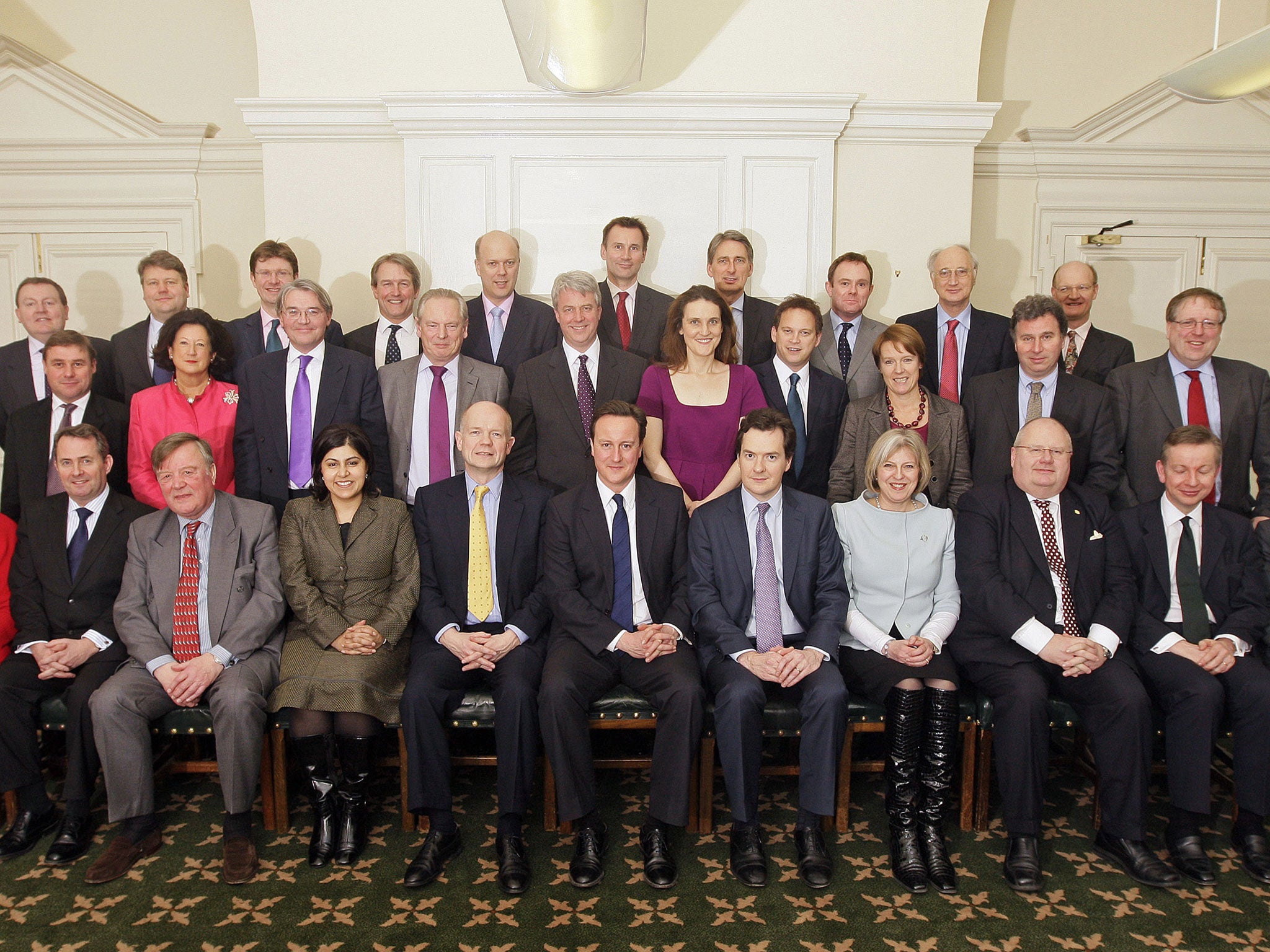
David Cameron is sunk, kaput, finito. He leads a party that has not won an election since 1992: back when nearly no one had heard of the internet; before text messages, DVDs, and even Take That’s first number one hit. They didn’t win the last election, after the British economy had jumped off Beachy Head and Gordon Brown was beginning to do an uncanny impression of a political Basil Fawlty.
Governing parties almost never increase their vote share at the next election. Every time the Tories have won an election since 1955, it has been on a lower share than the time before. They came third in the Eastleigh by-election as UKIP cheerfully chomped away at their vote. A poll by Lord Ashcroft reveals Labour on course to win 93 of 109 most marginal Tories constituencies, giving them a majority of 84. “Theresa [May], like me, has full confidence in the Prime Minister,” said Tory minister Sayeed Warsi yesterday. Oh dear: “full confidence” ranks among the most fatal phrases of British politics. Whether or not Labour gains an overall majority in two years’ time, the Tories cannot win, and this famously ruthless party will boot out its loser leader. To borrow a phrase from Italian comedian-turned-politician Beppe Grillo, David Cameron is a dead man talking.
Yet I didn’t write this to depress the spirits of the British right. Far from it. They are thriving. They are full of intellectual energy and creativity, churning out radical ideas on a daily basis. Among the complaints against Cameron is that he lacks a sense of ideological purpose or mission, in damning contrast to Thatcher. But it doesn’t matter, because he has surrounded himself with ideological crusaders: like Michael Gove with education, Iain Duncan Smith with our welfare state, Eric Pickles and local government, and the now-shunted Andrew Lansley and the NHS. Austerity has provided a convenient cover for the otherwise politically impossible. Theresa May, current hope of an increasingly desperate Tory party, branded as a British Angela Merkel, floated a radical Tory populist agenda this weekend, with talk of extreme free-market policies such as running schools for profit. Tory right-winger Liam Fox called for radical tax reform, urging that “it is time we set a clear philosophical course.”
The truth is, the right have been winning the intellectual argument for over 30 years. Last week, I watched This House at the National Theatre, a jaw-droppingly impressive and gripping play about the disintegrating Labour governments of the1970s. I watched it with a mounting sense of dread, because I knew of course how it would end: with a Tory government unlike any other.
But of course what we now know as Thatcherism did not just spring from a vacuum. Its foundations were laid decades before. Two years after the Second World War, 39 defenders of the faith met in a sleepy Swiss town called Mont Pelerin. “The central values of civilization are in danger,” was their panic-stricken declaration, and it had been “fostered by a decline of belief in private property and the competitive market”. Friedrich Hayek, an Austrian economist, wrote in The Road to Serfdom – which became the Bible of the dissident right – that “the prospects for Europe seem to me as dark as possible”. It was only when Western economies were thrown into chaos after the collapse of the Bretton Woods system and the 1973 oil shock that their chance came. “Only a crisis – actual or perceived – produces real change,” wrote the right-wing economist Milton Friedman. “When the crisis occurs, the actions that are taken depend on the ideas lying around”, and “the politically impossible becomes politically inevitable”.
And so it was with Thatcherism. Think-tanks bubbled away with ideas long before the Iron Lady assumed office: like the Centre for Policy Studies, set up as a rival to the Tories’ Research Department; Thatcher was the protege of its pre-eminent thinker, Sir Keith Joseph. There was the Adam Smith Institute, which created the blueprint of privatisation; the Institute for Economic Affairs, the Salisbury Group, and so on. As the Labour Party imploded into internal division, these right-wing Young Turks transformed Britain, turning the wacky into the prevailing common sense. The collapse of Communism in Eastern Europe apparently permanently consolidated their project: the left may have near-unanimously abhorred Soviet totalitarianism, but its collapse was spun as the disappearance of any alternative to untrammelled capitalism.
"The left may have near-unanimously abhorred Soviet totalitarianism, but its collapse was spun as the disappearance of any alternative to untrammelled capitalism."
Since then, the left has been forced into an entirely defensive posture. “Stop privatisation”, “defend our NHS”, “stop the cuts”, “save comprehensive education”; stop the world, I want to get off. Contrast this with the booming right-wing intelligentsia, injecting the seemingly impossible into the mainstream, pushing the political goalposts ever right-wards: Policy Exchange, the Taxpayers’ Alliance, ConservativeHome, and so on.
Five years into one of capitalism’s greatest crises, you might have expected the left to have gone on the offensive. Wrong: the right have pushed ever harder on the accelerator. That must change. There’s plenty of anger in Britain, but anger without hope is despair. Here’s two attempts to turn that around: to declare an interest, I’m involved with both. CLASS is a think-tank set up by trade unions, attempting to bring together often disparate economists, academics and experts to carve a coherent alternative to the current economic madness. The People’s Assembly, due to meet on June 22 in Westminster Central Hall, aims to unite all opponents of austerity in one movement.
Cameron’s time in Number 10 may be numbered, and if I were him, I’d start inquiring about a few private-sector consultancies. But that’s no reason for the right to be despondent. They remain the agenda-setters, the definers of political common-sense, the confident articulators of new ideas. The left must stop merely existing as a temporary buffer, slowing down Britain’s onward march to the right. Let’s learn from our enemies, snap out of our defensive posture, and launch an all-out attack.
Join our commenting forum
Join thought-provoking conversations, follow other Independent readers and see their replies
Comments
Bookmark popover
Removed from bookmarks