Fall of a Roman emperor: how the conviction of Silvio Berlusconi repeats the pattern of history
Though a farcical and fraudulent leader of Italy, the former Prime Minister was an autocrat very much in the mould of the emperor Tiberius - among others
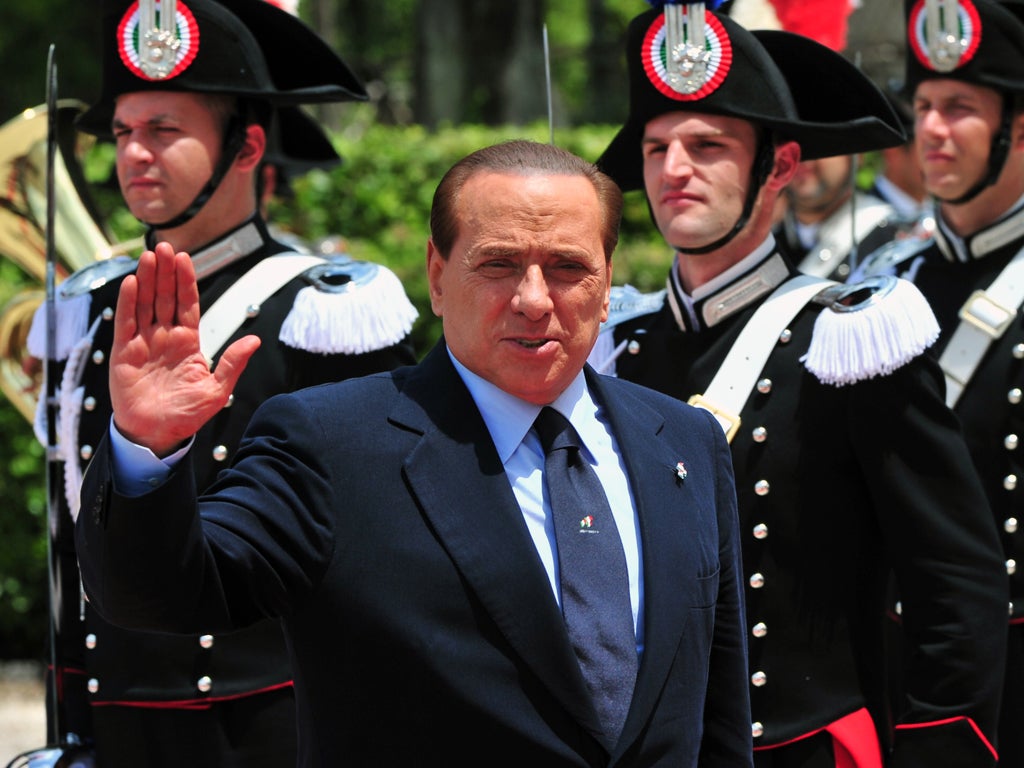
The parallels between Silvio Berlusconi and his ancient predecessors – the Roman emperors – have long been clear to classicists. And, indeed, to journalists. Two years ago, the Italian newspaper Il Messaggero ran a headline over a mocked-up poster of a flaming Rome, which read: “Rome Burns. Nero: It’s got nothing to do with me.” The newspaper’s point couldn’t have been clearer: the Italian economy was in as much peril as the buildings of Rome were in AD64, when a huge fire blazed through the city. Nero couldn’t or wouldn’t help his people then, and Berlusconi was no better now.
After a succession of charges, accusations and rumours about his personal and professional life, Berlusconi has finally been convicted of tax fraud, and was sentenced to four years in prison before a general amnesty reduced it to one year. The charge on which he was found guilty relates to Mediaset, one of his companies, reducing its tax liability by paying over the odds for the rights to films. If only he’d been convicted of handing out free focaccia too, we could have had the first case of bread and circuses since the satirist Juvenal coined the phrase.
However much Mussolini wished to be thought of as a modern Augustus, he has nothing on Berlusconi, who embodies the characteristics of so many emperors of ancient Rome that’s it hard to know who to pick.
Dodgy
His dodgy plastic surgery – hair transplant and an eye job – reminds us of Otho, who ruled very briefly in AD69, the year of four emperors. According to the imperial biographer, Suetonius, who missed his calling as a tabloid hack by nearly 2,000 years (though his biographies formed the basis of Robert Graves’s higher-brow novels I, Claudius and Claudius the God), Otho was as careful of his appearance as a woman. He depilated his whole body, and wore a wig over his bald head. His wig must have been more convincing than Berlusconi’s transplant, though: no one could tell he wore one, apparently.
And then there’s the fact that Berlusconi started out as a nightclub singer. Emperors could rarely resist the lure of an audience. Most famously, Nero (Christopher Biggins, for those of us who watched I, Claudius on TV) liked to take part in singing competitions. Oddly enough, the emperor quite often won the competitions he entered, though he went on for so long that, again according to Suetonius, women would give birth in the aisles, and men would drop from the walls at the back of the theatre because they couldn’t face applauding any more.
But Berlusconi’s autocratic nature is probably closest to that of the emperor Tiberius (played by George Baker, if you’re keeping score). He found dealing with the senators of Rome so tiresome that he declared them “men fit to be slaves”, and withdrew to his villa on Capri so he could rule without having to deal with any of them.
He was represented in Rome by his second-in-command Sejanus (Patrick Stewart in an unlikely wig), right up until he turned on him too, and told the Senate to get rid of him.
Berlusconi’s rather shaky relationship with the Vatican (which found his morals questionable, apparently), also seems to mirror Tiberius. Suetonius describes the bad-tempered emperor as “lacking any deep regard for the gods, or other religious feeling”. Though unlike Berlusconi, at least Tiberius was never hit in the face with a model of Milan cathedral.
Bunga-bunga
And then, of course, there are the famous bunga-bunga parties. Most emperors liked a good party (though Augustus wasn’t much of a fan – he used to limit himself to a paltry three or sometimes six courses, which is barely anything by Roman party standards). And many of those parties were pretty sordid: there’s a reason why Caligula is still Penthouse’s best-selling film, more than 30 years after its release.
But Tiberius surely had the most sordid ones. He would, as Suetonius tells us, lie naked in a pool and have small boys – his “minnows” – swim between his legs. It almost, though not quite, makes Berlusconi’s alleged fling with an underage prostitute look wholesome.
Whether Berlusconi actually serves any prison time is yet to be seen, since he’s expected to appeal against the verdict. He has a record of running down the clock, and the statute of limitations in the case is set to expire sometime next year. But in this regard at least, he’s probably better off than his ancient forebears. When the Roman elite decided it had had enough of the emperor Gaius Caligula (John Hurt, obviously), he was stabbed by the commander of his own Praetorian Guard, Cassius Chaerea. Cassius had apparently grown tired of being teased by the mad emperor, who used to give him mucky passwords to say, and waggle his fingers at him in an obscene manner.
And when Nero got the boot, he had to get his secretary to help him commit suicide. No one likes to be helped to die by the person who usually takes their dictation. Nero’s love of a show was revealed in his final words: qualis artifex pereo. What a great artist! But still I die!
Perhaps, in the end, it’s the Roman historian Tacitus who should have the last word. On the emperor Galba, who ruled for about 20 minutes, Tacitus described him succinctly: capax imperii, nisi imperasset. People would have believed him capable of ruling, if he hadn’t ruled.
Join our commenting forum
Join thought-provoking conversations, follow other Independent readers and see their replies
Comments