Forty years on, the benefits of EU membership are no longer compelling
Then we thought it was a matter of economics, not politics - and we still do today - but the rest of Europe doesn't
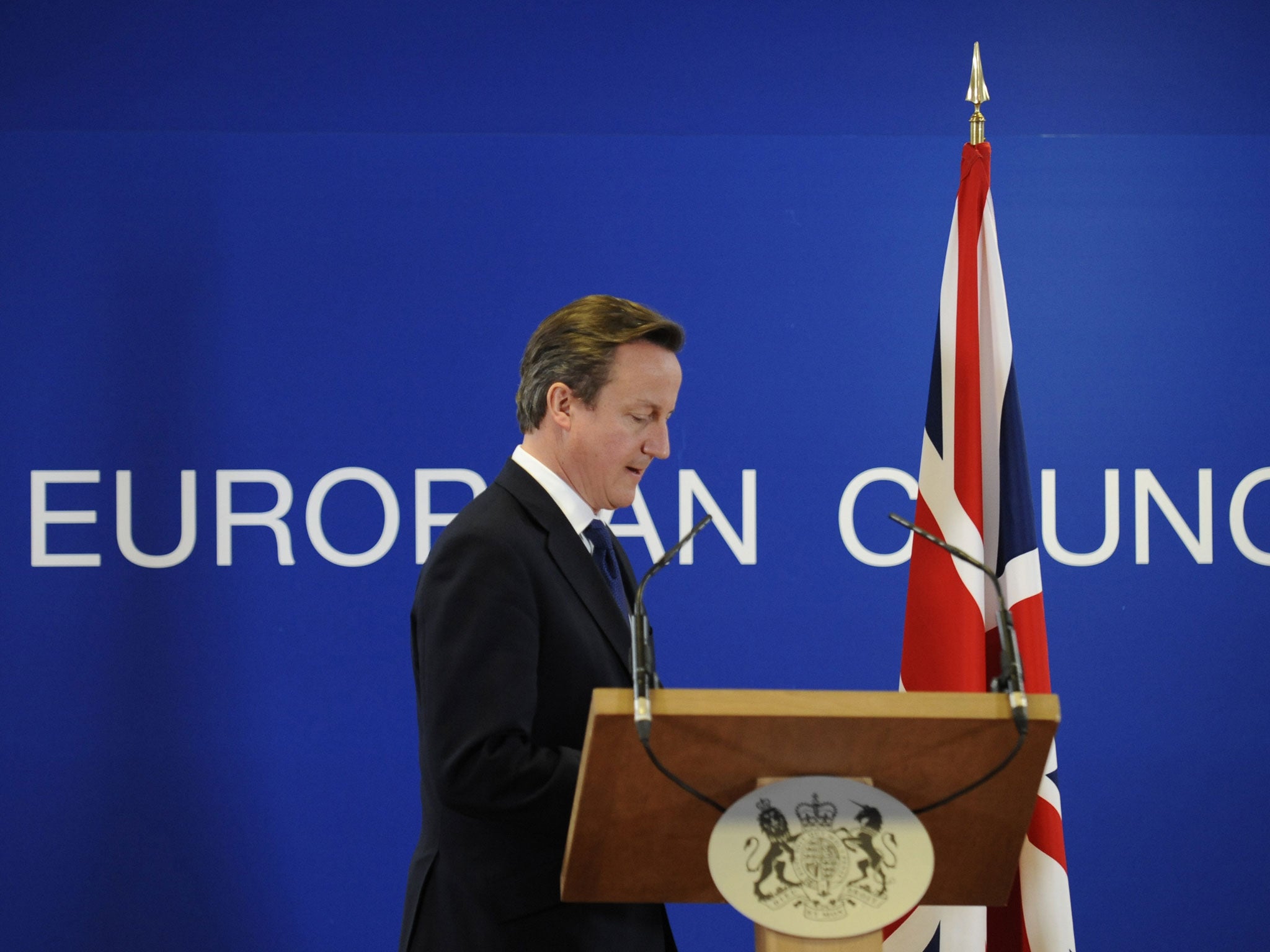
Forty years ago today a Union Jack was raised on top of the Brussels headquarters of what was then known as the European Economic Community. According to a report at the time, “one of Britain’s new European Commissioners, George Thomson, joined revellers in a torchlit procession”.
I may be missing something; but there do not seem to be any such celebrations, either in Brussels or Blighty, to mark the 40th anniversary of what must be accounted the most significant moment – at least symbolically – in post-war British history. The situation is somewhat different in Ireland, which joined the EEC on the same date and which today takes up the rolling national Presidency of what is now a union of 27 countries. “Through our membership, Ireland has a role in the world it could never otherwise hope to play,” wrote one Irish political celebrant last week.
There are other differences, obviously. In stark contrast to Britain, Ireland became a significant net beneficiary of EU funds; as a more rurally based economy the Common Agricultural Policy was embraced as an asset rather than endured as a cost of membership. And, perhaps most significantly, joining was seen as a way in which Ireland could escape from Britain’s long shadow.
In that sense, Ireland’s membership was as an enhancement of its nationalism, a profoundly political act quite divorced from any issues of financial gain or loss. This was not the case for Britain: we were unlike every other applicant in that the arguments of those advocating membership were almost entirely expressed in terms of narrow economic benefit. After all, earlier British governments had rejected the idea of membership of what was originally the European Coal and Steel Community because we had more than enough of the stuff for any purposes we could envisage; and unlike France and Germany, we did not think that if we failed to pool such industrial interests we would otherwise be at risk of starting another war.
Yet in the late 1950s and 1960s as our industrial performance relative to France and Germany went into decline, and our formerly flourishing trade with the Commonwealth also diminished, a recalculation took place: this was an economic club which seemed to have proved its worth and which we should therefore join.
And, eventually, under the Conservative administration of Edward Heath, we did. This was reinforced by a referendum in 1975, in which again the arguments of the “Yes” camp were entirely expressed in terms of economic benefits, enhanced by the fact that the business establishment was unanimously of the same view. Of course, when we joined the thing, it was actually called The European Economic Community: a phrase properly suggestive of an association of entirely independent nations coming together solely for the purpose of trade. As far as the political classes of its leading member-states were concerned, however, this was a misnomer: hence the later rebranding as The European Union (a title much more redolent of a single entity) and their subsequent attempt to create a European Constitution, with the full legal and symbolic panoply of statehood.
This, however, was and is political anathema to most Britons, whether Labour or Conservative voters ; and even though the Lib Dems have traditionally been the most enthusiastic of the political parties for such schemes, detailed opinion polls suggest that the electors who vote for them are scarcely less eurosceptic in their attitudes.
The most recent polls, indeed, consistently show a majority favouring exit from the EU, if offered a straight “in or out” question. A seismic shift in the attitude of the British people occurred as a result of the traumatic exit of the UK from the EU’s Exchange Rate Mechanism in 1992. Our membership of the ERM, with interest rates held at eye-watering levels to retain parity, had begun to seem merely masochistic; and when we exited, it appeared to bring with it an era of economic recovery. From then on, the British public treated with much greater scepticism the notion that being an integral and central part of the EU was somehow axiomatically an economic good: and to the extent that this acted as the democratic brake on Tony Blair’s professed intention to take the UK into the eurozone, it could only be seen as a blessing.
In order to realise just how very far removed modern Britons are from the mindset at the heart of the project, one only needs to listen to Angela Merkel, who has repeatedly declared that the euro’s continuation in its present form is “a matter of war and peace in Europe”. The German Chancellor, not a woman given to rhetorical flourishes or overstatement, clearly believes that preventing a break-up of the single currency – the monetary expression of the drive towards a single federal European state – is necessary to stop another war. In that sense, she is still back in 1951, when the Coal and Steel Community was formed.
Similarly, those who argue that Britain faces some sort of financial Armageddon if it were to leave are also living in the past. The EU is a diminishing proportion of our overall trade, rather than increasing, as it was in the 1960s. This is a function of the fact that Europe’s share of global Gross Domestic Product has fallen by half over the past 15 years. If anything, our trade should be less with Europe and more with the developing world. Meanwhile, national free trade deals have multiplied under the auspices of the World Trade Organisation; and the EU has itself negotiated tariff-free arrangements with a number of non-members, including Turkey. The idea that only by being part of an ever more prescriptive and centrally invigilated European political union can Britain realise its national potential is increasingly anachronistic.
Nor is it necessarily the case that those nations within its territorial boundaries would wish to punish Britain for seeking an exit. Last week, Jacques Delors, the architect of the euro and the former chief intellectual adversary of Margaret Thatcher, told the German newspaper Handelsblatt: “If the British cannot support the trend towards more integration in Europe, we can nevertheless remain friends, but on a different basis. I could imagine a free trade agreement.” He went on to remark that we were “strategically and economically important” and should stay “a privileged partner”.
I know that many think there is actually something uncivilised in not being a member of the EU. But I have never felt, when in Switzerland, that I am far from civilisation; nor that Switzerland’s international image is somehow diminished by its lack of membership of this particular political club. Forty years on, it is high time to reassess the terms of our own partnership: as with some marriages, amicable separation might be preferable to fractious co-habitation
Join our commenting forum
Join thought-provoking conversations, follow other Independent readers and see their replies
Comments
Bookmark popover
Removed from bookmarks