In the bitter cold, under a starry sky, a glimpse of a bird of mystery
The woodcock may be Britain's most secretive bird, but with the help of a leading expert it's possible to spot them on their nightly rounds
On Tuesday night, high on the Hampshire downland, it was five degrees below zero and, because there was no cloud, and no light pollution from any town, the stars were freezingly bright; they were pin-sharp. Orion blazed across the southern sky, infinitely grander than any triumphant statue, bigger than any skyscraper you will ever stand under; Jupiter was so brilliant it almost cast a shadow. Silence, and blackness, and a million shining points: the Universe was on display. To look up was to be spellbound.
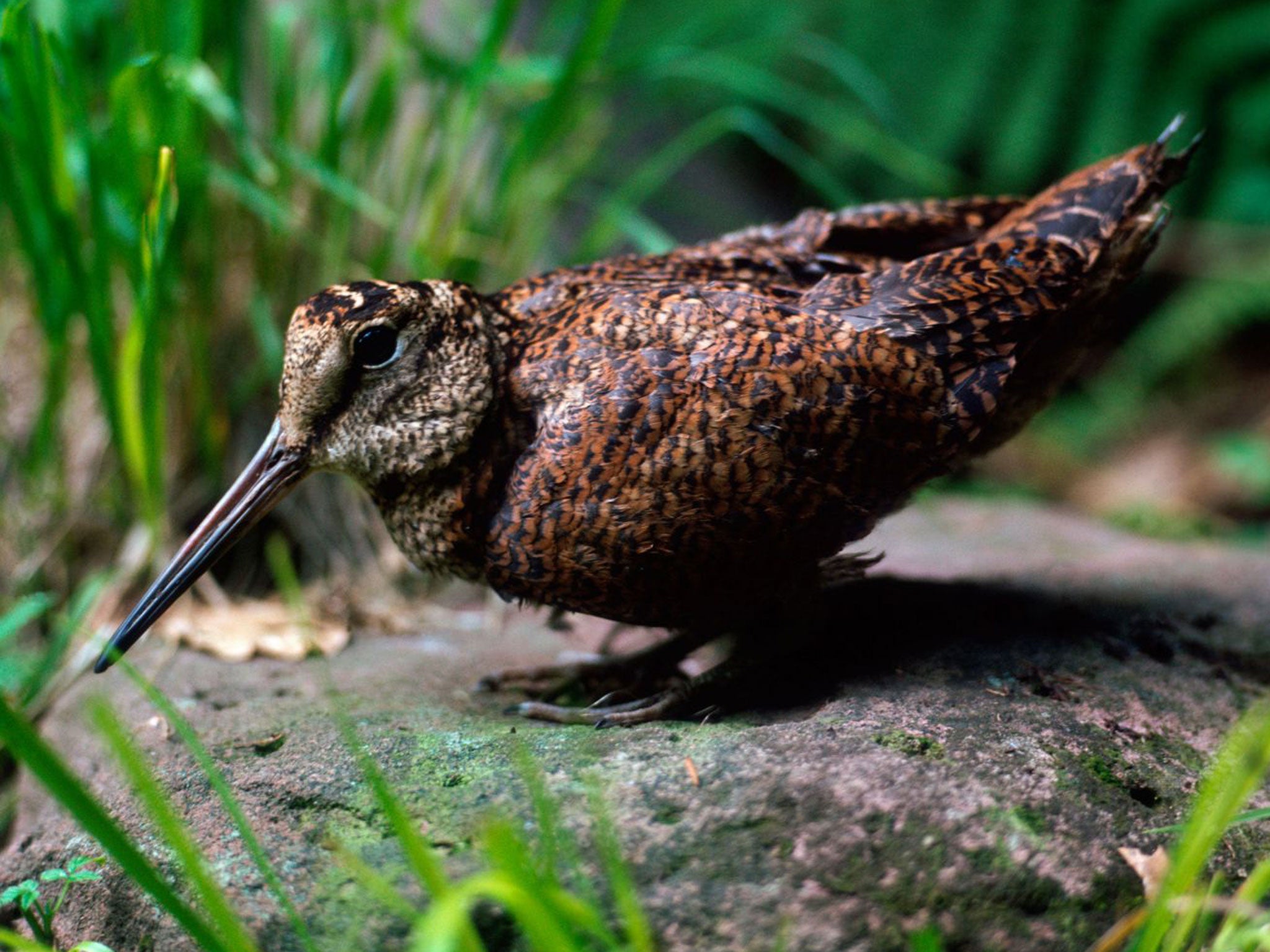
Yet remarkable things were happening down on Earth as well. As Andrew Hoodless swept the dark field with his powerful torch, beadlets of frost in the grass caught the beam and shone like Christmas tree lights; and then there were a couple of beadlets ever so slightly bigger. Andrew could pick them out from 75 yards – long before I could – and focused his torch on them and began to walk down the beam. I followed, and eventually in my binoculars I could see what the larger lights really were: the huge eyes of a woodcock. I saw the domed head, with its transverse stripes, rising out of the frosted grass tufts; I saw the long, long bill. And I was as spellbound as I was by the stars.
There were 17 of them in that field, or at least, 17 which we actually spotted in the torch beam: 17 examples of Britain’s most secretive bird, doing its business at night. Apart from their initial evening flight around their territory, known as roding, woodcock are almost on the same behavioural spectrum as owls, active only during the dark hours, which is why, although everyone knows about owls because of their prominent place in our culture, almost no one knows about woodcock.
Andrew Hoodless does: Dr Hoodless, of the Game and Wildlife Conservation Trust, is Britain’s leading woodcock expert and he was seeking birds he could tag with miniature satellite transmitters, to follow their migration back to Russia. Although we have our own native breeding stock (some tens of thousands of them), every autumn about three quarters of a million woodcock from eastern Europe pour into Britain in pursuit of milder conditions – in really hard winters, it may be as many as a million – and immediately disappear.
Remarkable. A million birds as big as pigeons, which nobody sees. For the woodcock is an evolutionary anomaly, a wader that never wades; a wader of the woodlands. To use the American term, it’s a shorebird, which never goes near the shore – and it hunkers down during the day in deep woodland undergrowth, emerging only after sunset, and flying out to feed in surrounding fields. And then it is Britain’s equivalent of another mysterious bird, the kiwi.
Just like New Zealand’s national emblem, woodcock probe the earth in pitch blackness for worms and insect larvae, with their long, ultra-sensitive bills. Hardly anyone ever gets to glimpse this. I only saw it because Andrew was using (in the cause of science) the technique known to every poacher, “lamping” – dazzling a creature with a powerful light beam and walking towards it unseen, behind the light.
He didn’t manage to catch any, because the night was so still and clear and freezing that the birds eventually heard our footfall’s tiny crunch on the frosted grass, and shot up vertically into the air. The nearest we got was about five yards away. But it was enough for wonderful views, watching them not only squatting down in the grass, but moving about on their legs which seem far too short for their body shape: they scurry like rabbits.
We saw rabbits as well in the torch beam, and hares – their eyes shine bright orange – and a fox. But Scolopax rusticola, whose eyes shine bright white, was the great prize, this mysterious creature that no one gets to see, there in the meadow before us, one after another of them, surrounded by the Christmas tree lights of frost in the grass. In the starlight. Under the great array of the Universe.
I am spellbound still.
Join our commenting forum
Join thought-provoking conversations, follow other Independent readers and see their replies
Comments