The Independent's journalism is supported by our readers. When you purchase through links on our site, we may earn commission.
News images are the Old Masters of our day
The new exhibition at the National Gallery asks - and answers - an intriguing question: can photography ever compete with the Old Masters?

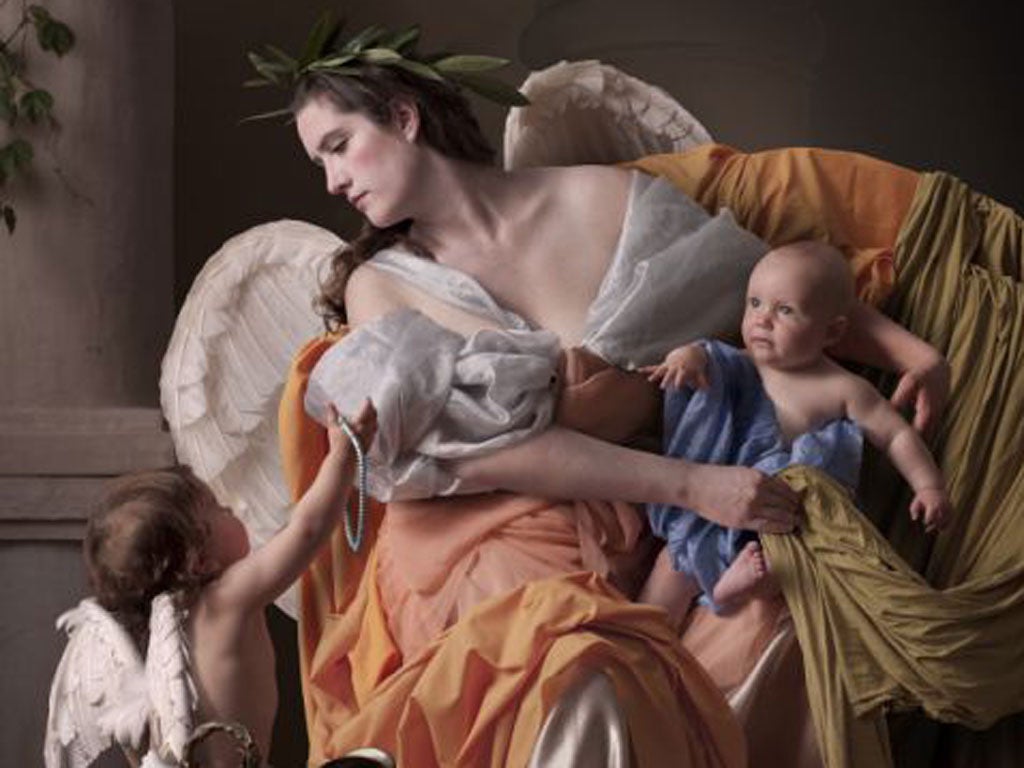
The mark of a good idea is that you wonder why nobody has thought of it before. The National Gallery, London, is mounting its first ever photography exhibition, “Seduced by Art, photography past and present”. It tackles a subject that could have been examined at any time during the past 100 years – the influence of the Old Masters of painting on the pioneers of photography.
The show also asks an updated version of that question: what do today’s practitioners, who use the medium as an art form, make of these early beginnings? The National Gallery’s method is to pair Old Master paintings with Victorian or contemporary photographs. In making these interesting comparisons, the question is raised, for instance, whether any photograph of high society people at repose in their grand homes or in their grounds can compete with, say, Gainsborough’s “Mr and Mrs Andrews” (1750), who stare out from the painting at us with looks so haughty and scornful that I, for one, would have stammered to have addressed them in case my words were considered to be… well… plebeian. Even Martin Parr, the excellent British documentary photographer and photojournalist, with his shot of a self-possessed couple in their 1990s reception room, cannot get near Gainsborough’s power.
The National Gallery exhibition, however, substantially enhances the reputation of one of the early photographers, Julia Margaret Cameron. She shines in this company. Cameron did not take up photography until 1863, when she was 46. Being socially well-connected, she was able to do a series of portraits of the celebrities of her time – Charles Darwin, Alfred Tennyson and Robert Browning, for instance. However, the National Gallery puts her up against great 17th-century painters such as Guido Reni rather than Victorian notables. And when you remember how limited were the technical means at the disposal of Victorian photographers – essentially limited to adjusting the focus to produce hard or soft outlines, bringing out some portions of the image while de-emphasising others – you see how Cameron’s sheer artistry allowed her to hold her own in an unequal battle.
It is extraordinary given the array of sophisticated techniques they now have at their disposal but few of the contemporary photographers in the show do as well. Judging by its prominence, the curators are particularly proud of Maisie Broadhead’s 2010 photograph “Keep them sweet” (above) in which her sister, wearing angel’s wings and a laurel wreath, with two young children, models a pose that deliberately imitates the Louvre’s “Allegory of Wealth” by Simon Vouet (1635). But the comparison is embarrassing. Whereas the Vouet exudes energy, there is only torpor in the Broadhead. And where there is vigorous line in the former, there is but dull arrangement in the latter.
Even more striking is the contest between a Fantin-Latour still life of roses in a vase (1886) and Ori Gersht’s “Blow Up”, 2007. Indeed creating and photographing a mini-explosion seems to have been the only response that Gersht could find to the work of the 19th-century French painter. Gersht says he realised that while a photograph’s literalness can convey visual information quickly and efficiently, a painting communicates slowly and partially.
So he felt driven to speed everything up. First, he took a bouquet of flowers and froze them with liquid nitrogen so that they looked as if they had been killed off by frost. Next, he hid small explosive charges among the flowers. Then he detonated them so that the petals flew into the air as icy shards. Finally, he used a high-speed digital camera to record the explosion. And that is the image that one sees in the National Gallery show.
I don’t wish to be unduly negative about this interesting exhibition. I would be the happy owner of a number of the contemporary works. Among them is a “constructed landscape” by Beate Gütschow, which is really a seamless amalgam of details drawn from a variety of municipal parks, industrial sites and urban scenes with a haunting quality.
At the top of my list, however, are two big panoramic photographs by the former Newsweek photojournalist Luc Delahaye. The first shows the final stages of a meeting of Opec. Reporters have rushed up to the platform to question the officials running the meeting. They jostle and push, they strain to hear the officials’ comments, they raise their cameras and push forward their microphones, unconsciously forming a series of groups pressed against each other, which the curators describe as a “fluid scene of strikingly Baroque chiaroscuro”. That is as maybe, but it is a wonderful picture.
The second Delahaye is called “US bombing of Taliban Positions, 2001”. You see an empty landscape, scrubland with ditches and, in the distance, a range of hills. There is nothing else. No soldiers or civilians. No planes in the sky. Only plumes and clouds of smoke rising from exploding munitions indicate the presence of war. It is contemporary, it is eloquent and it owes nothing to precedent.
Join our commenting forum
Join thought-provoking conversations, follow other Independent readers and see their replies
Comments