Poverty: The election issue that dare not speak its name
Out of America: Neither Obama nor Romney has much to say on the 46 million who live below the breadline
A presidential election campaign approaches its climax, as Barack Obama and Mitt Romney criss-cross the land in search of the last few votes. But my thoughts have turned to a couple of candidates from long ago, who have been back in the news these past few days.
One is George McGovern, best known for his landslide defeat at the hands of Richard Nixon 40 years ago and who now, his family announced, lies close to death in a hospice in his native South Dakota. The other is Robert Kennedy, indirect subject of a new documentary on HBO devoted to his widow Ethel, among the last living contemporary links to Camelot.
The programme wasn't particularly good – too much family frolicking, too little about the Kennedy tragedies, The New York Times's reviewer complained. "All this introspection, I hate it," says Ethel, now 84, at one point. But it was a reminder of what the country lost with the assassination of RFK, whose short-lived candidacy in 1968 remains one of the great "what ifs" of 20th-century American history: how different things might have been if he had gone on to defeat Nixon at that year's election.
But the mere names of Bobby Kennedy and George McGovern get you thinking: whatever happened to the old-fashioned American liberalism under whose banner they so proudly fought? Not today's diluted "liberalism" as practised by Obama, and which is little more than a schoolyard taunt hurled by right-wing talk-show hosts, but the liberalism that set out to right the wrongs of American society, first and foremost the scourge of poverty.
For Bobby, the reality of what he would call "the disgrace of the other America" struck home during his 1967 "Poverty Tour" of the Mississippi Delta. In McGovern's case, the concern was on a global scale, ever since President John F Kennedy appointed him director of the Food for Peace programme in 1962.
Listen to Obama and Romney, and you'd imagine poverty had vanished. During their debate last week, the President didn't mention the P-word once. Romney did five times but, one suspects, mainly in an effort to make amends for his infamous remarks about the 47 per cent of Americans who consider themselves "victims" and would never vote for him.
But his dominant concern, like Obama's, was the middle class. Hardly a sentence was uttered during the debates without a reference to it: jobs for the middle class, tax cuts for the middle class, healthcare for the middle class, and so on. In the US, the middle class is a pretty elastic entity, a metaphor for ordinary Americans who had already seen their income stagnate for more than a decade before being clobbered by the Great Recession. Depending on the income model you use, they account for between a third and three-quarters of the population. They're a huge number of voters, and appeals to them make perfect political sense.
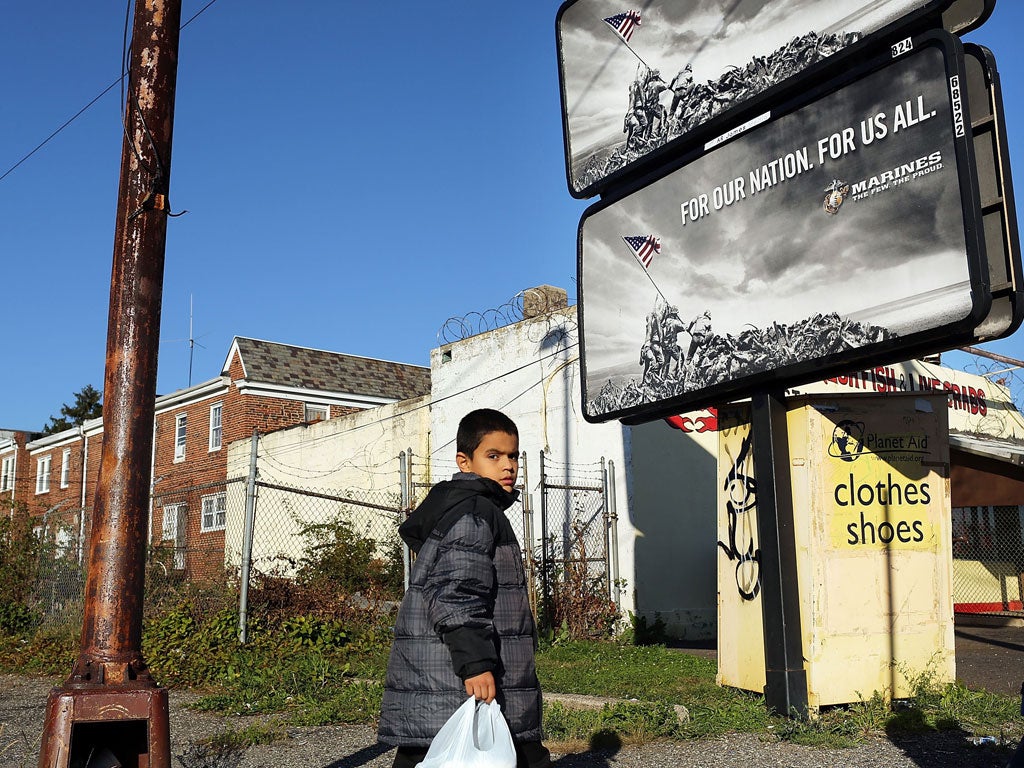
But the poor are with us too – more so than ever. According to the Census Bureau, 15 per cent of Americans, or more than 46 million people, live below the poverty line, defined as an annual income of $23,000 for a family with two children. Of those, six million live in extreme poverty, with an income of half that or less.
Poverty, of course is relative, and a family on $23,000 would be fabulously wealthy in parts of Africa where people have to live on $2 a day. But we're talking not about the Congo or Liberia, but the most powerful country on earth, and the US today has the highest poverty rate of any rich nation.
While welfare programmes of the 1960s and 1970s may have taken the edge off what RFK saw in Mississippi, the children "with bellies swollen by hunger", the basic problem has not disappeared. Since the 2008 crash, six million Americans have slipped back into poverty while tens of millions more who cling to the politicians' cherished "middle class" feel the cold breath of poverty at their necks. But no one talks about it like that, and up to a point you can see why.
The political spectrum has shifted to the right since liberalism's high-water mark in the 1960s; a relaunch of Lyndon Johnson's "Great Society" is inconceivable. In the Ayn Rand universe inhabited by the modern Republican Party, it's every man for himself. Welfare recipients are held to be lazy scroungers, and during the primaries Newt Gingrich's most reliable applause line was to mock Obama as "the food stamp president".
But something deep down is wrong. "Redistribution" may rank second only to "liberal" as the dirtiest word in the conservative political lexicon. But the return of poverty rates to a level not seen in a quarter of a century is just another facet of the ever-growing income inequality in the US, where the richest 1 per cent have a greater share of the cake than at any time since the Great Crash of 1929. Politicians still worship at the altar of the American Dream, the notion that anyone can make it big in the US, no matter how poor their origins. The fact is that social mobility, as measured by academic studies, is less here than in coddled, sclerotic Europe.
Soon after LBJ became president, an ally warned him not to squander his political capital on worthy but hopeless causes, such as civil rights and poverty. According to the biographer Robert Caro, Johnson's reply was: "Well, what the hell's the presidency for?" As you ponder cautious Obama, you think of Johnson, of Bobby Kennedy and George McGovern. Where are their likes today?
Join our commenting forum
Join thought-provoking conversations, follow other Independent readers and see their replies
Comments
Bookmark popover
Removed from bookmarks