Whatever Lord Leveson says, Britain should hold on to its feral beast of a press – despite all its horror
There is already a regulatory framework for newspapers. It is called the law: and there is no journalistic immunity from prosecution
Lord Justice Leveson missed a trick by not asking Sir Tom Stoppard to be one of his six assessors, called to aid the distinguished judge in his inquiry into the British press.
I say this not only because Britain’s greatest living playwright would have been a wonderful extra pair of eyes to make sure that the report, vast as it threatens to be, will also be a literary pleasure to read when it emerges in two days’ time. The real point is that Sir Tom, who started his writing career as a 17-year-old trainee on the Western Daily Press in 1954, has for all those intervening years been thinking about the rights and wrongs of the British press.
In his 1978 play Night and Day, Stoppard examined and satirised our trade with beautiful precision. As in this exchange: “Milne: ‘No matter how imperfect things are, if you’ve got a free press everything is correctable, and without it everything is concealable.’ Ruth: ‘I’m with you on the free press. It’s the newspapers I can’t stand.’” Ruth speaks for all those who feel the tabloid press have abused a great privilege.
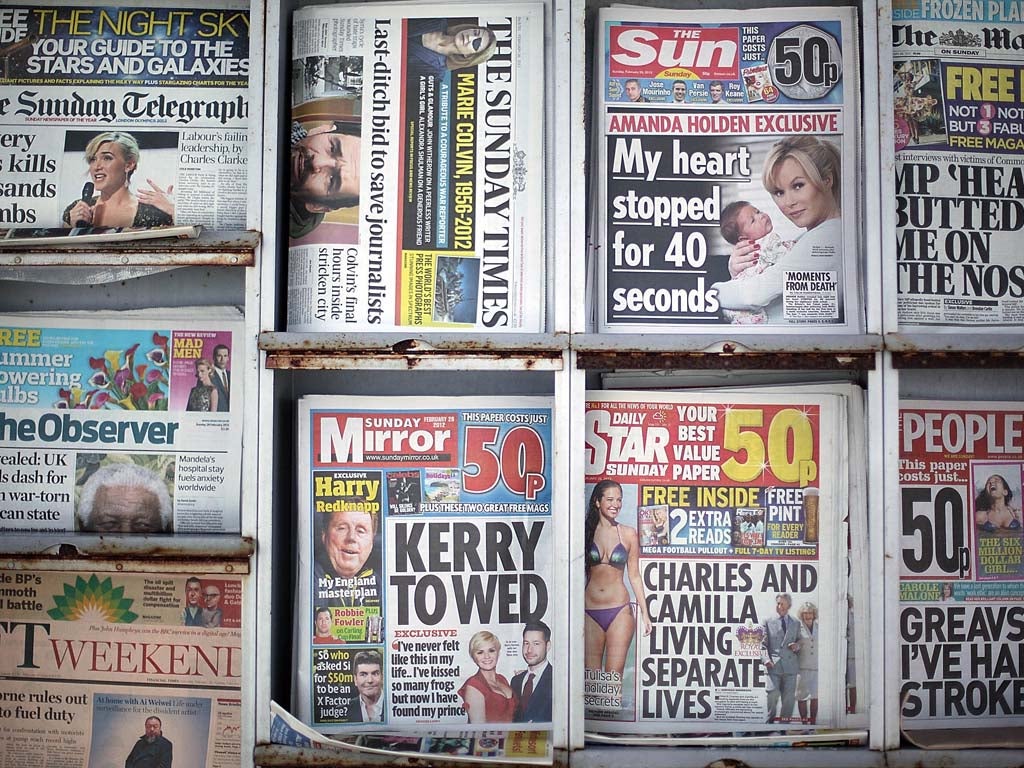
This point was expressed last week by the American political scientist, Frank Luntz, addressing the Policy Exchange think-tank. Luntz, precisely because he admires Britain, said in some exasperation: “I do not understand how a national newspaper in this country can put nude women on page 3.” Duly behaving like a character from a Stoppard play, I put my hand up and asked Luntz: “So what page do you think they should be on?”
Despair
This, of course, did not address the American’s point. The correct response to that sort of objection was put by the character Milne, who one suspects spoke for the playwright’s own view: “Junk journalism is the evidence of a society that has got one thing right, that there should be nobody with the power to dictate where responsible journalism begins.” That does seem right, though junk journalism can at times make some of us at the posher end of the trade feel embarrassed or even tainted by association.
Five years ago, on these pages, I wrote an article of despair at the way some papers in this country had treated Kate McCann, whose child Madeleine had been abducted while on a holiday in Portugal, and who at least one British newspaper had all but declared guilty of murder. I described it as “a tsunami of prejudice masquerading as detection”; the Daily Express, in particular, had treated the McCanns with disgusting cruelty. One should not lose sight of the fact, however, that a year later the McCanns were awarded £550,000 in libel damages; and the Express titles were forced to accompany that payout with front-page apologies to the parents they had so grievously wronged.
Similarly, Christopher Jefferies – who was subjected to character assassination by tabloid after he had been erroneously arrested on suspicion of murdering 25-year-old Joanna Yates three years ago – has received considerable financial compensation for the defamatory attacks he suffered. This doesn’t make the papers’ behaviour any more acceptable; but it does show there is already a regulatory framework governing newspapers.
It is known as the law: and the same law – in this case criminal rather than merely civil – is now bringing prosecutions against newspaper executives in connection with the illegal interception of communications, or, in the vernacular, phone hacking. Indeed, no fewer than 185 police officers are involved in this case, making it, by one account, “the biggest investigation in British criminal history”.
In fact, it is the man who put Brian Leveson’s name forward for his unenviable task, the Lord Chief Justice Igor Judge, who has best made the argument against new laws specifically to govern the press. In the 13th Annual Justice Lecture, the most senior member of the judiciary declared a year ago: “An independent press will, from time to time, behave appallingly or employ individuals who in order to pursue a story will commit criminal offences. No editors, I think, have ever advocated that they are entitled to some special journalistic privilege if they do so, immunising them or their employees from criminal prosecution. So that is not the issue... We do not say that the General Medical Council and self-regulation have failed when, as sometimes happens, a doctor sexually molests one or more of his patients, or like Dr Shipman murders them.”
It is understandable that many MPs, who can never forgive the press for its exposé of the abuse of the parliamentary expenses system, and who now have to submit those expenses to an independent scrutineer, should be rubbing their hands at the prospect of the press itself coming under statutory oversight. Yet it should occur to these politicians that there is a special reason why their financial dealings have been exposed to the rigours of quasi-legal external invigilation: the money they receive is taken directly from the public, without the latter having any discretion in the matter. In that sense, they are much closer to the BBC, which is paid for out of a poll-tax.
Feral
This is why the former Director-General of the BBC, Mark Thompson, argued last year: “It is not obvious to me that newspapers that people can choose to buy or ignore should be held to the same level of continuous supervision and accountability as broadcasters who reach out into every household in the land.” To which one can add that it is advertisers as well as readers who hold commercial newspapers to account. One reason why there is no equivalent to the page 3 nude in the US press is that advertisers wouldn’t want to be associated with such journalism; and it was an advertisers’ strike which was the proximate cause of the closure of the News of the World, and the loss of over 300 journalists’ jobs.
It is true that the British press is, to quote Tony Blair, “feral”; or certainly more so than its equivalents in the USA or Europe. If you are a Prime Minister, it might well be a source of deep irritation that you should be lampooned and hounded in a way which your European counterparts would not have to endure. By the same token, we journalists in this country are envied by our European colleagues.
This was made clear in a speech last week by Jurgen Kronig, the head of the Foreign Press Association in London: “We foreign journalists coming to London are swiftly confronted with this deep cultural commitment to press freedom – no register of journalists, no legal requirement even to have a Press Card. Britain has in my view the freest, probably the best press in the world. At the same time it can be the most irresponsible press. Two sides of one and the same coin.”
Devalued as it may have been, it is a coin worth keeping.
d.lawson@independent.co.uk
Join our commenting forum
Join thought-provoking conversations, follow other Independent readers and see their replies
Comments