Why we all love Attenborough
There are people in whose company, because of a million tiny signals, we quickly feel at ease; I would submit that Attenborough has that effect on the whole nation
What does it take for a whole nation, with its full complement of cynics and pessimists, to trust someone? Is that not a remarkable event, if and when it happens? Here’s an example: few Britons under the age of 40 may have heard of Walter Cronkite, but for a generation he was a world figure as America’s most celebrated broadcaster, in particular as the anchor of the CBS evening news from 1962 to 1981 – two decades that included the assassinations of President John F Kennedy, Robert Kennedy and Martin Luther King, and the traumas of the student revolt, the Vietnam war and the Watergate scandal in which President Richard Nixon was ejected from office.
These were years of turbulence for the United States, yet the individual who relayed the details of it all to US citizens in their own homes, night after night, emerged untouched by the consequent growing disillusionment with public life: according to opinion polls, he was not only famous, he was the most trusted man in America. Such was his aura and influence that when, on his return from a Vietnam trip in 1968, he pronounced that the US could not win the war, President Lyndon Johnson is said to have exclaimed: “If I’ve lost Cronkite, I’ve lost Middle America!” and shortly afterwards announced he would not seek re-election.
Sir David Attenborough’s views on Britain’s own recent military involvement in Afghanistan, if any, are not known. Our leading TV naturalist, who this week signed off from his most recent grand wildlife series, Africa, doesn’t do politics. Governments of all persuasions probably think: a good thing too, as there is no doubt that any Attenborough pronouncement about any policy whatsoever, delivered in those ultra-measured, ultra-reasonable tones, would have an effect on the population at large; at the very least, it would be listened to in sympathetic silence.
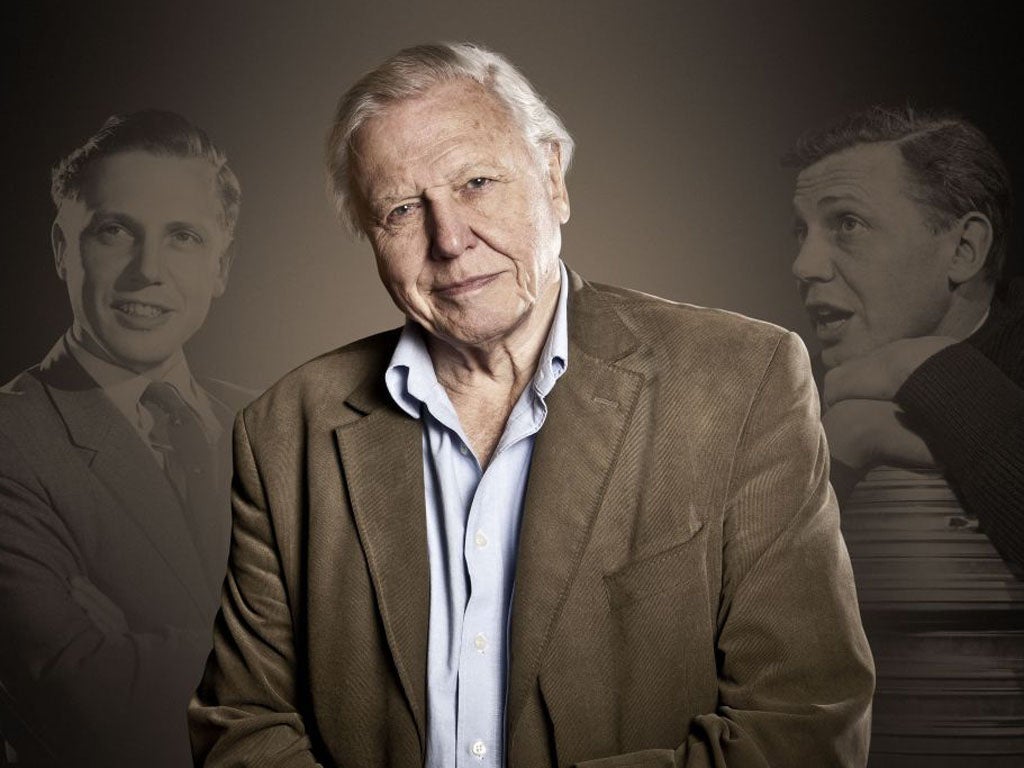
For Sir David has now reached that scarcely believable peak of national public confidence which Walter Cronkite attained across the pond a generation ago. He is more than revered; he is, polls show, the most trusted man in Britain. But how has a zoologist, a man who began his television career collecting animals for London Zoo, matched the vast public faith once placed in an American whose business was interpreting the great affairs of state?
I would offer three reasons, the first, of course, being the obvious one: he is our supreme interpreter of the natural world. The programmes he has presented have entranced many millions of viewers with their moments of revelation about unfamiliar aspects of animals’ lives. Attenborough’s great gift has been to capture the wonder of it all, and give it intense personal expression, without any of the cheesy anthropomorphising, say, that characterised early Walt Disney nature documentaries such as The Living Desert. The final image of Africa, which showed him on all fours chatting – there’s no other word for it – to a blind baby rhino, was so moving because it was unforced and entirely artless. And he’s been doing this for 60 years. (He’s now 86.)
The second reason concerns the key quality Attenborough enshrines: the high seriousness of the original BBC, where he has spent his working life. He embodies the principled vision of public service broadcasting, with its mission to inform, of the first BBC director-general, Lord Reith; and yet, unusually, he is entirely unstuffy. The accent is perhaps the key; there is nothing demotic about it, no concessions whatsoever to popular culture, but neither are these the tones of a toff. The voice is resolutely intelligent, but resolutely neutral in class terms. It is more than the voice of Middle England; it is the voice of Britain at its best.
But the third reason I would put forward is different altogether: it is not a rational one. Rather, as Sir David might perhaps appreciate, it is zoological, in that it comes from the animal side of us. For we evolved as tribal carnivores, just as chimpanzees still are, and one of the senses we acquired along the way, to help us survive as hunter-gatherers encountering rival tribes, was a finely honed intuition about other humans; in particular, the ability to detect threat, and to detect falsity (which is closely related). We have it to this day. We can all read body language; we have all experienced the inchoate feeling that “I dunno what it is, but there’s just something about him I don’t like”.
Yet this sense has its reverse: we have also evolved keen intuition about which other humans we can trust. There are people in whose company, because of a million tiny signals with no words spoken, we quickly feel at ease, people whose attitude we quickly sense is authentic, and not fabricated; and I would submit that our nation as a whole has directed this biological, non-rational intuition at David Attenborough, and he has passed the test.
He may not be perfect (in private he can be bad-tempered), but we sense strongly that he is not vain; he is not out for himself; he is not pretending to be something he isn’t – and this is a judgement we might by no means make of all the up-and-coming TV presenters who are now being touted as his eventual successor.
Animals, of course, as our man knows as well as anyone, often do this sort of thing by smell. Sniff; breathe in; yes, no problem here. And perhaps it’s not a bad analogy to explain the deepest reason why this zoologist is, like Cronkite the newsman in America a generation ago, his country’s single most trusted individual. Collectively, as a nation, we have smelt you, David, and you smell good.
Join our commenting forum
Join thought-provoking conversations, follow other Independent readers and see their replies
Comments
Bookmark popover
Removed from bookmarks