Why we should pay more attention to Lebanon's 'Little Palestine'
The Palestinians in Lebanon are fixated on the cause of their homeland
Palestinians around the world woke up today to news that the United Nations General Assembly voted overwhelmingly to recognise the Territories as an observer state. But for those Palestinian refugees awaking in Lebanon, the joy was particularly acute: they can now hope that developments on the international stage may one day lead to their being able take their place in a sovereign state.
Palestinian patriotism is strong here, despite being forged on foreign soil.
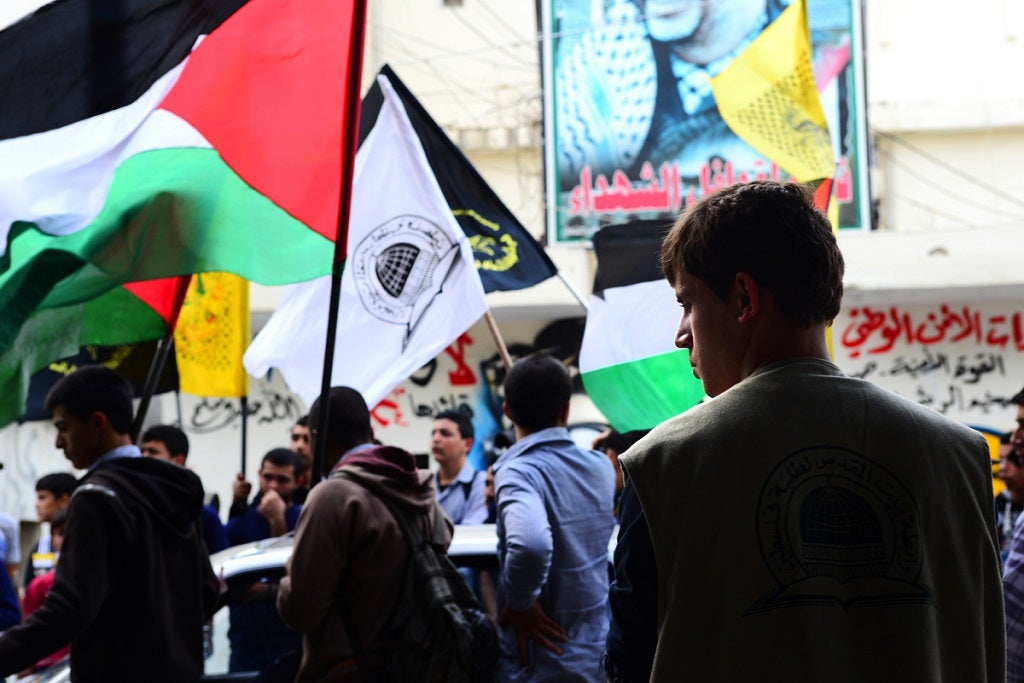
In fact, as you wind your way through the streets, it is hard to escape the visual bombardment of patriotic symbols. Each available space serves its purpose whether as a canvas to graffiti of the omnipresent Arafat, revolutionary lyrics painted on walls, posters of martyrs or ribbons strewn across the narrow gaps in the tapering streets in the red, white, black and green of the Palestinian flag. In the streets of Bourj el Barajneh camp last night, residents took to the streets with joy and a furious pride in their newfound recognition. “This is big, very big for us,” shouted an elderly woman over the bagpipes and snare drums played with gusto by a group of Palestinian boy scouts. She had been dancing the Dubke or traditional dance with such youthful vigour that her headscarf was in disarray. “This is proof that the world is not against us.”
Scars
The loyalty of the refugees to their homeland is a force of increasingly relevant consequence. In 1982 when the presence of the PLO led Israel to invade Lebanon’s southern frontiers, it left deep fault lines of conflict still running today; an Israeli stamp in one’s passport will prevent you from entering the country. Not that Israel is alone in bearing the brunt of animosity when the Lebanese consider the civil war that ravaged the country; resentment of Palestinian refugees is acutely felt, more so when spats of violence erupt around the camps where unlicensed weapons circulate freely, and often end up in the hands of youngsters.
According to the United Nations, more than half of Palestinian refugees in Lebanon are under the age of 25, and just under two thirds are unemployed. As one refugee working as a school teacher in Nahr el Bared camp said: “Here you either have two choices, you work with UNRWA in the camp, in one of their schools or medical centres, or you find work with one of the mafias in the camps. That is why there is so much tension – you have all these young men and boys, testosterone all over the place, with no jobs and nothing to do but obsess over liberating your country.”
At a time when the Lebanese government is gripped in its own withering crisis, and fears are mounting of the country being pulled into neighbouring Syria’s civil war, there has been little speculation on the effects of the Israeli-Palestinian feud from within. Unlike Palestinians in the territories who live alongside Israelis – those displaced to Lebanon don't integrate, leaving them to vilify the absent enemy without interruption or contradiction. Here, hopes and desires for a two-state solution are lacking. An official from Fatah living in Beirut, who asked not to be identified, said during the recent hostilities in Israel, “everyone wanted to support Hamas by fighting the Israelis. It was all anyone was talking about.”
Captive audience
As air strikes continued to batter Gaza, the twelve camps of Lebanon were conducting coordinated protests and demonstrations in solidarity with Hamas, whom the US and other Western governments regard as a terrorist organisation. Even revolution-themed merchandise was quick to circulate some of the camps, with purple and navy t-shirts emblazoned with the words “I support the resistance of Gaza against the Zionist entity” being handed out for free in Rashidieh camp near the southern border.
The response to calls for activism and demonstrations by many of the popular committees inside the camps has been so effective for the simple reason that the refugees in Lebanon are a captive audience.
Without jobs, without rights to travel, even without rights to owning your own home, there is little for Palestinians in Lebanon to do except dedicate themselves wholly to ‘the cause’.
What the latest developments at the UN may bring are still debated, many have concerns that it may put a spanner in the works of any possible two-state solution. Yesterday’s vote may carve a path towards membership of the Security Council, allow the Territories to bring Israel to an international court over settlement building and even allow them control over their own airspace and put an end to the Gaza blockade. It might also bring the West Bank its own airport, allowing refugees to actually return home without the problems of crossing an Israeli border. While the Israeli frontier for now remains tightly manned with convoys and border patrols, it would still be wise for them, given these developments, to heed the distilling fervour and patriotism swelling in ‘Little Palestine’ to the north.
Join our commenting forum
Join thought-provoking conversations, follow other Independent readers and see their replies
Comments
Bookmark popover
Removed from bookmarks