A N Wilson: Church bells ring the soundtrack of Britain
The Somerset couple who complained about the quarter-hour chimes are in the wrong place. Ringing goes straight to the heart
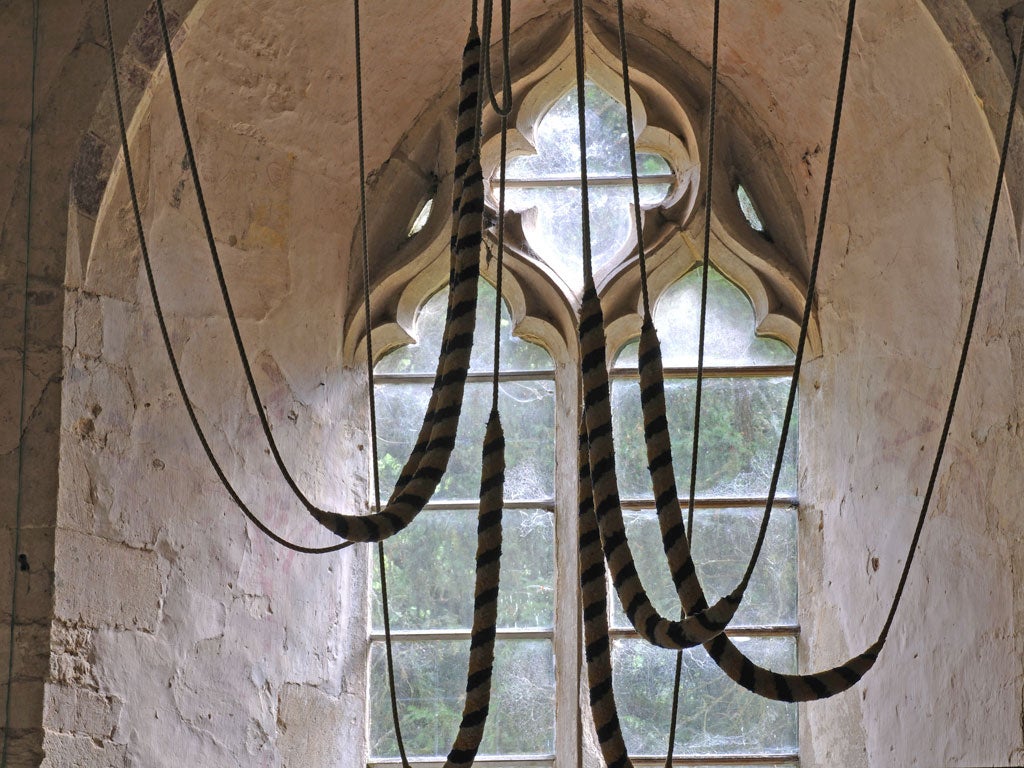
A busybody's work is never done. Nick Yates, spokesman for North Somerset Council, last week informed the world: "Our case officer has assessed the complaint, as has a colleague, and they are satisfied that the noise is a clear statutory noise nuisance." To what can he have been referring? The yell of ladettes at 3am, as their lager-lout swains spewed in the town square at Taunton? The everlasting drone of long-distance lorries on the M5 between Bristol and Exeter? The pounding thump of heavy metal booming from open car windows as motorists snarl up in Yeovil, or the droning on, in local radio studios, of the know-it-all Lord Ashdown, giving his views on every aspect of the world situation? No, although those are all noise nuisances which afflict Somerset from time to time, Nick had found another which to his ears was more offensive.
The noise nuisance in question was the quarterly chime of All Saints' Church, Wrington. For more than 100 years, the bells have marked the quarter hours. The people of the village have absorbed the striking of the church clock into the inner music of their hearts. Anyone who has lived within the sound of such chimes knows how this happens. On the rare occasions when I spend a night in Oxford, the keeping of the hours by the clock towers in New College, and Merton, and the great booming of Tom tolling 101 times at 9pm at Christ Church are inextricably interwoven with memories and regrets and lost joys. The sound almost sends me mad, so intense are the feelings it evokes. The nation at large, when it turns on the radio, awaits the boom of Big Ben before the six o'clock news. We are a people "summoned by bells", to quote the title of John Betjeman's autobiography, and both the chiming of the hours and the complex art of bellringing are the inner music of our lives in towns and villages all over the land.
They were in Wrington, too, until Jonathan Apps, an operations director at Young Masters Golf, chose to come and reside there last year, with his partner Christina Hallett. The newspapers did not enlighten us as to Christina's sphere of usefulness, but it is in London, and she comes down to the village only at weekends. The golfing operations director and Christina happened to view their tempting property at a moment when the church tower was being restored, so that the chimes were silent while they exchanged contracts and paid £587,000 for their house. When the clock started again, you might have thought that they would have seen the poetry of the thing. You might have thought they would be patient, and allow the rhythm of the chimes to become part of their inner minds. The rest of the village were not insomniacs, since they had grown used to the bells. "They were old Chimes, trust me... They had clear, loud, lusty voices, had these Bells, and bent on being heard on stormy nights, by some poor mother watching a sick child", as Dickens wrote in his Christmas story "The Noise Nuisances" – sorry, "The Chimes".
The rest of the inhabitants of Wrington love their chimes, but this fact is apparently of less importance to North Somerset Council than the vital question of whether a woman commuting from London and treating the place as a weekend pied-à-terre should have her sleep patterns mildly disturbed. So, on goes the gagging order, and the chimes have been silenced between 11 o’clock at night and 7 o’clock in the morning.
A pity. A scornful German in the Victorian age, noting that the British had no Brahms or Beethoven, dismissed this country as "Das Land ohne Musik" – the land without music. It is true that there were no mid-Victorian composers on the high level of Tallis or Byrd, nor of later composers like Elgar or Vaughan Williams. But Britain is in many ways a musical land, and part of its distinctive music is the sound of church chimes, and church bells.
Change-ringing is an English invention of the 17th century. Its compositions are based on a mathematical system that constantly alters the order in which bells are rung, so that what starts as a descending scale elaborates into "methods" such as Grandsire or Cambridge. When a peal is rung on eight bells, there are at least 5,040 "changes", with no bell sequence repeated. The doughtiest ringers have been known to ring for up to 10 hours, in peals with as many as 16,000 changes. It is a noise like no other, an extraordinary combination of technological skill and musicality, blending into one the great collective pieces of folk art to be produced by northern Europe.
The sound of bells permeates our literature, and our common culture. One thinks of the little village in that marvellous propaganda war film (Ealing Studios) Went the Day Well, in which Thora Hird played the heroic land girl resisting the Nazi storm troopers. It was a story line which influenced the Dad's Army episode in which Captain Mainwaring's platoon enter the church where Nazis are holding the ARP and others hostage, robed as the church choir, though with guns under their surplices.
Church bells were silenced during the war, because it was agreed that the signal of an enemy invasion would be to ring them. Hence the calamity, in Walmington-on-Sea, when Corporal Jones is hoisted up into the bell-tower by accident and sets the bells in motion. Frequent cries of "Don't panic" have, as usual, a contradictory effect.
In Dickens' "The Chimes", from which I quoted earlier, he alludes to the fact that old bells in the Middle Ages were baptised by bishops ("and had their silver mugs no doubt, besides. But Time had mowed down their sponsors and Henry the Eighth had melted down their mugs"). Iris Murdoch uses the idea of named, and indeed baptised, ironwork in her novel The Bell – the old bell lost in the lake at the abbey being a potent symbol of the lost faith of the angst-ridden existentialist times in which the book was written (mid-1950s). That was the era when Betjeman was hymning the glory of bell music:
Bicycle bells in a Boar's Hill pine;
Stedman Triple from All Saints' steeple
Tom and his hundred and one at nine,
Bells of Butterfield, caught in Keble...
It would no doubt be very sentimental to argue – but I would argue it nevertheless – that the peculiar combination of joy and sadness in bell music – both of clock chimes, and of change-ringing – is very typical of England. It is of a piece with the irony in which English people habitually address one another.
Try it out on yourself, the next time bellringing catches you by surprise. You are driving through a town or village and suddenly the air is awash with that music. You roll down the car window and listen. Yes, your heart will lift up, unless you are the noise nuisance officer of North Somerset. But it will also sense paradise lost, something gone. The German word Sehnsucht – yearning – does not have an exact equivalent in English. Maybe we have the bells instead.
Is it a specific thing – that the chiming of the hours reminds us of our inexorable ride towards death? Or that the peal of bells fills us with regret for an unhappy past? (As when Arthur Clennam, at the beginning of Little Dorrit, hears the Sunday evening bells on his return to London, and reflects, "Heaven forgive me! How I have hated this day!") I do not think the explanation for our feelings about bells can be pinned down, in most cases, with such accuracy. Rather, as with any experience of listening – to birdsong, as to the music of great composers – there is a sense of something which cannot be put into words. Poignancy? Hope? Nostalgia for a past we are not even aware that we are missing?
Probably all these ingredients are present, as they are in Tennyson's great lines about the peal of bells on New Year's Eve: "Ring out the feud of rich and poor, Ring in redress to all mankind".
It is an essential part of the bell's function that it is heard by all, and that its music is felt by all. It is folk art of the most sophisticated, the music of a bigger society than politicians could ever summon up. As far as the officialdom of North Somerset Council is concerned, it is simply a question of – Ring out, noise nuisance, to the wild sky!
For the time being, the chimes of Wrington have been silenced. Yet, it is tempting to say that those who do not see the beauty of church bells should not choose to live near English village churches, but should seek out some area more congenial to them – Detroit, perhaps, or Bahrain.
Join our commenting forum
Join thought-provoking conversations, follow other Independent readers and see their replies
Comments