Christina Patterson: If we're all in this together, then so is the public sector
The question isn't who wrecked the economy. The question is what you do when it is wrecked
Sign up for the View from Westminster email for expert analysis straight to your inbox
Get our free View from Westminster email
It seems a long time since Gordon Brown refused to use the C-word. His advisers were worried that if he did, then everyone might get upset. So, in his pre-Budget report at the beginning of last year – yes, it really was only the beginning of last year – he decided to focus on investment in "decent frontline services" instead. Voters, he thought, wouldn't like the word "cuts".
Voters don't like the word "cuts". Nor do economists. Nor do politicians. Politicians prefer words like "efficiency savings", which make them sound as if they're rolling up their sleeves and sorting out a mess, and "austerity", which makes people think of digging for victory and stiff upper lips. Economists prefer phrases like "negative growth", which, although it seems to be what some of us remember being taught was an oxymoron, sounds measured, and grown-up. But it doesn't really matter what you call it. What it means is people losing their jobs.
Yesterday, the Bank of England cut its predictions for growth for the British economy this year from 1.5 to 1 per cent. It cut its prediction for growth next year from 2 to 1 per cent. It said that if the eurozone crisis continued, which everyone seems to think it will, then growth would be even lower. It said this while the Government announced that youth unemployment, at one million, was the highest since records began.
Growth in Germany is predicted next year, by a European Commission report, to be 0.8 per cent, in Spain 0.7 per cent, in France 0.6 per cent, and in Italy 0.1 per cent. In Greece, the economists are predicting "negative growth" of 2.8 per cent, and in Portugal of 3 per cent. Unemployment, which is already at 21.5 per cent in Spain, is predicted to continue at current levels, or get worse. The whole continent, said the report, is likely to face a "deep and prolonged recession".
Which makes it an interesting time for Tube train drivers, who currently earn a basic salary of £45,545, and who have just won a four-year pay deal that will put them on £52,000 by 2015, and who get nearly nine weeks of paid holiday a year, which isn't bad for something that only requires 12 weeks of training, to talk about a strike. They're worried, or at least members of Aslef are worried, that they might, like quite a lot of people who work in shops, petrol stations, hospitals, restaurants, cafés, cinemas, pubs, and newspapers, have to work on Boxing Day.
Since the Tube does run on Boxing Day, or is meant to run on Boxing Day, you'd have thought they might have thought about this when they applied for their jobs. But apparently it's been a shock. Aslef members don't like the idea of doing what everyone else who works at weekends and bank holidays does, which is take it in turns. They think you should only work the same hours as millions of other workers if you have an "incentive". They think that incentive should be "something like triple time and a day in lieu". And to get it, they're prepared to wreck the Christmas holiday plans of several million people.
Aslef, like the RMT, which has just reappointed Bob Crow as its leader, and whose strike in June is thought to have cost the economy about £50m, doesn't seem to care all that much about other people. It is, like the RMT, "prepared for the battles ahead". The RMT has, its president, Alex Gordon, boasted this week, just secured some of its members a 10 per cent pay increase "at a time when workers are being told to accept pay freezes and pay cuts". The union refused, he explained, "to accept that our members should take a hit on their standards of living".
In this, members of the RMT, and Aslef, sound very much like the public-sector workers in Greece, who yesterday went on strike again. They sound like the 88 per cent of people who took part in a travel survey this week who said that they would consider moving to Spain, Italy or Portugal in the next five years, for the "better job opportunities" and "better lifestyle". They sound like people who haven't opened a newspaper, or switched on the telly, for quite a while.
And so, I'm afraid, do the two million public sector workers who are planning to strike on 30 November, over planned changes to their pensions. They think that public-sector workers, who are less than a fifth of the work force, and who are paid better than people with similar qualifications in the private sector, and who get much better holidays, and sick leave, and maternity leave benefits than people in the private sector, and who have been able to look forward to pensions which someone working in the private sector would have to pay 37 per cent of their salary throughout their working life to match, should carry on getting the same benefits they thought they'd get for ever and ever and ever. They think they should do this even if the world has changed.
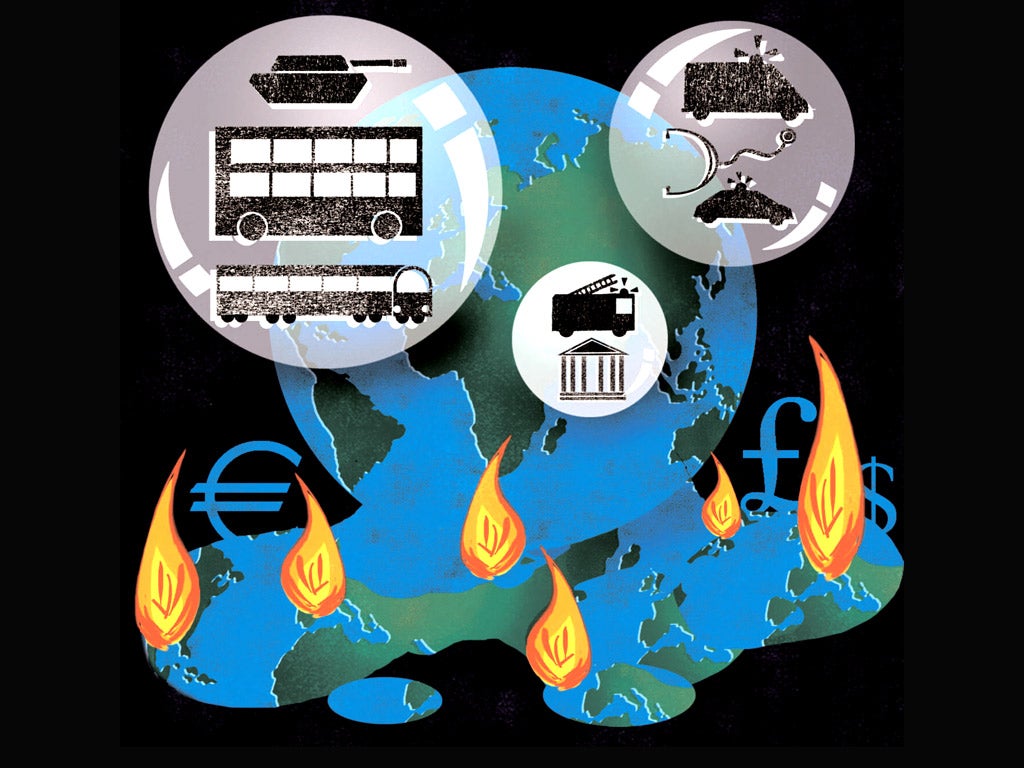
What public-sector workers, in Britain, and Greece, and Italy, say is that they didn't cause the global economic crisis, and so they shouldn't be affected by it in any way. And it's true that they didn't cause the global economic crisis. Greed and debt caused the global economic crisis, and some of that was the greed of bankers, and some of it was the greed of people, and governments, who borrowed more than they could afford to pay back. But the question, unfortunately, isn't who wrecked the economy. The question is what you do when it's wrecked.
It would, in fact, have been quite hard to argue that the terms and conditions that many public-sector workers enjoy could have continued anyway, in a world where people live so much longer and seem very unwilling to pay much tax. But in the light of a global economic collapse, and a massive crisis in the eurozone, and a rise in power in the East that can only signal a decline in power in the West, which means that, unless somebody comes up with a miracle, almost everyone's standard of living is likely to drop, words like "triple time" and "final salary pension" sound almost as crazily optimistic as "no return to boom and bust".
I don't blame anyone for wanting the world to stay the same. None of us wants our pay and conditions to get worse. But it would be nice if some of the people who are fighting to preserve perks that most workers can only dream of, could remember that it's the people who pay their salaries they're planning to punish.
Join our commenting forum
Join thought-provoking conversations, follow other Independent readers and see their replies