Craig Murray: A secret history of the kilt
The fashionistas in New York went wild for men in tartan last week. Our writer extols the garment with magnificent sway
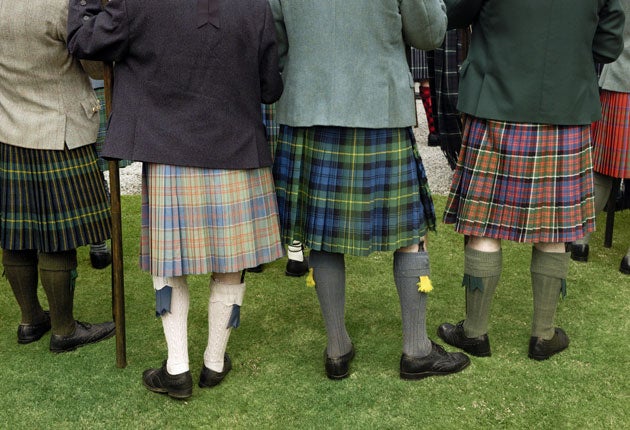
Tartan week has been in full swing in New York. The government-backed effort to make Scots Americans as conscious of their heritage as Irish Americans has made limited headway. But men in kilts remain ever popular, and Kiefer Sutherland, Jason Patric and my successor as Rector of the University of Dundee, Brian Cox, have been making a splash, sporting their sporrans on the catwalk and, according to press reports, baring their arses to delighted audiences including Billy Connolly and Donald Trump.
I have worn my kilt when presenting my diplomatic credentials to President Karimov of Uzbekistan, and in private audience with the Queen. I have also worn it at official functions, and in private parties, bars and nightclubs, on every continent. I would like to tell you that it immediately marks me out as Scottish, and unlocks the floodgates of international affection, but sadly that is not always true. When I entered the Ragu Bar in Tashkent after a reception for Kofi Annan, the barmaids phoned the owner and told him a man had just come in wearing a skirt – should they have him arrested? On a similar note, a kindly police commander took me aside at a wedding in Ghana and told me that homosexuality was illegal in the country, and I really should be more discreet.
But those are exceptions; by and large, the kilt does indeed give you immediate recognition as a Scotsman, and there is undoubtedly a huge well of fondness for Scotland and the Scots. The world has an idea of the Scots as poetic warriors; brave, good humoured, full of life and whisky, romantically doomed and exuding manly virtues. The Braveheart phenomenon amplified this view; but Braveheart was born of it and certainly did not invent it.
A good kilt is not cheap. With the recent resurgence of interest in kilt-wearing, you can buy very cheap versions made of polyester or very light wool, with shallow pleats, using as little as three yards of cloth. But that is not really a kilt. Mine is a standard kilt made of eight full yards of 18oz woollen cloth. It is a heavy item. A proper kilt is fastened higher than trousers, above belly-button level, and reaches down to the knees. When you add jacket, sporran, hose, flashes and brogues, you won't get much change from £600.
That is another reason I wear mine so often. It set me back £300 a couple of decades ago. As a good Scot, if I lay out that much cash, I am going to get full value for it. I am not going to spend that kind of money on something to wear just for weddings.
All that weight of heavy wool, double layered in front and deep pleated at the back, is the prosaic answer to another age-old question. Is anything worn under the kilt? No, it's all in perfectly good working order without. And the reason is that it is very warm and cosy swathed in all that pure wool. If anything, it gets too hot down there. Underpants would just be – well, sticky. I have walked round Ekaterinburg in my kilt in minus 25 degrees, and not found my ardour in the least chilled.
But isn't it all a bit of a joke? Why is a middle-aged man wearing a garment which you see very seldom worn in Edinburgh, Glasgow or even Inverness? When I was a child, the only daytime TV that seemed to exist was The White Heather Club. Andy Stewart sang songs about kilt-wearing, like "I Love Tae Wear the Kilt", "The Wearin' o' the Kilt" and, most famously, "Donald, Where's Yer Troosers". It was knowing kitsch. I have close friends who are leaders of today's Scottish traditional music scene. They, like many of Scotland's key cultural figures, would not be seen dead in a kilt.
They are in danger of throwing the baby out with the bathwater. It was fashionable when I was young to decry the kilt, quite falsely, as a Victorian invention. That is completely untrue. The precise codification of different clan tartans is a Victorian imposition, but even that had a basis in historical fact, and wealthy aristocrats were outfitting their family and followers in recognisably modern uniform tartan livery at least 300 years ago. Tartan has very ancient origins. Woollen material in checked designs was worn by Celts in numerous locations around Europe in Roman times. The more complex patterns of modern tartan design evolved gradually in Scotland. There are early 17th-century portraits showing cloth we would describe immediately as tartan.
The word kilt is not Celtic, but comes from Old Norse and probably has the same origin as quilt. The Gaelic is "feileadh", which means something like "wrap". The kilt seems to have emerged in about 1550 as a means of wearing a large plaid. This was put into heavy pleats on the ground, the wearer then lay on it, wrapped it round his stomach, and secured the pleats in place by pulling tight a heavy leather belt. The remainder of the plaid was then draped over one shoulder and also secured into the belt. This was the basic form of dress in the Scottish Highlands – but not the Lowlands – for over 200 years. It is suggested that aristocrats started to have the pleats sewn in place to make it easier to put on, from an early date. This makes sense, but evidence seems short.
The modern kilt, or small kilt, minus the shoulder plaid, appeared around 1700. There are stories attributing the development of the short kilt to specific individuals, including a blacksmith and a factory owner. Most likely the reduction of the garment happened naturally in different places. A loose flowing cloth that was suitable in agricultural work was simply not practical in the working conditions brought in by the industrial revolution, and a more compact design was needed. The modern, tailored kilt, with the pleats sewn into place, finally appeared in the 1790s. The heavy leather belt, used to secure the folds, thus became redundant, but is still always worn.
The kilt is inevitably associated with the cruel destruction of Highland population and culture in the second half of the 18th century. The Jacobites at Culloden would have worn a mixture of great and small kilts – all of which they would have discarded before they charged wearing only their linen undershirts, contrary to the imagination of every painter of the battle since.
The comfortable unionist myths about Culloden should be challenged. There were actually about three times as many Scots on the Jacobite side as on what should rightly be called the English side. And modern research on the rebellion shows that open and avowed Scottish nationalism was a key part of the motivation of all ranks. So the kilt, small or large, and tartan, and other attributes of Highland culture, were banned by the vicious Acts of Proscription in force from 1746 to 1782, under which the penalty for wearing a kilt or tartan trews was up to seven years transportation. As Highlanders were being at this time widely butchered, hanged and driven out, the prohibition of the kilt was not their biggest problem. But none the less, some were transported for wearing the kilt.
When the proscription was lifted, the proclamation stated "You are no longer bound to the unmanly dress of the lowlander". So, whatever Victorian gentrification and mythmaking may have since accrued, for me the kilt is an expression of desire for personal and national freedom.
It is also, as that old proclamation noted, more "manly". There is undoubtedly a significant section of the opposite sex who are intrigued and attracted by the kilt. My gay Scottish friends tell me it works in their circles too. George Lazenby's Bond only had to don a kilt in order to win over Diana Rigg and the pampered lovelies of the villain's Swiss lair. In Uzbekistan, the dictator's ruthless daughter Gulnara, described by a Wikileaked US diplomatic cable as "The most hated person in Uzbekistan", went all coquettish and postitively hung on my every word when I handed her a drink while wearing my kilt. It was not my speeches on human rights that had that effect.
I remember many years ago, having a late night discussion with a kilt-wearing friend. When out in our kilts in the evening, we both felt we had to work hard, if you catch my drift. At some stage in the evening, at least one woman was going to lift your kilt or stick her hand underneath to check if anything else is worn, and we both felt under pressure not to disappoint. Now you know why men in kilts often sport rather fixed and strange grins.
Craig Murray is Britain's former ambassador to Uzbekistan and author of 'Murder in Samarkand'
Join our commenting forum
Join thought-provoking conversations, follow other Independent readers and see their replies
Comments
Bookmark popover
Removed from bookmarks