DJ Taylor: All woes lead to the hapless Mr Lansley
Whether on binge drinking or cosmetic surgery, the Conservative instinct not to interfere is becoming difficult to defend
It was a notably bad week for the idea of a free society – "free society" being defined as a social organism minimally policed by the legislators whose controlling force is its citizens' sense of personal responsibility. To list only a few impediments to this lofty ideal, the Government discovered that it could not determine the full extent of the breast implant scandal because no one in this "Wild West" industry has kept a record of the ruptures. Simultaneously, its efforts to fling back the oncoming tide of obesity by enlisting the help of celebrity chefs to "educate" the public were ridiculed by health professionals, who insisted that a much better solution would be to limit sales of low-cost, high-calorie junk food.
As if this weren't enough, the first days of 2012 brought the usual stories of how much damage the nation's binge drinkers had done to their livers over the festive period. It is odd – or rather, not so odd – how nearly all these collisions between sweet, glorious liberty on the one side and health-endangering licence on the other seem to involve the perennially embattled figure of the Health Secretary, Andrew Lansley. The difficulties of Mr Lansley's position are, alas, not always appreciated by those disposed to regard him as a spineless exponent of the half-measure. There he sits at the Department of Health, ever more conscious of the nation's descent into crapulous overindulgence and yet uneasily aware of the responsibility enjoined on all Conservative governments to suck up to the brewers and the big food companies.
Whenever I read one of Mr Lansley's homilies about not penalising the responsible consumer, I always think of the family whose members sit 20 yards away from me at Norwich City's home matches. There are four of them: a gigantic dad squeezed uncomfortably into his seat, the slightest movement of whose titanic elbows threatens to dislodge the person sitting next to him, his butterball wife, and two burger-chewing children whose waistlines are rapidly expanding.
In an ideal world, this outsize quartet would be shadowed by their very own health worker, and legally obliged to listen to non-stop dietary advice and to chain up their fridge. To extend the operational focus, one can think of half a dozen areas of our national life, from tanning salons to the scrap metal industry, which are crying out for more regulation, not less. The idea that we should be encouraged to take responsibility for our actions is a wonderful thing. But in the area of health management Mr Lansley, no doubt for good reasons, continues to offer about 30 per cent of the population nothing but the rope with which to hang themselves.
To scan the pictures of the Conservative MP Louise Mensch, and to read extracts from the widely circulated interview with her published in this month's GQ, was to experience a faint tremor of unease. Here, one felt, warily surveying the ruffled Thatcher-sanctioned blouse, the swept-back hair and the air of steely resolve, was another of those scary women who march periodically on to the public stage and whose power rests on their ability to combine a feminine poise with a thoroughly masculine habit of not suffering fools gladly.
On the other hand, comparing Ms Mensch with some of the other scary women one has knocked up against – names that suggest themselves include the Dowager Duchess of Devonshire, Joanna Lumley and Ann Widdecombe – you have an idea that this flower of the Tory back benches might be slightly overplaying her hand. After all, any one with an outré dress sense, the right kind of make-up and a nice line in repartee can come across like Siouxsie Sioux.
The really sharp operator, experience insists, works by the "less is more" principle, achieving her effects by stealth, subtlety and quiet subterfuge. The elderly spinster at Somerville College Oxford who taught me Norman history, had the edge on each of these exemplars by dint of her surface innocuousness. For some reason, when she gravely urged you to "think a bit harder, Mr Taylor", it was as if the floor of her book-lined study had begun to melt beneath your feet. There is a lesson here for Ms Mensch, never mind all the other Thatcher epigoni.
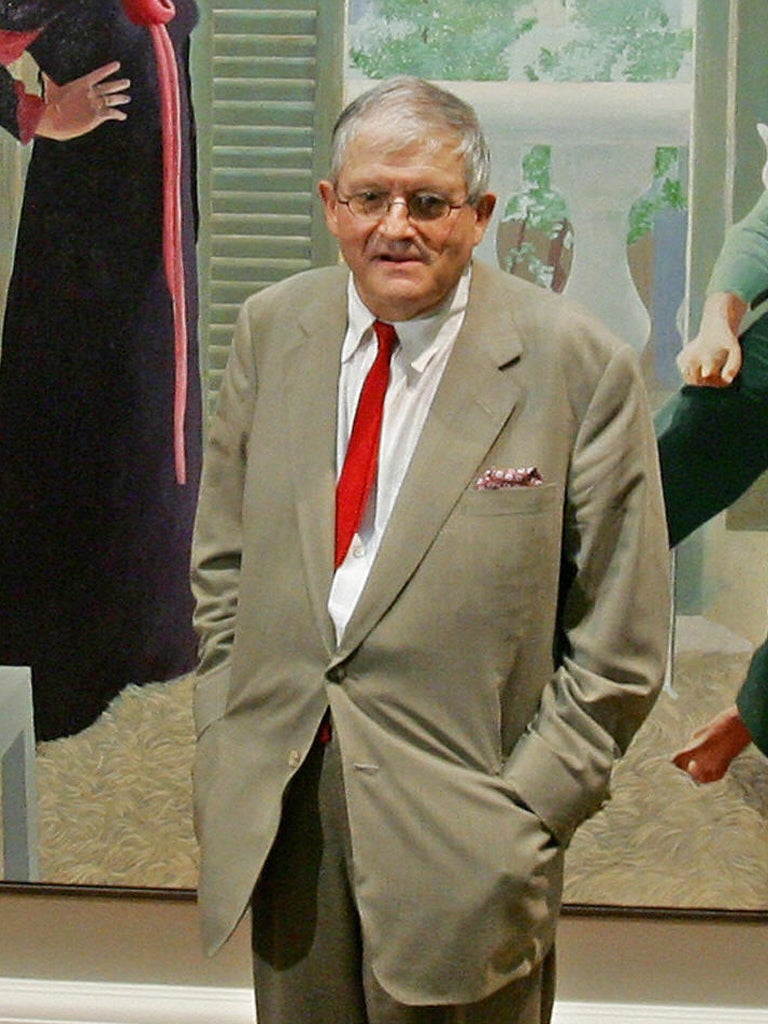
It was disappointing to find that the art-world professionals bidden to comment on the spat between David Hockney and Damien Hirst over the use of "assistants" were so keen to pour oil on troubled waters. Mr Hockney, also in the news for his recent elevation to the Order of Merit, had criticised his fellow practitioner's use of hired help as "a little insulting to craftsmen". This was too much for Michael Petry, author of The Art of Not Making, who remarked: "It is one thing to say, 'That's not the way I work', which is fine, but we don't need to throw stones at each other."
While no one wants creative artists to be permanently at one another's throats, there are times when a little personal animosity has an agreeably bracing effect on the art form involved: not only by reminding us that artists are human beings, but by gesturing at the existence of diametrically opposed theories of art. One of the depressing things about the contemporary novel, for example, is the way in which those writers who have reached the top of the tree all affect to admire each other's work. If Julian Barnes, say, could be persuaded to tell us how much he disliked Ian McEwan's new one, there might be some hope for the form.
"Funny, the Fifties," observes Frederica Potter in A S Byatt's classic account of that epoch, The Virgin in the Garden (1978). "Everybody thinks of it as a kind of no-time... But we were there, it was rather beautiful." The 1950s are so regularly represented as a desert of complacent conservatism, Butler and Gaitskell's "Butskellite" economic consensus, and deep-dyed cultural timidity, that it takes a career like that of Ronald Searle, news of whose death was announced last week, to remind you of the de cade's more anarchic and less conventional side.
In the era of Churchill, Eden and Harold Macmillan, especially in the fields of literary and visual humour, one finds traces of the Searle footprint. Stephen Potter's Gamesmanship books were advocating an approach to life more or less based on cheating. In Lucky Jim (1954), Kingsley Amis created a university lecturer who maintains that "culture" is pretty much a racket. Angus Wilson, in these pre-Wolfenden days, was already writing novels in which homosexuals were presented not as tragic, victimised and overwrought, but as ordinary people who happened to be gay. No doubt about it, Nigel Molesworth, hero of Down with Skool (1953), Searle's first co-production with Geoffrey Willans, is one of the great existential heroes of his age.
Join our commenting forum
Join thought-provoking conversations, follow other Independent readers and see their replies
Comments
Bookmark popover
Removed from bookmarks