Felipe Fernández-Armesto: Never mind the hour, we have lost track of what time really means
There's more to connecting with the seasons than clock-changing

Sign up for the View from Westminster email for expert analysis straight to your inbox
Get our free View from Westminster email
Time is change. No change, no time. Change is observable time. When our ancestors found regular, predictable cycles of change against which to measure the fluctuating rhythms of their bodies – their pulses and periods, their breathing and blinking – they founded the science of timekeeping. Once timekeeping started, life could never be the same again. Humans had a unique way of organising memory and anticipation, prioritising tasks, and coordinating collaborative endeavours.
We can be confident that the standard the first timekeepers adopted was the motion of celestial bodies. The passage of the sun and the rotation of the Earth roughly matched their intervals of sleep and wakefulness. The moon's phases shaped the menstrual cycle. The species that people ate grew or fattened according to the seasons.
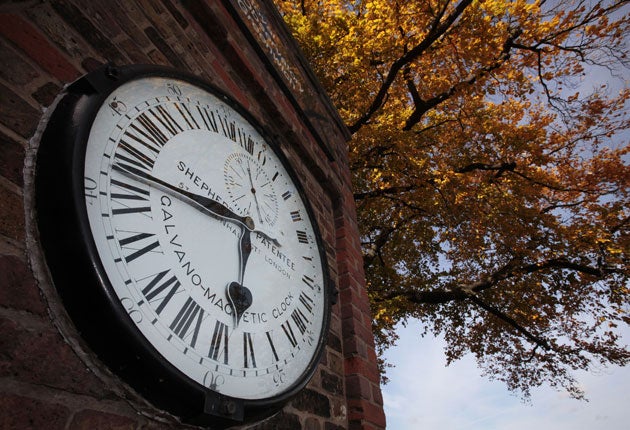
Last night, when we turned back our clocks back, and this week, when Britain debates the merits of daylight saving, we shall abjure the tradition the first timekeepers started. We have turned time into an adjustable convention, unrooted in reality – or, at least, with roots so remote that we have almost forgotten them. By choice, rather than necessity, we stay bound to the Earth and snagged to the Sun for the units we roughly call days and years. But in our detailed timekeeping we have discarded the Sun, Moon and stars, along with almost every other source of enchantment, and now rely on an arbitrary standard for measuring the pace of change: the rate of radiation of an atom of caesium. How did we lose touch with the heavens?
The earliest evidence of celestial timekeeping is a flat bone from the Dordogne, carved about 30,000 years ago with crescents and circles at what look like systematic intervals that correspond with the phases of the moon. A yawning gap in the record follows, until the fifth millennium BC, when horizon-marking megaliths appeared, erected to track or echo the passage of the sun through the sky. Time mattered, because it was literally ethereal, ordered and ordained by gods. Compared with cosmic time, human histories seemed puny.
If you measure time by the motion of celestial bodies, you are likely to think of change as cyclical, like the revolutions of the heavens. What goes round comes round. History and prophecy fuse. But some peoples have always preferred to compare linear sequences of change as means of recording the passage of time. The Nuer of the Sudan, for instance, use the growth rate of cattle or the life stories of members of the community when recalling the time at which an event occurred. They might say a famine, war, flood or pestilence happened "when my calf was so high" or "when such-and-such a generation was initiated into manhood". This sort of thinking evades the notion of cycles and encourages a linear concept of time.
Our own civilisation inherited such a concept from ancient Hebrew sages who imagined a unique act of creation that inaugurated change within changelessness and time within eternity. This did not necessarily mean that time had to be consistently linear: it might have started like a loosed arrow or like released clockwork. Still, Jewish tradition increasingly emphasised the image of the arrow, speeding straight towards an apocalyptic end, and passed it on to the early Christian church. A Christian could not have a cyclical notion of time without lapsing into heresy. Christ's second coming would not be a repeat performance but a final curtain call at the end of time. This helps, perhaps, to explain why, in medieval Christendom, clocks replaced sundials as a means of monitoring the hours of worship. Sundials were stained with paganism.
Christians did not have to submit to the rhythms of the sun, as if that fireball were divine, but could ordain prayer at fixed intervals, like stages on a linear pilgrimage.
In the 19th and 20th centuries, some scientists endorsed this originally religious understanding of time as developing in a single direction from a finite starting-point towards a final end. The theory of evolution encompassed the history of life in a single, progressive story. The second law of thermodynamics suggested that the universe was heading for entropic immolation and that its entire past could be described as a single process of energy loss. The discovery of radioactive emissions, constant and unilinear, in 1896, seemed at once to support the linear conception of time and to provide a means of measuring it independently of sidereal bodies. The discovery in the 1920s of the apparent expansion of the universe impressed most observers as disclosing another unidirectional phenomenon. Meanwhile, evidence accumulated that all the apparently cyclical processes that impressed ancient timekeepers are illusory. The Sun and stars are burning up. The rotation of the Earth is slowing down.
Meanwhile, a third possibility lurked inside critical minds. Maybe time is neither cyclical nor linear. Maybe it has no direction at all. Maybe it is just a mental construct or a convention people devised to help organise experience. Until the early 20th century, few thinkers could get their heads around such a radical notion. But in 1889, the French philosopher Henri Bergson proposed a new way of understanding "duration" as "a state of consciousness" and subverted belief in the objective reality of time.
In partial consequence, the world paid heed in 1905, when Albert Einstein emerged, like a burrower from a mine, to detonate a terrible charge: every observer has his own time, which varies according to his speed and vantage point. Work on time, in Einstein's wake, revealed more possibilities. Time's arrow could turn out to be a boomerang. The universe might contract, for instance, and reverse the flow of time. The order in which we perceive events – and therefore the structure of cause and effect we infer from this order – is negotiable. Time is not given to us by God or the gods. We can unthink it or re-think it as capriciously as we please.
Meanwhile, we have discovered that much of our proverbial wisdom about time is false. It does not "heal". Eventually, it inflicts the terrible oblivion of senility. It does not ripen judgments, but merely multiplies them. It does not necessarily make individuals wise, but, at least as often, solidifies their follies. If we measure its pace by the rate of change in our own lifetimes, it seems to lurch uncontrollably with unsettling effects, in a crazy version of Rip Van Winkle's world, where, every morning we awaken to find our environs disturbingly, sometimes unrecognisably, changed. We can suspend menstruation and impede ageing while modern life quickens our pulses and accelerates our heartbeats towards ever more imminent apoplexy.
Maybe we should readjust our timepieces accordingly. Mechanisation and globalisation have severed us from our ancestors' relationship with celestial time. We can slip out of the noose of the sun and the moon's influence and the spell of the stars. In the Western world, we ceased long ago to observe lunar months, except for the calculation of some rather arcane religious festivals. We can no longer be sure that the sun is at its high point at noon, nor can we still set our watches by the progress of the guard stars around Polaris. We no longer even have to respect the passage of the seasons or the sequence of the days. We can measure time according to whatever convention pleases us or best suits our ways of life and habits of work.
To tinker with daylight saving seems trivial, compared with the re-thinking open to us. Why continue to respect a 24-hour day or a 365-day year? Reasons of convenience may play a part, but I suspect deeper emotions are at work: sentimental attachment to tradition and to the precious comfort of familiar routines.
Join our commenting forum
Join thought-provoking conversations, follow other Independent readers and see their replies