Robert Fisk: A place of refuge from fear and guilt
The final part of our series visits a Jordanian women's group that has opened shelters nationwide to protect victims of marital abuse
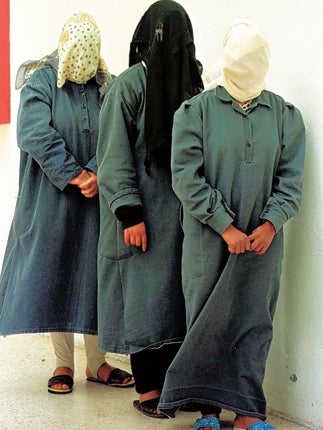
It is a small villa in a shady street, with a sunny courtyard and trees, and a kitchen tucked away at the end of an alleyway, and there are cheerful women in scarves to explain Jordanian laws on marriage and divorce to girls who come to them, frightened, desperate, in fear of their lives.
But within the villa lie the dark secrets of a society, stories which are not supposed to be told, tales of female terror and death which are meant to remain within the family, within the community, within the refugee camps. These stories are not for strangers from the West. Yet Nadia Shamroukh – perhaps the most exuberant, courageous, intelligent woman to emerge in this women's organisation – wants to talk: about the 4,000 women who have passed through her group's shelters; about her staff who work for nothing; about their lawyers who fight for the rights of women in the courts; about their 14 offices in Jordan which try to protect the country's women from violence and death threats. Irbid is the busiest, along with the Palestinian refugee camps.
Just now, she is dealing with one of the curses of marital abuse: Egyptian women who are courted by Jordanian men in Cairo and agree to marry them – Jordanian papers are more valuable than an Egyptian passport – only to find when they reach Amman that their husbands are Jordanian gypsies.
"These men do not want to work and they expect their wives to make money for them by dancing in bars or by prostitution or begging," Shamroukh says with anger. "The women come to us for help and the Egyptian embassy here is very good and we find ways for a divorce and to get them back to Egypt."
One of her organisation's lawyers has been threatened by the family of a Jordanian gypsy who wanted to keep his wife – the woman, a Cairo university student, has just returned to Egypt to study law and to help women's groups there. The police had treated her as guilty for not staying with her husband. There are nine women hiding in Shamroukh's shelter this week, most of them fearful of death after being accused of "honour" crimes. There were 18 last week. Yet Nadia Shamroukh glows as she takes me round the villa – it has been bought by the women's union – where women, separated by divorce and family divisions, bring their children to see their fathers.
Three couples are sitting silently under a tree, talking quietly, a little girl playing on a slide in the garden. There is a humanity about this place. There's an internet cafe on the first floor and a shop sells chocolate and sandwiches. There's a small library for the women up the road. And there's a one-room salon for the women in the shelter to learn hairdressing. A young staff member walks up with a coffee from the sandwich shop and a file of papers; two of the shelter girls smile at her. "We try to give the women training and to help them earn money, to be strong enough to go ahead with their lives," she says. "Maybe we can find a chance of a job for her. When we first wanted to open this shelter, the government and police came to us and wanted to guard it – they wanted to turn it into a jail. We said 'no'. This is not what we want at all."
A Jordanian Palestinian woman, who asks me not to reveal her identity, talks of a happy marriage with her cousin, who opened shops in Amman and became wealthy – "When a man has enough money, he wants more women," she says with sadness – and of how her marriage then failed, her husband taking a second wife and then, after her death in a car accident, a third. It is a story of death threats and family feuds over children and running from home.
She took a taxi south to Aqaba, alone and frightened and with only a little money. The taxi man tried to find her an apartment but another driver arrived. I am waiting for another sordid story of betrayal. I am wrong. "The two men talked about my case, then one of them said: 'We are all Palestinians – we must all help each other.' And so they brought me back to Amman – they didn't let me pay the fare – and found out the address of the shelter and brought me here. I stayed here for 14 days and worked in the kitchen. The women's group tried to fix up a divorce with my husband and they got my kids back. They helped me start a coffee shop and I made clothes and bought a new car. My son is now in sixth grade." Success.
The Jordanian Women's Union, which set up the shelter, began in 1945. It dissolved 12 years later when King Hussain imposed martial law, and restarted in 1974. In 1981, it was dissolved again. It was the same old Arab failure: a police force suspicious of women's groups and a government which wanted to control every aspect of the country's social life. "We went to the supreme court and they gave us the right to work again," Shamroukh says. She is herself a schoolteacher, but trained in law. "We were reinstated in 1990, opened a hotline for women six years later and started our shelter here in 1999 – the first one in the Arab world."
The shelter staff hold elections every three years and have won the admiration of NGOs and European governments. Their money comes from groups in Spain, Italy and Sweden as well as the EU. They took money from Britain – until the Iraq invasion. "Dfid [The Department for International Development] was helping us up to that date, but after the invasion we decided we couldn't take British money any more and informed the government in London of this," Shamroukh explains – not, I thought, without a certain pleasure. "The UK ambassador here telephoned us and we went to see him and he said he was sorry to hear of our decision because many people in Britain were also against the war. He said that he personally was against the war. But we said we couldn't continue the relationship with the UK after what it had done."
Shamroukh organises international seminars for Arab human rights workers. In July, women came to Amman from Bahrain, Lebanon, Egypt and the occupied Palestinian territories to discuss secularism and civil society and women's rights in an Islamic community. She and her colleagues travel around the Arab world, keeping in touch with other women's shelters, trying to teach local police forces that they must protect rather than judge women, that they must treat them as innocent rather than guilty, that they must not arrest them as criminals and return them to violent families.
In Jordan, the government has also opened a shelter, of which Shamroukh approves. "We are dealing with family law in the Arab world: in Lebanon, Palestine, Egypt, Jordan. We approach all this through the civil law. The judges fought back. They said they couldn't interfere with religion. So now we are going to target the Arab League. Here in Jordan, there are Christians as well as Muslims, and per capita the Christians suffer from 'honour' crimes more than the Muslims."
Many of Jordan's Christian community – perhaps most – are Palestinian refugees.
Join our commenting forum
Join thought-provoking conversations, follow other Independent readers and see their replies
Comments