Johann Hari: The management consultancy scam
"We were proud of the way we used to make things up as we went along", he says. "It's like robbing a bank but legal"

Sign up for the View from Westminster email for expert analysis straight to your inbox
Get our free View from Westminster email
In the long fake boom of the Nineties and Noughties, we were sold a thousand scams. End government regulation of the financial system! Turn banks into casinos! Pay CEOs 500 times more than their staff! Bow, bow, bow before our mansion-dwelling overlords and the Total Efficiency they will bring! Yet from under the rubble left by these delusions, one of the greatest scams has skipped out unscathed, and it is now successfully selling itself as a solution to the fading of the boom-light. It is probably in your workplace now, or coming soon. Its name? Management consultancy.
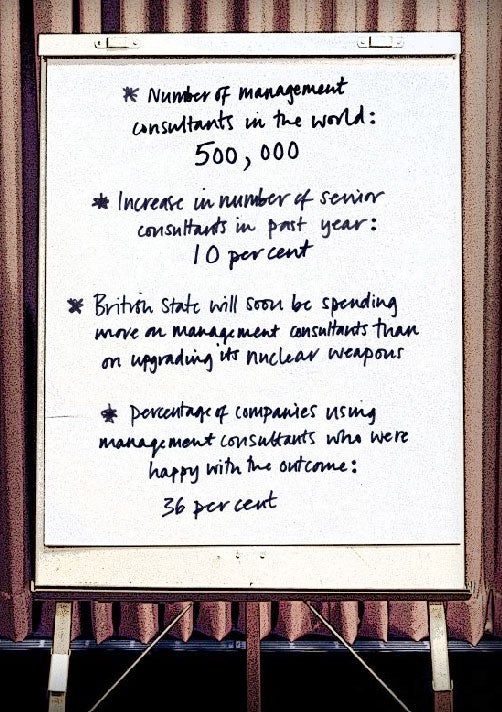
There are now half a million management consultants in the world, and they all grumble that they face one question wherever they go: yes, but what is it that you actually do? They claim to be able to enter any organisation, watch its workers for a short period, and then – using graphs, algorithms, and a jargon that makes quantum physics look like Sesame Street – render it dramatically more efficient, for a fee. They are everywhere: in the US, AT&T (to pluck a random company) spent $500m on them in just five years, while the British state will soon be spending more on management consultants than on upgrading its nuclear weapons.
Yet the process of management consultancy has always been shrouded in priestly secrecy. Over the past few years there has been a string of memoirs by highly successful former management consultants, finally pulling back the flow-charts.
David Craig gives a typical explanation of what the consultants Actually Do. After getting a degree specialising in romantic poetry, he was astonished to be hired by a prestigious management consultancy, given three weeks training, and then dropped into major corporations to tell them how to run their oil rigs, menswear stores, and factories, for tens of thousands of pounds a pop. In his brave memoir Rip Off! he explains: "We were proud of the way we used to make things up as we went along... It's like robbing a bank but legal. We could take somebody straight off the street, teach them a few simple tricks in a couple of hours and easily charge them out to our clients for more than £7,000 per week." It consisted, he says, of "lies, lies and even more lies."
He worked to a simple model, which is common in the industry. He had to watch how a workforce behaved for a week – and then tell the company's bosses, every time, that they had 30 percent too many staff and only his consultancy could figure out who should be culled. If he calculated they actually had the right amount of staff, he was told by his bosses not to be so ridiculous and do his sums again: where was the money for them in a properly-staffed company? The company had to be POPed – People Off Payroll.
Of course, this advice was often disastrous. His company was sent into a chain of 500 menswear shops. They advised them to cut staff by (surprise!) 30 per cent, and to replace most full-time staff with part-timers. The result? The full-time employees had been highly motivated, because they wanted a career in the company; the part-timers only wanted a little extra cash. So motivation levels in the company collapsed, and with it the standard of service. The company was bankrupt within a few years.
Yes, you might say, but surely he was just a bad management consultant. The rest must get results. The evidence suggests not. The Cranfield School of Management studied 170 companies who had used management consultants, and it discovered just 36 per cent of them were happy with the outcome – while two thirds judged them to be useless or harmful. A medicine with that failure-rate would be taken off the shelves.
Matthew Stewart, another former consultant, summarises his high-flying years in the industry by saying: "I felt like a snake oil salesman without snake oil." When he was sent into a company, he was told to use complex formulae to analyse the productivity of its staff, but he soon realised that the results were "nearly random... Similar results could have been achieved by having four monkeys throw darts at a few matrices." Yet, on this basis, he was taking a fortune in payments, and firing thousands of productive people.
The recession has given a fresh burst to this industry, as corporations beg to be told where to apply the leeches. The number of senior consultants has swollen by 10 per cent in the past year, while the number employed by local government has grown by 11 per cent.
But there is a growing body of academic research showing that the strategies pushed by these consultancies are in fact disastrous – and hasten the collapse of a company or service. Professor Wayne Cascio of the University of Colorado has studied the relative costs and benefits of POPing your workforce. Corporations and governments are receptive to the idea that the quickest, easiest way to save money is to fire workers. But Cascio has shown that, most of the time, the costs outweigh the gains. Obviously, you have immediately to find large amounts of redundancy and severance pay. But the costs don't stop there. Your workforce becomes very nervous – and a nervous workforce is dramatically less productive and less innovative. The best people leave. The service to the customer deteriorates – so they abandon you even more.
The facts backing this up are striking. The OECD has studied developed economies over a 20-year period, and it found labour productivity growth was much higher in the countries where it is hardest to fire people. The better you treat a workforce, the better they work. Professor Peter Cappelli studied 122 companies and found that lay-offs most often shrank their future profitability, instead of swelling it.
Yet this is the antithesis of the management consultancy mindset. Stewart says "consultants are the cattle prods of the modern corporation. The chief message to be communicated, in almost all situations, is that you will be expected to work much harder than you ever have before and your chances of losing your job are infinitely greater than you have ever imagined." It's a dark, dehumanised vision of workers as cogs in a machine – and it's been there from the beginning. Frederick Taylor, the founder of management consultancy, compared workers to "an intelligent gorilla" and said "our scheme does not ask for any initiative in a man. We do not care for his initiative."
When challenged, the paltry evidence base of this industry soon becomes clear. Tom Peters, the author of management consultants' bible Excellence, snapped at an interviewer who asked about his way of analysing businesses: "Of course, we all know this is to some extent phoney baloney."
David Craig suggests a simple way to call their bluff. Insist that, from now on, all management consultants are paid by their results. If they promise greater productivity or higher sales, fine: don't pay them until it comes through. Today, almost no management consultancy works on this basis. If they did, they'd all be bankrupt.
And yet, and yet... you almost have to admire the rancid chutzpah of it. As the management consultant Bruce Henderson once sniggered: "Can you think of anything more improbable than taking the world's most successful firms and hiring people just fresh out of school and telling them how to run their businesses – and [getting them] to pay millions of pounds for this advice?" It's tempting to chuckle at the absurdity – until you realise the cack-handed consultants' scythe could come for you.
Follow Johann Hari on Twitter at www.twitter.com/johannhari101
For further reading
'House of Lies: How Management Consultant Steal Your Watch and Then Tell You The Time', by Martin Kihn (Grand Central, 2005); 'The Management Myth: Why the Experts Keep Getting it Wrong', by Matthew Stewart (Norton, 2009)
Join our commenting forum
Join thought-provoking conversations, follow other Independent readers and see their replies