John Kampfner: What the Italians can teach us about tax avoidance
The coastguard has mounted helicopter raids on mega-yachts off the Sardinian coast
Sign up for the View from Westminster email for expert analysis straight to your inbox
Get our free View from Westminster email
I wasn't sure if I was suffering from sunstroke. On Saturday, sitting on the beach in Puglia, in the south east of Italy, I was reading that the Prime Minister, Mario Monti, had declared his country was in a "state of war". It certainly didn't look like that to me as thousands of locals were vying theatrically for spots on the crowded public beach.
The ability of Italians to laugh off their problems has been both their salvation and their curse. It is the pact that made Silvio Berlusconi attractive for so many – you leave me alone to make my money and to shag nightclub dancers, and I'll leave you alone to cheat on your taxes.
Whenever anyone sought to intervene they were given short shrift. Romano Prodi, the centre-left Eurocrat, was punished for having the temerity to try to sort out the state's horrific public-sector deficit. With Berlusconi's eventual demise last year (and one suspects there is political life in him yet) came Monti and his technocratic solutions – put up taxes, clamp down on avoidance, tackle the deficit.
Such are the vested interests that pretty much every Italian has had something to complain about. From taxi drivers to owners of chemists' shops, liberalisation has been resisted. As for his real-estate tax – 0.4 per cent of registered value for primary residencies and double the rate for second homes – that has gone down badly even though the register used hugely undervalues their worth and even though the rate is relatively small. The aim is to claw back €10bn, a tiny fraction of Italy's debt.
Monti, who has vowed not to cling on to public office, is unabashed. He says his war is on two fronts – on domestic evasion and on unnecessarily punitive German-driven austerity terms. He insists that the two are linked; Italy's record on tax evasion has turned much of the international community against it.
Unlike pretty much the rest of Italy, he has not shut down for the month of August. While briefly sojourning in the Swiss Alps, Monti met the Swiss finance minister to try to come to a deal on stashed assets. George Osborne did the same with the Swiss a year ago – a limited arrangement involving a one-off levy while maintaining the (absurd and unethical) attraction of banking confidentiality.
The most ostentatious part of the Monti crackdown brings me back to the beach. On the other side of the country, off the island of Sardinia, the coastguard has been mounting helicopter and boat raids on the super-rich as they lounge on their luxurious mega-yachts offshore. The authorities' double whammy has been to steer ships away from protected environmental zones, and to warn the owners about their obligation to pay taxes.
Not surprisingly, this message has hardly gone down well among the oligarchs, sheikhs and footballers. There have been threats to start the throttle and swoop along the Med to Saint-Tropez. Among ordinary Italians, the reaction has been more favourable. For as long as the wealthy are getting away with it, perhaps it is no wonder the working and middle classes see an injustice when the tax man comes to call.
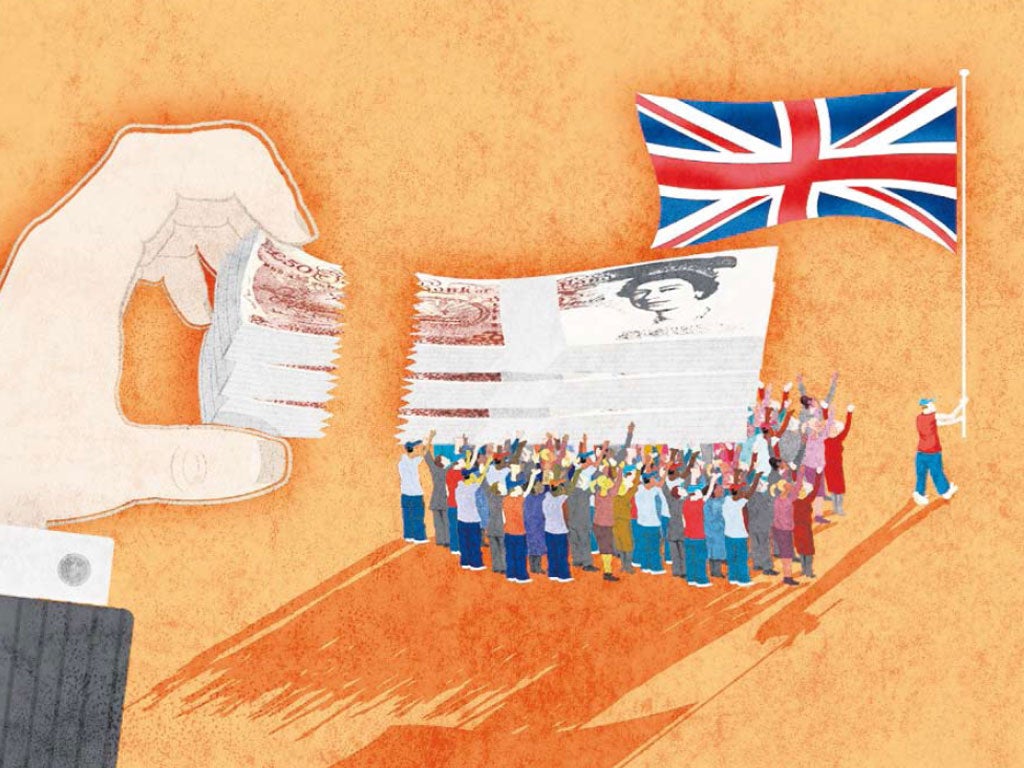
Monti's Costa Smeralda show of strength is unlikely to bring much into state coffers. But the message is what matters. It would be amusing to see that message replicated in a Britain looking almost desperately at how it can consolidate the Olympic mood of solidarity. The Monti recipe could be what's needed to remove the snorts of derision from David Cameron's "we're all in it together" mantra. Given the starring role at the Olympics played by both the volunteers and by the squaddies, why not unleash them on the super-rich?
Imagine the scene: trucks of soldiers descending on the mansions of the plutocracy, a platoon of marines and accountants demanding to see their books. Or imagine the other army of volunteers, in their purple garb, ringing the doorbells of Mayfair hedge-fund offices, with television cameras in tow, politely reminding those assembled of their moral and legal obligations.
Of course, this is the stuff of mid-summer fantasy. But for as long as individual countries descend to the lowest common denominator, then nothing will be done. According to a report last month, more than £14 trillion of untaxed private wealth was invested in global tax havens in 2010. This corresponds to more than a quarter of the world's GDP – or the size of the US and Japanese economies combined.
In 2007, a book took Italy by storm. Called The Caste: How Italian Politicians Have Become Untouchable, it described in acute detail the scams that enabled the politicians, moguls and financiers to fleece the country. This class, the book's co-author Sergio Rizzo told me, is "increasingly indifferent to the common good and the notion of sound administration".
While corruption in Italy has been characteristically flamboyant, its notionally legal twin brother, tax avoidance, has for years run rampant in the UK. I lose track of the number of times I argued with ministers in the Blair and Brown governments about the social dislocation, not to mention the financial damage, caused by there being one rule for the very rich and one for the rest. They would shrug their shoulders, with their "he'll grow up one day" look about them, arguing that any money that was accrued from these borderless global folk was helping to build schools and hospitals and children's clubs.
The mood has shifted. Last week's report by the Treasury Select Committee was pleasingly direct and angry, attacking Bob Diamond, the former CEO of Barclays, and the regulators for the Libor interest-rate stitch-up. But in practical terms, little so far has changed. Her Majesty's Revenue and Customs still does sordid deals with banks and big corporates that try to shy away from their obligations, refusing to divulge their details under the spurious justification of client confidentiality. Instead, they should be naming and shaming, inducing change via public opprobrium.
Monti will not win his "war" through rhetoric alone. In fact, he almost certainly won't win at all. The best that can be hoped is that he makes inroads. And if Italy, for all its history of dodgy dealings, can give it a go, then there is no reason we can't too.
John Kampfner is the author of 'Blair's Wars' and 'Freedom For Sale'. twitter @johnkampfner; jkampfner.net
Join our commenting forum
Join thought-provoking conversations, follow other Independent readers and see their replies