Mary Ann Sieghart: Is 50p a year really too much to end this corruption?
81 per cent of us believe people give money to parties in the hope of favours or special access

Sign up for the View from Westminster email for expert analysis straight to your inbox
Get our free View from Westminster email
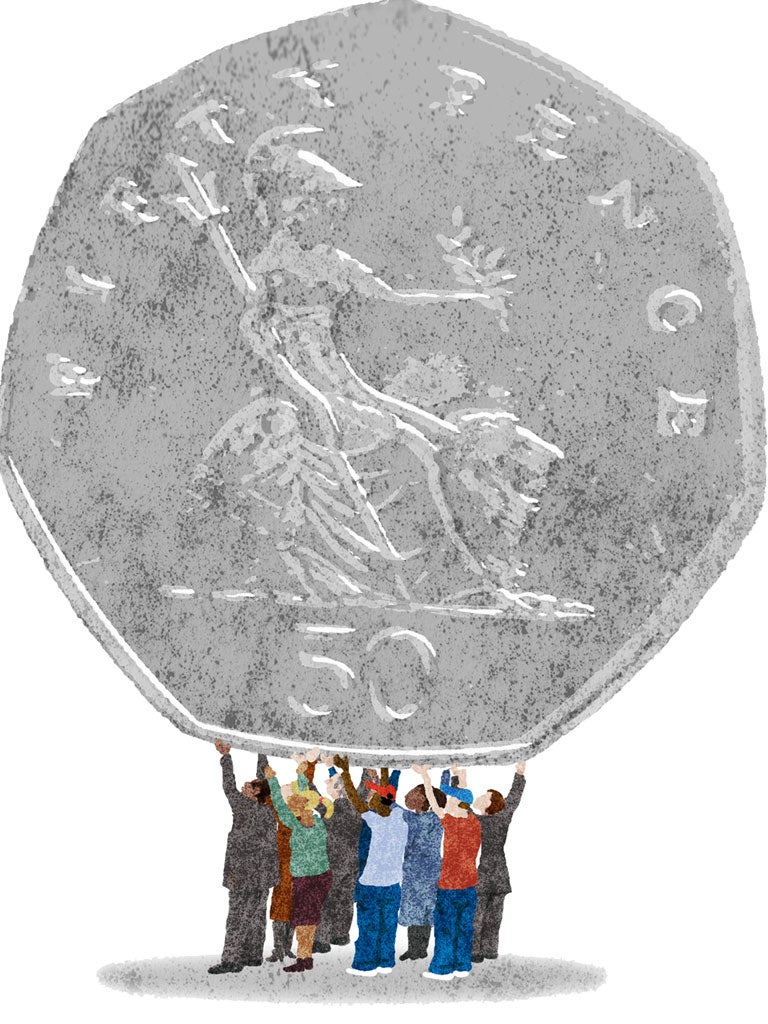
How much do you care if our government was being corrupted by shady donors? What would you be prepared to pay once a year to stop it happening? The cost of half a pint of beer? Too much? How about a pound coin? Still too much? Surely we can settle for 50p then, the price of a first-class stamp?
That is the minuscule charge to us of preventing the disgusting practices that now contaminate our politics: yesterday it was a wide-boy Tory treasurer promising undercover Sunday Times journalists a private word with David Cameron and a submission to the policy unit in return for a big six-figure bung. To win a decent democracy, we're not being asked to lay down our lives, as people have done in the Arab Spring. We're not even being asked to chain ourselves to railings, as the suffragettes did to win the vote. We're being asked to part with just one silver coin a year.
Except that we're not even being asked to do that. The 50p suggestion came from an excellent report on party funding published by the Committee on Standards in Public Life last November, presciently titled Ending the Big Donor Culture. In return for capping individual donations at £10,000, the Committee suggested making up the shortfall with tax relief and public funding to the tune of 50p per-voter, per-year. But all three political parties have fought shy of supporting its suggestions, terrified of asking voters for state funding of political parties at a time of austerity.
The Committee, chaired by Sir Christopher Kelly, had a pretty good idea that its proposals wouldn't be popular with party leaders. Its members have seen enough empty promises of reform wafted away on the political breeze. They knew that both main parties have a vested interest in keeping the current system, however discredited it looks to voters. But they also knew that one day, another big funding scandal would erupt, which would be a good time to brush the dust off this report and try to enact it. None of them guessed the chance would come this quickly.
For yesterday's revelations are as shocking as they come. Peter Cruddas, the Conservative co-treasurer, offered the reporters, who he thought were representatives of a Liechtenstein company backed by Middle Eastern money, the prospects of a private dinner with the Prime Minister and his wife in the No 10 flat, the chance to bend Cameron's ear on "practically any question you want", and the opportunity to have policy ideas fed through to the No 10 Policy Unit (a governmental, not a party body). He even suggested the party could find ways round the law forbidding donations from foreigners. All for "two hundred grand".
No wonder, as the Committee on Standards in Public Life found, that 81 per cent of us believe the most common reason for giving money to a party is the hope of receiving favours or special access in return, and only 16 per cent think it is belief in what a party stands for. We now have filmed evidence appearing to show that special favours and access are offered in return for cash, even when the cash comes from abroad. Voters may be over-cynical about much of what goes on in politics, but here their cynicism is completely justified.
It doesn't have to be like this. We can't expect to return to the 1960s, when the combined membership of the three main parties was seven times higher than it is today. The era of mass membership is over, and parties are never again going to be able to fund themselves through individual subscriptions. But we can reduce the total cap on what the parties are allowed to spend (another Kelly recommendation), introduce a limit on individual donations of £10,000 and ensure that if individual trade unionists want their money to go to the Labour Party, they have to say so explicitly. Then the difference can be made up by a small amount of public funding.
The Kelly report proposes that these rules shouldn't start to be introduced until 2015, by which time the worst of the public spending cuts should be over. That absolves politicians for asking for state funding now, when austerity is still biting. But in the end, if you want to take private money and undue influence out of politics, you have to replace it with modest amounts of public money.
So now the task falls to the three political leaders. Talks between the parties are going to resume over the next few weeks. The Tories will have to accept a lower cap on private donations, which would hit their donors. Labour will have to accept an "opt-in" from individual trade union members to sanction their union giving money to the party. One would be a fair trade-off for the other.
The Liberal Democrats, who have no natural financial backers, would benefit from the Commission proposals. Their only worry is looking out of touch by backing state funding. But if all parties agree to do so together, none can be penalised electorally, particularly if they make clear how tiny are the sums involved.
It's not as if party funding reform is alien to any of them. All three had it in their manifestos. And the Coalition agreement promised to "pursue a detailed agreement on limiting donations and reforming party funding in order to remove big money from politics". But what's odd is that none of the three leaders is leaping to be the first to endorse the Kelly report and challenge the others to join him.
Ed Miliband has a lot to gain. He won the leadership of his party thanks to the unions. They don't shrink from using the threat of withdrawing their money to blackmail him into supporting policies. It would be hugely liberating for him if Labour could receive the money of individual trade unionists rather than their bosses – and it would make the party look more independent and attractive to voters. Sure, he wouldn't raise as much, but nor would the Tories with the £10,000 cap.
After yesterday's embarrassment, though, maybe Cameron needs to be the one to claim political credit for reforming the system. He reacted more quickly than Gordon Brown to the MP' expenses scandal and the public rewarded him for it. Now he has a chance to do the same on party funding. His best hope of putting the Cruddas horrors behind him is to back Kelly in full, and ask us each for a paltry 50p a year to do so. It's cheap at the price.
Join our commenting forum
Join thought-provoking conversations, follow other Independent readers and see their replies