Mary Dejevsky: We're rewriting the nation's future. Here's how it looks...
Big projects, stamped with a Union Jack, were ecstatically embraced by public opinion

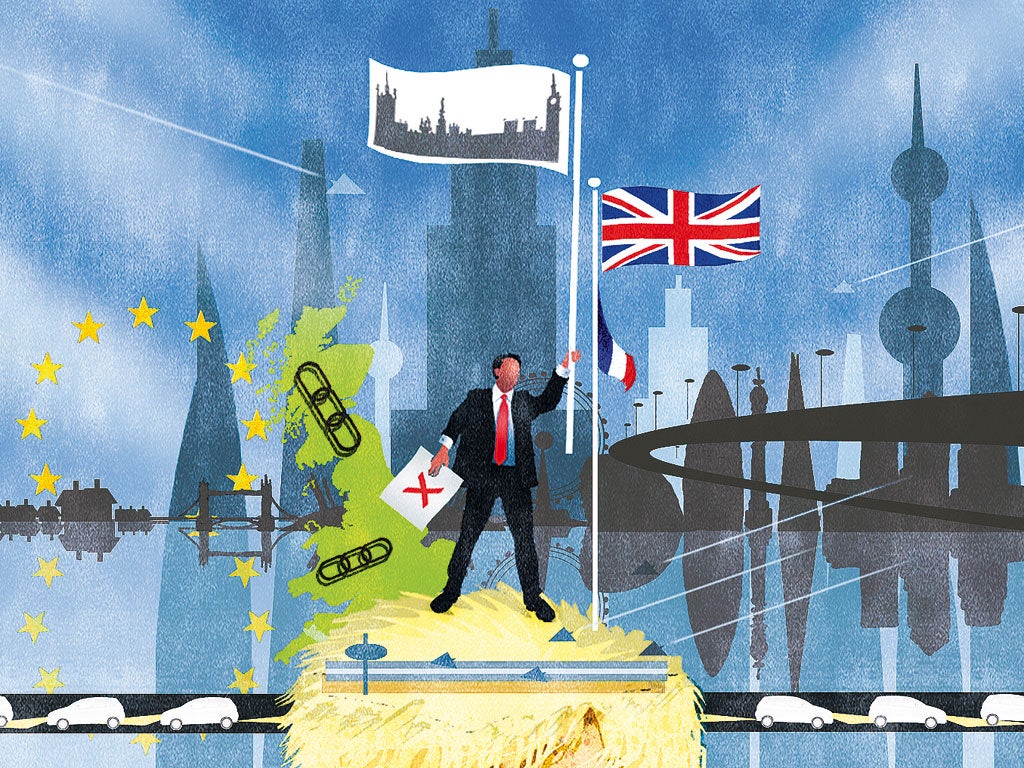
It's the summer of 2037, and the media – yes, they are still on top form – are gearing up for a crop of anniversaries. They are agog for the release of the most secret papers relating to the Abdication; on the horizon is the 50th anniversary of the Great Storm – Michael Fish's infamous forecast is gleefully resurrected – and, of course, it is 25 years since the London Olympics. Several of the medallists are now esteemed Members of Parliament; Lord Coe retired as President of the International Olympic Committee six years ago, and the Prince who cheered on the quaintly named Team GB was recently crowned King William V, the crowds in the Mall reminiscent of those who had toasted his marriage 26 years before.
In many other respects, however, the UK, or rather Great Britain, is a very different country from the apprehensive, self-deprecating one that surprised itself with its sudden blossoming in 2012. For a start, it remains a united kingdom – or almost. Someone did break away, but contrary to expectations, it was not Scotland; it was Northern Ireland which quietly negotiated its entry into the Irish Federation that came into being in 2022, the centenary of the Republic's secession.
Scotland and Wales, while still proudly wrapping themselves in their flags, never actually sought full independence. Scotland did, to be sure, flirt with the idea of restoring its sovereignty, but that turned out, in the end, to be little more than a vanity project of a canny old politician called Alex Salmond (now a hoary patriarch on the back benches at Holyrood). While the failure of the Royal Bank of Scotland had illustrated the dangers of being a small country, the crop of medals for Scottish athletes in 2012 had illustrated the lure of belonging to a big country. Plans for a referendum on independence were shelved when David Cameron fast-tracked a Bill introducing the option absurdly named Devo Max through the UK Parliament in almost his last act as Prime Minister.
In fact, Devo Max had its own repercussions, fuelling pressure for an English Parliament and eventually forcing the creation of something akin to a real federation. Although abolished only 10 years ago, the previous system, under which MPs from all over the UK met at Westminster around the year, now seems impossibly wasteful. The English legislature meets at Warwick Castle, and the Great Britain Parliament now convenes for a week three times a year. The country continues, however, to field united sports teams, and GB actually won the football World Cup in 2030 – without going to penalties.
But it is not only the constitutional shape of Britain that can be traced to the Olympic effect of 2012. One of the most striking, and rapid, results was the rekindling of faith in big national endeavours. Before 2012, the UK had been content to let France lead the way in grands projets. Indeed, successive governments had taken almost a perverse pride in their incompetence at "scale". The Olympics – with the Park coming in "on time and under budget" and Team GB's success – had revealed a can-do spirit few suspected was there.
A startled Coalition Government, treading cautiously at first, decided to build the Severn barrage, creating thousands of jobs and traineeships in an undertaking whose progress was regularly chronicled on TV. In its wake came a new road tunnel across the Channel, parallel with the rail tunnel; a new tunnel and bridge combination linking Wales to Ireland; an east-west high-speed rail line, built partly underground – and, of course, London Thames Airport (known to everyone as Boris Island), which opened, ahead of schedule in 2025, without – let's hear it for old-fashioned British quality – lost bags or transport breakdowns.
The mode for big undertakings stamped with a Union Jack was ecstatically embraced by public opinion. And while by no means all the money came from government, the vast organisation and investment required conveyed the message that the State was back. One consequence of this mood change was that Ed Miliband and Labour, carrying the flag for the return of big(ger) government, won an outright majority when the Coalition completed its term in 2015. Labour's fortunes had been enhanced by the sweep to power of the Left in France shortly before London hosted the Olympics; by Germany's unexpected shift to the left in 2013, and by the way in which investment replaced austerity as the European buzzword. There were those who thought Cameron unlucky not to benefit from the success of London 2012. But while he co-opted the new vocabulary, it somehow lacked credibility from his lips.
Miliband, though, found his room for manoeuvre increasingly constrained. While the political mood had swung left, giving him a second term, it had also been coloured by the new patriotism. The result was not only the successful push towards British federalism, but unstoppable momentum for leaving the European Union. The year 2022 thus saw not only the departure of Northern Ireland, but the end of Britain's always ambivalent EU membership and growing national introversion. The advent of an English Parliament cramped Miliband's style further, not least because Boris Johnson – who was able to capitalise on the Olympics as Mayor of London – won a landslide in direct elections to be England's First Minister.
Almost imperceptibly, the geography of London had also started to change. While the regeneration of Docklands had taken much of the financial centre to the east, the Olympic development and anticipation of the new airport accelerated the trend. With the English Parliament in Warwick, Westminster functioning only part of the year, and Heathrow fading into dilapidated old age, the plusher western parts of town settled into genteel peace, rather as bourgeois west Berlin after the fall of the Wall.
Which brings us to where we are today, in August 2037 – a more compact, more confident, almost Great Britain, boasting Europe's prime aviation hub and trains running on time. In fact, so sure of itself has the country become, that a "Britain into Europe" movement has gained traction, fronted – in a revived double-act – by Lords Cameron and Clegg. As transpires from their published accounts, their patron is a sprightly 84-year-old commoner, Tony Blair, who persists in the belief that he was the real genius behind London 2012.
Join our commenting forum
Join thought-provoking conversations, follow other Independent readers and see their replies
Comments
Bookmark popover
Removed from bookmarks