Matthew Bell: As time goes by, a night in Rick's Café means more than ever before
As 'Casablanca' is re-released this week, 70 years after its premier, Matthew Bell says play it, Sam
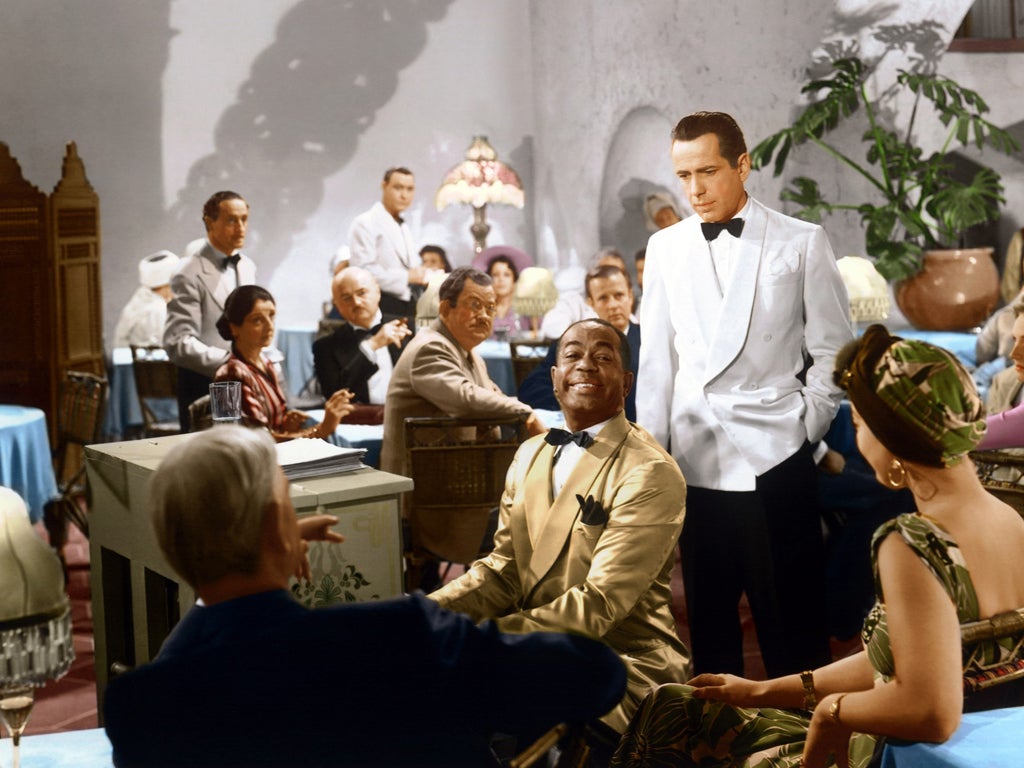
Of all the films in all the world, I had to walk into this one .... Casablanca is 70 this year, and apart from being the most misquoted movie ever made, it's also the most endlessly fascinating. Mention Rick's Café and even those who haven't seen it will suck their teeth and shay, "Play it again, Sam", though, as we all know, Humphrey Bogart never actually says it. This is what happens when a good film becomes a classic: fiction acquires its own fiction. And no film-set has been more mythologised than the louche, jangling, gin joint of Rick's Café.
But how did this happen? How did a standard Hollywood romance, one of hundreds churned out by Warner Brothers in the 1940s, became engrained in Western culture as possibly the best-loved film of all time? It helps that the script is a catalogue of oven-ready quotes: "We'll always have Paris", "Here's looking at you, kid", and "This is the beginning of a beautiful friendship." As with Shakespeare, who gave us so many phrases that we don't even know when we're quoting him, Casablanca has become a giant cliché factory.
It was never meant to be like this. Made in the most uncertain period of the Second World War to boost morale, Casablanca was cobbled together and rushed out in late November 1942, just weeks after the allied invasion of North Africa. Casablanca is often thought of as just a love story – no doubt the reason why it's being re-released this Friday, in time for Valentine's Day – but it's also the finest bit of pro-Semite, anti-Nazi propaganda ever made. It capitalises on the uneasy sense that Europe's traditional liberties were being threatened by a menacing, bullying, murderous regime. Don't forget that, when it was made, there was no happy ending guaranteed for Europe.
Though it was shot on a flimsy set in Hollywood, thousands of miles away, the tension was real: 1942 was the year when the systematic elimination of Jews began in earnest, and many of the extras were in exile from Europe. I can never help blubbing at the "battle of the anthems" scene, when the Nazi soldiers are drowned out in their jingoistic singing by a hotch-potch of pickpockets, refugees and Jews belting out "La Marseillaise". France may have surrendered within weeks of invasion, but this vignette brilliantly captures the spirit of the Resistance.
Of course, this sentimentality is frowned upon by film buffs. In a typically po-faced piece of film theory, Umberto Eco sniffed that Casablanca is, "aesthetically speaking, a very mediocre film". He said there were so many clichés that "we sense dimly that the clichés are talking among themselves, and celebrating a reunion", whatever that means. But he also recognised that Casablanca has maintained its fascination for successive generations, while other war movies have been long forgotten and "technically" better movies have come and gone.
Perhaps the reason is that Casablanca has got it all. It's the most complete and gratifying 102 minutes of cinema, a perfectly balanced combination of romance, comedy and suspense. Not to get too film-studies about it myself, Casablanca explores themes of sacrifice, exile, duty and thwarted love. Not bad for a movie made in such a hurry that they supposedly didn't know how it would end until they filmed it.
The film's inception dates back to the summer of 1938, when an American English teacher called Murray Burnett travelled to Vienna to help his Jewish relatives escape the Nazis. Afterwards, he spent some time on the Cote d'Azure, where he visited a nightclub where a black pianist played to a mixed crowd of Nazis and refugees. When he got home, he wrote a play called Everybody Comes to Rick's. He sold the script in January 1942 to Warner Brothers for $20,000, and they changed the title to Casablanca, apparently in an attempt to replicate the success of the 1938 hit Algiers. Filming began on 25 May, and was wrapped up by 3 August. Unlike most movies today, it was made in sequence because only the first half of the script was ready when shooting began. Hollywood was like that in those days.
Many myths have emerged from the making of Casablanca, among them the rumour that Ronald Reagan was lined up to play Rick. This isn't true, though the future president would have had one advantage over Bogart, who was so short that he had to stand on blocks next to Bergman. But more interesting than the backstory of Casablanca's slapdash production is the film's story itself. At its heart is the idea of personal sacrifice for the greater good. Rick may come across as a hard-bitten cynic, who "sticks his neck out for nobody". In fact (look away now if you haven't seen it) he is an idealist who once ran guns to Ethiopia and fought in the Spanish Civil War. Given the choice between running away with the love of his life, Ilsa, or saving a hero of the Resistance, Victor Laszlo, who will save thousands of Jews, he chooses the latter. Or, as Rick puts it, "the problems of three little people don't amount to a hill of beans".
While Ilsa and Laszlo are the perfect doe-eyed romantic heroes, and Major Strasser is a pantomime baddie, it's the shadier characters in between that elevate Casablanca from a standard schlock-fest to a nuanced observation of human nature. Take the appalling Captain Renault, played by Claude Rains - a spineless stooge of Vichy France, who will appease anyone to make his own life agreeable. Like Rick, he wishes to remain neutral, but unlike Rick has no shame, and forces desperate girls to sleep with him in exchange for an exit visa. As an allegory of wartime France, you couldn't get more damning. His refrain of "Round up the usual suspects" whenever the Germans stamp their feet is the pithiest lesson in how to dissemble that any politician could ask for.
Someone once said that all the best novels revolve around a big house with plenty of people coming and going. This is one of the key plot devices of Casablanca, as Rick's Café provides the opportunity for several sub-plots to be spun around the main story. So tinkling away at the piano there's Sam, Rick's sidekick, who promised never to play "As Time Goes By", as it reminds Rick of Ilsa. Then there's the story of the young Bulgarian couple, desperate to flee . She's prepared to sacrifice her dignity by secretly sleeping with Captain Renault in exchange for an exit visa. But in a neat example of a small act of evil being committed to stop a greater one, Rick rigs the roulette table so that her husband wins enough money to buy their way out, and her dignity is spared. Again, the themes of sacrifice and duty are lightly packed into one little sub-plot.
The twists and turns of the plot are so many that the first-time viewer is kept guessing until the very end. Even on my eleventh viewing, I was shocked, shocked! – at how Captain Renault tips off Major Strasser that the goodies are getting away. But he turns out to be not such a bad cove, saying "round up the usual suspects" after Rick murders Strasser. It's an odd ending to a Hollywood romance, two men walking into the distance embarking on a "beautiful friendship". Most upsetting is the idea that Rick has sold his café to the owner of the Blue Parrot, and that his rackety little world is no more. But then, resolving a film like Casablanca was never going to be easy. Once you start watching, you want it never to end.
Join our commenting forum
Join thought-provoking conversations, follow other Independent readers and see their replies
Comments