Melanie McDonagh: All hail Alice and her 150 years of quiet scepticism
To amuse the Liddell sisters, Lewis Carroll created an enduring host of pompous eccentrics – and one defiant little girl who is not take in
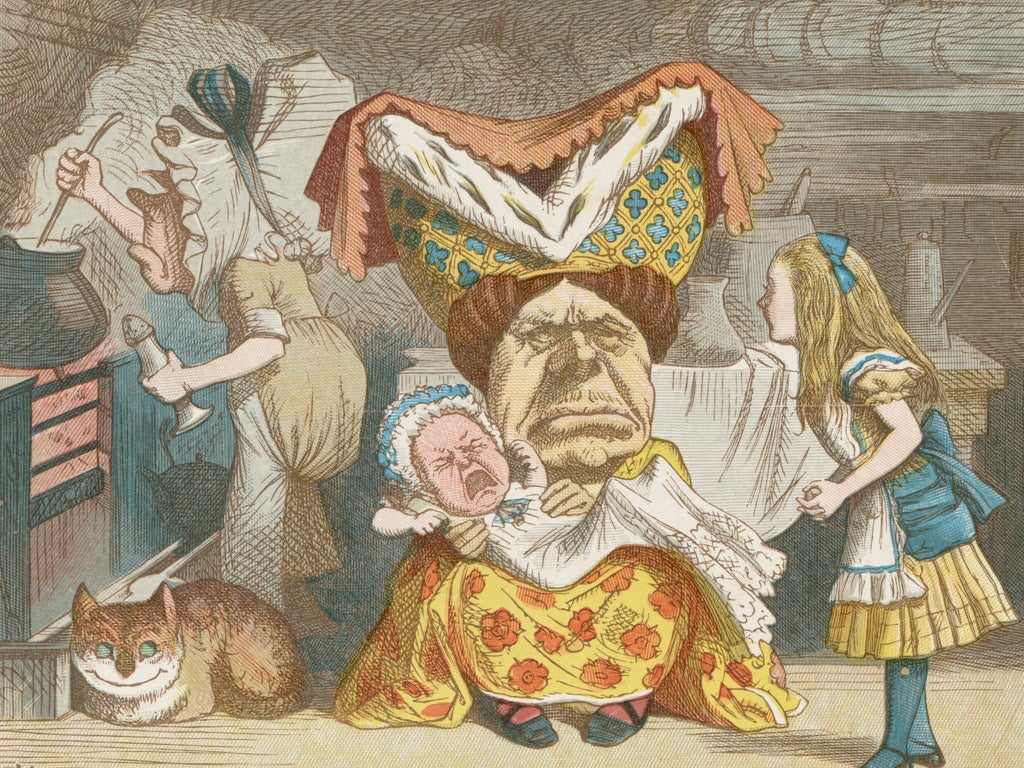
It was Friday the fourth of July, 1852, 150 years ago this week, when Charles Dodgson, a mathematics don at Christ Church, Oxford, and his clergyman friend, Robinson Duckworth, took the three little daughters of the college dean boating on the river from Folly Bridge to Godstow village for a picnic. That fourth of July, observed W H Auden, was "as memorable a day in the history of literature as it is in American history". Roger Lancelyn Green, the children's author, called it "probably the most famous picnic that has ever taken place", though a case could probably be made for the picnic at the start of The Wind in the Willows that cemented the friendship between Ratty and Mole.
"We had tea on the bank," wrote Dodgson, better known as Lewis Carroll, in his diary, "and did not reach Christ Church again till a quarter past eight... on which occasion I told the fairy tale of Alice's Adventures Under Ground, which I undertook to write out for Alice." And with the writing of the story, with the title later amended to Alice's Adventures in Wonderland, the nature of children's literature changed for ever. Indeed, you could say that children's literature itself, in a new form, came into being.
Duckworth, the other man in the party, rowing stroke to Dodgson's bow, later recalled: "The story was actually composed and told over my shoulder. I remember turning round and saying, 'Dodgson, is this an extempore romance of yours?' And he replied, 'Yes, I'm inventing as I go along.' I also remember how, when he conducted the three children back to the Deanery, Alice said, as she bade us goodnight, 'Oh Mr Dodgson, I wish you would write out Alice's adventures for me!'" He promised to do so, and stayed up nearly the whole night writing down his recollections, but he continued to tell parts of the story on another of his boating trips with the daughters of Dean Liddell.
Carroll described the "golden afternoon" of the boat trip in the verses that preface the book. He jokes about the bossy Prima, Secunda and Tertia, otherwise Lorina, 13, Alice, 10, and Edith, eight, who demanded a story. And so the tale of "the dream child moving through the land of wonders wild and new" came into being. He recalled later: "In a desperate attempt to strike out some new line of fairy lore, I sent my heroine straight down a rabbit hole, without the least idea what was to happen afterwards."
And so quite a new literary genre was born, the children's story without a moral. There are other claimants to be the begetters of children's literature as we know it: Dodgson's friends, George MacDonald and Charles Kingsley, of The Water Babies fame, pre-eminent among them, along with the subversive geniuses who wrote the first penny dreadfuls for boys. But Alice was different. As Dodgson wrote to a friend, "I can guarantee the [Alice] books have no religious teaching whatever in them – in fact, they do not teach anything at all."
It is hard to overstate the importance of this joyous liberation. Of course there have always been storytellers who told the story for the story's sake, but in books written specifically for children, didacticism was, one way or another, the norm. (And if you think it's a vanished genre, take a look a the countless dispiriting modern children's books with an environmental message.) As Harvey Darton wrote in 1932: "The directness of such a work was a revolution in its sphere. It was the coming to the surface, powerfully and permanently... of liberty of thought in children's books."
This was not, it should be said, because Dodgson was irreligious, though there have been some bizarre claims to this effect. He was an Anglican deacon of irreproachable orthodoxy – other than an inability to believe in perpetual damnation for the wicked – who took his Christianity seriously. But this story was told to give pleasure and that is how it was written.
And of course, Alice's Adventures in Wonderland, has, as you might expect, umpteen references to the people the girls knew. The Dodo in the race was Dodgson himself; the Duck was Duckworth; the date of the Mad Hatter's tea party was the fourth of the month, the Mad Hatter may have been based on a local furniture dealer called Theophilus Carter, who wore a top hat and invented an "alarm clock bed" that woke the sleeper by tossing him on to the floor. (Honestly.)
All this has been unearthed in the avalanche of adult literary industry that has been unleashed on the playful story and its author. Some, like the explanations of allusions to mathematical concepts in the Alice books, are amusing; others are malign.
Several biographers have suggested a sinister element to Lewis Carroll's interest in children; his photographs of little girls naked or semi-naked, taken in the company of their mothers, goes down badly nowadays.
And he was, without question, infatuated with little girls. He was a paedophile, in the sense of a lover of children. (He was a shy maths don, afflicted with a stammer; in their company, he could be unaffected, playful and at ease.) As he once observed, "I am fond of children (except boys)". And he was especially fond of the Liddell girls, and fonder of Alice than any of them. She does seem to have been a child of unusual charm and determination: she captivated John Ruskin too, who taught the girls drawing. Yet it was another Alice, a Miss Raikes, who gave rise to the sequel to Wonderland, Alice Through the Looking Glass. "I am very fond of Alices," Carroll told her.
One of Carroll's biographers, Morton Cohen, thinks, after reading his diaries, that he may have suggested to Mrs Liddell, Alice's mother, when she was 11 that he and her daughter might, one day, marry when she was grown up. (The ambitious Mrs Liddell would have given the idea short shrift.) It is rather different from suggesting that there was anything untoward in his behaviour towards her or any of the little girls whose friendship he sought. As Martin Gardner wrote in his comprehensive edition The Annotated Alice, "There is no indication that Carroll was conscious of anything but the purest innocence in his relations with little girls, nor is there a hint of impropriety in any of the fond recollections that dozens of them later wrote about them."
Carroll was, in fact, the very opposite of another children's writer, J M Barrie, whose relationship to the Llewellyn boys, which gave rise to Peter Pan, was dark and may have been predatory, at least emotionally. Carroll sought happiness in the company of little girls and they were happy with him.
What no one can deny is that we have all been the beneficiaries of Carroll's boating trip with the Liddell girls and the stream of nonsense that he came up with to please them, as he and Duckworth rowed and rested. He would sometimes stop "until next time", only for the girls to shriek: "It is next time!" Without that imperious command to write down the story, we would never have had that unaccountable dream world which has set free the imagination of Lewis Carroll's successors.
Contemporary children may find the written style of the Alice books difficult or alien – grown-ups can relish it though – but they still get a kick out of the films it generated. We all of us live in a world inhabited by the Mad Hatter, the Cheshire Cat and the Queen of Hearts, and we are richer for it. And it is satisfying to think, as Lewis Carroll observed, that it was written "to please a child I loved". It has pleased so many more.
Join our commenting forum
Join thought-provoking conversations, follow other Independent readers and see their replies
Comments