Owen Jones: This austerity backlash across Europe could transform Britain
The truth is that the real world has paid the high priests of austerity an unwelcome visit
When I first read Naomi Klein's The Shock Doctrine a few years ago, I had no idea how prescient the book was. It was a polemic about "disaster capitalism", arguing that sudden crises are intentionally manipulated to push through extreme free market policies that were otherwise not politically possible. But early 2008 was a completely different era: although Northern Rock had just suffered the first bank run for 150 years, it seemed like a bizarre blip. The US sub-prime crisis was rumbling away, but it was like sheet lightning from a distant storm. "The deficit" was not an everyday term of political debate. It was not at all clear that the world was about to be utterly transformed.
And yet the past four years have proved a total vindication of Klein's argument. A crisis of the market was cleverly transformed by free market ideologues into a crisis of public spending. Across Europe, the biggest slump since the 1930s has been used to push through policies straight out of some right-wing wet dream: the slashing of taxes on the rich and major corporations; the selling off of public services; and a bonfire of workers' rights. It is disaster capitalism on speed.
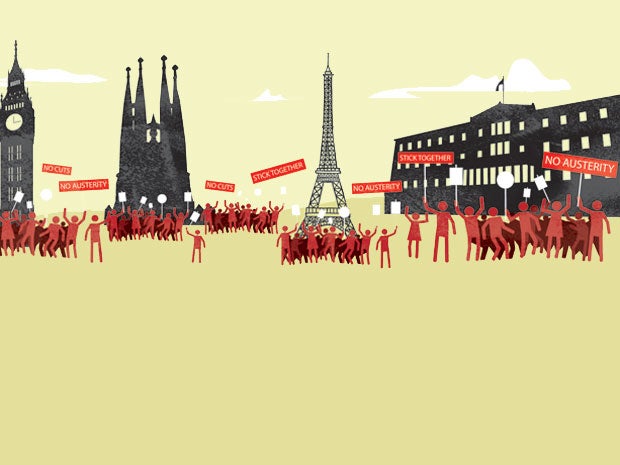
But, this week, the great revolt against the Shock Doctrine began. That is exactly how we must understand the sudden sea change in European politics: not least, the election of Socialist François Hollande in France, and the stunning breakthrough of anti-austerity leftists in the Greek elections.
Before I am accused of a swivel-eyed left-wing conspiracy theory, it is worth pointing out that even some proponents of austerity are candid about their strategy. Last November, I was in Portugal, which – after being bailed out by the EU and IMF – is pushing through a far-reaching free market agenda. The first wave of the most radical privatisation programme in the country's history is under way, including the selling off of energy, water, public transport and the national airline. VAT on electricity and gas has been hiked from 6 per cent to 23 per cent, driving up energy bills; many public sector workers are facing a drop in income of a quarter; and unemployment benefits have been slashed by nearly a fifth. Austerity has plunged the country into a deep recession, and debt-to-GDP ratio is soaring: but that is not the point. Portugal is being remade in the image of neo-liberal dogma.
Free market economists in Portugal had long supported such policies, but knew they could not get away with them in normal circumstances. "The thing with deep reforms is that democracies have a strong bias in favour of the status quo," I was told by Professor Ferreira Machado, the Dean of one of Portugal's leading business schools, who boasted that he was just a phone call away from the country's Prime Minister. When asked if there was a collision course between democracy and the radical reforms he thought necessary, he was candid. "I think there is a difficulty reconciling it," he said, and mentioned an opposition leader who had caused a political storm by suggesting the suspension of democracy for six months. "Of course, she was not advocating that – she was actually expressing that collision course between the two things, and what she was saying was that it would be much easier to do the necessary reforms if we could put democracy in brackets."
Democracy in Europe has not been suspended, and the collision course is more apparent than ever. "Stop the world, we want to get off!" was The Wall Street Journal's verdict on the mounting European anti-austerity backlash. The truth is that the real world has paid the high priests of austerity an unwelcome visit. Their policies have sucked growth out of the economy, failed to tackle debt, dramatically increased unemployment, and devastated living standards. It would be utterly baffling if people did not fight back.
No wonder Greece is at the forefront of the backlash. A modern European society is being dismembered by austerity. The economy has shrunk by nearly a fifth, and the country's debt continues to mount. Over half of young people are without work; the minimum wage has been slashed to desperately low levels; and wages have fallen by a third since 2009. Then there's the ultimate indicator of despair: the number of people taking their own lives. Greece had one of the lowest suicide rates in the world, but experts suggest it may have doubled since the crisis began. Austerity is literally killing people.
But, along with the booting out of France's Nicolas Sarkozy, the Greek elections could mark the beginning of the end for Europe's Shock Doctrine. "This is a message of change, a message to Europe that a peaceful revolution has begun," declared Alexis Tsipras, the leader of radical left coalition Syriza, which trebled its seats in Parliament and came second. Given the failure of any party to form a government, new elections beckon, and Syriza can expect to do even better. But, already, the results have boosted the confidence of all those taking on the austerity offensive across Europe. In the Netherlands, the anti-austerity Socialist Party looks set to stage a breakthrough in the upcoming elections. Those calling for a "No" in the upcoming Irish referendum on the EU Treaty – slammed as an "Austerity Treaty" by opponents – feel momentum is on their side, too. "The people of France, the people of Greece are against the policies of austerity and it is now the moment for Ireland to add our voice to that," declared Mary Lou McDonald, a leading anti-Treaty politician.
For the first time since this crisis began, the momentum is with those taking on the Shock Doctrine. It has the potential to change the whole political climate here in Britain. Polls show two-thirds reject the Government's economic programme. The Tories and their Lib Dem allies got a kicking in the recent elections. Cameron's approval ratings are in freefall.
Until now, Britain's anti-austerity movement has been fragmented and lacking in direction. The new winds blowing from the Continent could change all of that. An attempt to use this crisis to transform society in the interests of the top is floundering here and across the Channel. The prospect of building alliances across Europe is no longer fanciful. It is a moment of transition: what happens next is uncertain. As the Italian Communist Antonio Gramsci put it as he languished in fascist jails in the 1930s: "The crisis consists precisely in the fact that the old is dying and the new cannot be born."
Join our commenting forum
Join thought-provoking conversations, follow other Independent readers and see their replies
Comments