Patrick Cockburn: Galloway won for some very good reasons
World View: Commentators who portray him as a self-serving demagogue are only showing their own biases

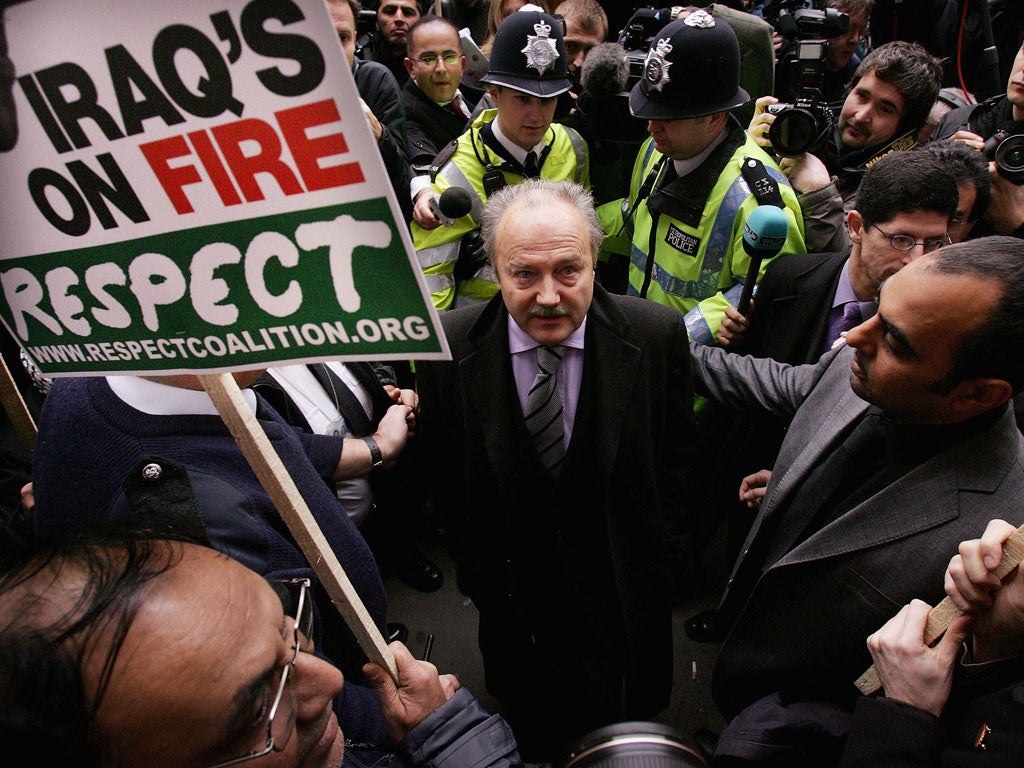
The ferocity of the attacks on George Galloway by the British commentariat is one of the most revealing outcomes of his victory in the Bradford West by-election. News presenters saw no problem in conducting interviews with the newly elected MP that were largely a shower of insulting and unproven accusations. Columnists wrote thousands of shrill words warning readers that he and his victory were atypical and had no broader significance for the country. And, if his success did have any relevance, it was the ominous one of illustrating deepening racial division in Britain, despite the fact that Mr Galloway continually explained that he had won in non-Muslim as well as Muslim majority wards.
There is an amusing half-hour to be spent watching YouTube clips of television interviews with Mr Galloway in the days after he was elected. With a few honourable exceptions – Sky was more even-handed here than the BBC or ITN – most of the interviewers appeared in the role of prosecuting attorneys. They had the air of men and women who knew they were not going to be reprimanded by their employers, however rude they were to the successful candidate. They were convulsed with rage because Mr Galloway said complimentary things to Saddam Hussein and Bashar al-Assad when he met them. Of course he had, as had every other visitor from Donald Rumsfeld to Tony Blair who had been to see these autocrats when they were in power. Other criticism was of astonishing naivety. For instance, had not Mr Galloway played ethnic politics by cultivating Muslim voters? Of course he had since they were numerous in the constituency, but then so had Labour to a far greater extent by selecting a Pakistani Muslim as its candidate.
These interviews, analyses and commentaries told one more about the cast of mind of inner circles of the British political class than it did about Mr Galloway or the people of Bradford. Since few reporters appear to have gone to the city before or after the election, and commentators were quick to say the result did not matter, it was difficult even to establish basic facts about the poll, such as why people voted the way they did. It is an old American journalistic nostrum that "comment is free and facts are expensive", but US op-ed writers and their television counterparts at least make more effort than in Britain to pretend to first-hand knowledge of whatever they are commenting about.
Probably there is a case against Mr Galloway, but if so it was never made. The underlying theme for his critics is that he is a demagogue appealing to irrational passions, but to make this charge stick it is necessary to take a peculiar view of recent world politics as it affects Britain. At the centre of Mr Galloway's campaigns for the past two decades has been opposition to four policies supported by American and British governments: the sanctions against Iraq between 1990 and 2003; the American and British occupation of Iraq; foreign intervention in Afghanistan; and the blockade of Gaza.
All these are important issues, but even raising them invites allegations of demagoguery. For instance, The Economist, after recording that Mr Galloway is "a hate figure for the British establishment", claims he won his seat "mostly by touting his opposition to the war in Afghanistan." (Note the use of the loaded word "touting".) But what should be more relevant to current British politics than the Afghan war where 407 British soldiers have been killed and a small British army of 9,500 is still fighting? It is a conflict in which men and women have died and are dying in vain: their intervention has achieved nothing; the Taliban are not being defeated and this should long have been self-evident.
Sir Sherard Cowper-Coles, the former British ambassador in Kabul and the Foreign Secretary's special representative for Afghanistan and Pakistan, says in his excellent memoir Cables from Kabul that failure is not more openly admitted by journalists because of "the media's need for copy, both visual and written, which can be obtained only by embedding with a military machine". As for the average British politician, worried about "leaks to the press suggesting he was not backing our boys", he ends up taking the advice of the generals, however self-serving and disastrous this has proved in the past. On a small scale the atmosphere is closer to the First World War than the Second World War, with critics of official policy being caricatured as unpatriotic. As a result, politicians and generals responsible for failures hold their jobs, ready to fail again.
Already British commentators often treat the Iraq War as if it were as distant as the Boer War. When Mr Galloway so much as mentions it he is treated either as an eccentric, raising dead issues, or as a rogue, exploiting ancient feuds. His focus on 13 years of UN sanctions against Iraq is portrayed as even more outré, but I was often in Iraq for many of those years and I watched the collapse of a whole society into poverty. I remember stopping in Diyala province and being mobbed by farmers holding X-rays of their sick children, hoping against hope that I might be a doctor. Hundreds of thousands died unnecessarily. Mr Galloway was one of the few politicians who tried to make an issue of this man-made catastrophe which did nothing to bring down Saddam Hussein and inflicted terrible injuries on the Iraqi people, but unfortunately he failed.
The invasion of Iraq turned into an even greater disaster. Many Iraqis wanted to get rid of Saddam, but very few wanted their country to be occupied by foreign powers. Given the tens of thousands of Iraqi dead, and Iraq torn apart by one of the most savage sectarian conflicts in history, was it really so wrong for Mr Galloway to oppose this war?
Few statements by the new member for Bradford West seem to have enraged pundits so much as his comparison between his own electoral victory and the Arab Spring. One interviewer, her voice rippling with distaste, asked how he could compare his success with a movement in which thousands had died. But Britain does sometimes feel like Egypt, a country in which disasters occur but somehow nobody running the country is ever held responsible and where power circulates within a narrow clique. Decisions on war and peace have been delegated to the US. Wars are fought supposedly to defend Britain against terrorism, when all the evidence is that they provoke it. It says something about the comatose nature of British politics that an effective critic of these failed wars like Mr Galloway, who beats an established party, should be instantly savaged as a self-serving demagogue.
Join our commenting forum
Join thought-provoking conversations, follow other Independent readers and see their replies
Comments