Paul Vallely: A welcome move, but thousands remain political prisoners
Sign up for the View from Westminster email for expert analysis straight to your inbox
Get our free View from Westminster email
One man has been freed. Ai Weiwei, China's most famous living artist, has been released from jail. His offence, according to the Beijing police department, was tax evasion. But the whole world knew the prominent dissident had really been arrested for having the temerity to make public criticisms of China's oppressive record on human rights – and urging the regime in Beijing to reform its political system.
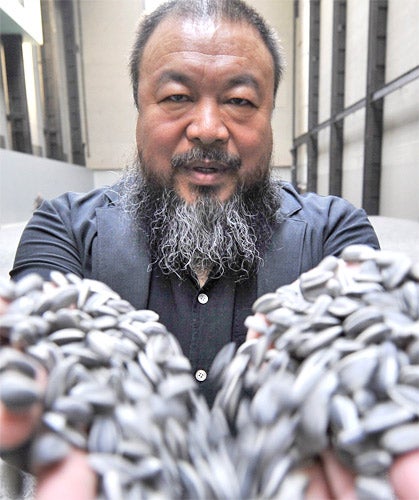
Ai Weiwei is a brave man. But he is one of the lucky ones. He is an artist of international renown and his detention prompted a worldwide campaign for his release. Protest exhibitions, winning wide-scale media coverage, have been held in top art galleries across the globe, such as the one in London's Tate Modern where last October the artist unveiled a carpet of 100 million porcelain sunflower seeds which he said questioned the role of an individual in society. But what of the others?
China is thought to have the highest number of political prisoners of any country in the world. Human rights activists counted 742 arrests in 2007 alone. More recent estimates have put the number between 2,000 and 3,000. There is no way of knowing the total behind bars for "endangering state security" – the charge which in 1997 replaced "counter-revolution" in the Communist criminal code.
The world knows the names of only two or three per cent of those the repressive state has arrested, according to the Dui Hua Foundation, a body based in the United States, which is dedicated to well-informed dialogue between the democratic world and China, and is not known for producing sensationalist figures.
In China, serious human rights violations are commonplace. At their most extreme they include torture and execution, with China still holding the dubious honour, just ahead of the United States, for the highest number of people subjected to capital punishment. But there is much more at a lower level, with a steady flow of arrests and excessive use of force in public order policing as part of the repression of dissent.
Ai, 54, was released, the police department said, because he had "agreed to repay the taxes" and because of "his good attitude in confessing his crimes". If a globally-prominent figure can be cowed into that – supposing it is true – it chills the blood to wonder at the fate of the thousands of others.
His arrest came amid one of China's biggest clampdowns on activists in years. It was condemned by Western governments on the grounds that China was breaking its own laws by holding the artist in secret and without access to a lawyer. The whereabouts of his relatives, accountant and driver, who were detained at the same time as the artist, remain unknown.
So it is with thousands of others. As China's economy has burgeoned the Beijing government has grown more confident in cracking down on dissent. Political freedoms have been matched by some loosening of social constraints but by little in the way of lifting the regime's tight political restrictions. Anyone advocating democratic reform, defending human rights, speaking up for suppressed ethnic minorities, holding religious beliefs not sanctioned by the state or even peacefully expressing their views has been the subject of a more confident and more aggressive repression.
Six years ago, in an interview with the BBC, Ai Weiwei said that China was opening up and giving its citizens more freedoms. "Certain areas, certain taboos can't be touched. There's still censorship there. You really have to be very alert about where is the fine line, the border," he said. "You don't know exactly where it is, you have to be intelligent." Either Ai Weiwei's judgement proved faulty or that line has shifted in the six years since he said that.
The 2011 Amnesty International report on the country put it this way: "It faced intensifying domestic discontent and protests stemming from growing economic and social inequalities, pervasive corruption within the judicial system, police abuses, suppression of religious freedoms and other human rights, and continuing unrest and repression in the Tibetan and Uighur regions of the country."
In the face of this Beijing has clamped down on most kinds of dissent. But the rule of law is highly partial.
The growing intransigence of the Chinese political class has been noticeable abroad too. That was clear from the way Beijing threatened economic and political retaliation against countries that criticised its human rights record. The regime reacted angrily to the news that the 2010 Nobel Peace Prize had been awarded to long-time Chinese political activist Liu Xiaobo. It pressured foreign diplomats to boycott the ceremony in Oslo in December and indefinitely postponed bilateral trade talks with Norway.
As a result, says the 2011 Amnesty report, "many countries appeared reluctant to publicly challenge China on its lack of progress on human rights, and bilateral channels, such as human rights dialogues, proved largely ineffective."
Leaders like Barack Obama and David Cameron have paid lip-service to the issue, raising human rights in private talks with the Chinese leadership. But few think they have had much impact. Indeed Beijing politicians riposted by raising the UK's prison over-crowding, Britain's age of criminal responsibility, and its handling of "ethnic tensions" in the North of England.
Ai Weiwei's international high profile may have made him just too hot to handle for China's jails. But that did not save the Nobel Peace Prize winner Liu Xiaobo from persecution. For the thousands of others languishing in China's prisons hope must be even more slight.
Join our commenting forum
Join thought-provoking conversations, follow other Independent readers and see their replies