Rupert Cornwell: Obamacare is in the hands of the unelected
Out of America: The Supreme Court has the power to trump Congress and consign to history the US's boldest attempt at universal healthcare

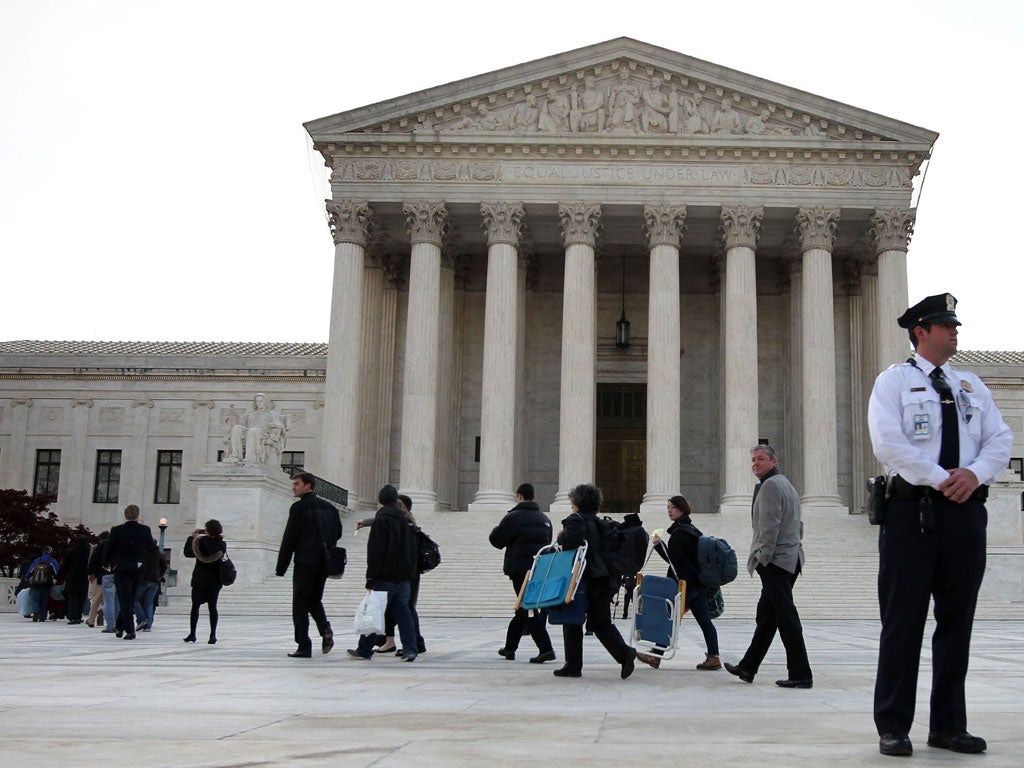
When an American president nominates a new member of the Supreme Court, I sometimes used to wonder, why all the fuss? Is this appointment of a single judge – just one justice among nine – really important enough to throw Congress into a spin, dominate the blogosphere and mobilise every lobbying group in the land? Yes, the US is a litigious, law-obsessed place. But isn't such extreme agitation a bit excessive? The events of last week, however, have banished every doubt.
It's a dangerous game predicting how the court will rule on the challenge to Barack Obama's healthcare reform, the signature domestic achievement of his first term. Even so, it is clear that the measure is in serious jeopardy. Indeed, it may, for all intents and purposes, already be dead, if a majority of the justices voted to strike it down at their crucial conference on Friday. Such decisions, however, are among the few in Washington that do not leak. We shall find out three months from now, when the majority opinion and various dissents are written, and the court makes its ruling public.
But at the very least, expectations have been turned on their head. Last Sunday, the smart bet was that the Affordable Care Act would survive – that one or more of the five conservative justices would join with the court's four liberals to let the law stand. Not out of any great affection for it, to be sure, but from modesty, and a belief that law-making should be left to Congress, which approved the measure two years before.
Yet that was before the conservatives subjected the hapless Donald Verrilli, Obama's Solicitor-General, to two days of battering during oral arguments last week. The nub of their objections was that by forcing people who did not have health insurance to buy it, Congress had overstepped the powers laid down in the constitution. If that provision – the so-called "individual mandate" – is rejected, then the whole financial edifice of Obamacare comes crashing down.
With the stroke of a judicial pen, unelected judges would have voided the most important piece of health legislation since the Medicare and Medicaid Acts in 1965, and destroyed the boldest effort yet to give America what is taken for granted in every other industrial country: universal health coverage. In the process, they would be setting new limits to the reach of Congress. What was I saying about a Supreme Court nomination being no big deal?
Whatever happens, the immediate political consequences will also be huge – most obviously for November's presidential vote. By galvanising public opposition to Obamacare, Republicans swept to their historic victory in the 2010 mid-term elections. Some say that its overthrow by the Supreme Court now would be a giant "I told you so" moment that this time could hand the party the White House.
Other political seers disagree, arguing that the Democrats would be the ones galvanised. President Obama could mount a populist campaign, depicting the court as a callous stooge of the Republican party, which had ensured that America remained the only advanced economy where illness could mean bankruptcy and financial ruin.
If it is rejected, Obamacare may go down in history as the last chance to build universal healthcare under the traditional American framework of employer-based coverage schemes and for-profit insurance companies, leaving no alternative to some form of single-payer system.
Key to the reform is the mandate that obliges healthy individuals to buy insurance, thus widening the risk pool so that everyone can be covered. This is, of course, the basic principle of insurance. The mandate, moreover, was a Republican idea (and, lest we forget, implemented in Massachusetts by Mitt Romney when he was governor of that state). For having embraced this Republican idea, Obama is now labelled a "socialist".
The biggest casualty of all, however, could be the reputation of the Supreme Court itself. Only the most naive would contend that the court is completely above politics, an impartial arbiter operating in a realm of absolute truth. Judges are human, and so are the presidents who pick them, naturally gravitating towards candidates who share their philosophy. Thus Republican presidents choose more conservative jurists, Democrats more liberal ones.
Indeed, Supreme Court appointments, which last for life, are any president's most enduring legacy. In the persons of justices Antonin Scalia and Anthony Kennedy, Ronald Reagan is still with us, though he left office a quarter of a century ago. George W Bush, too, appointed a couple of conservatives, while Democrats Bill Clinton and Obama each named two liberals to the court.
In retrospect, however, the crucial step was taken by Bush the elder. He served but one term in the White House and named just one justice, a black to replace another black. What could be more reasonable than that? In fact, by giving the seat of Thurgood Marshall to Clarence Thomas in 1991, Bush Snr created today's conservative-majority court. And everyone knew it at the time. Not by accident were Thomas's confirmation hearings the nastiest of the modern era.
In the years since, the court's centre of gravity – the swing 5-4 vote – has edged ever more to the right. And Republicans have benefited mightily, with the Bush vs Gore ruling which handed them the White House in 2000, and the 2010 Citizens United judgment that opened the floodgates to unlimited corporate campaign contributions, and the infamous Super PACs that now bankroll their presidential candidates. And now, maybe, a third goodie, if Republican appointees to the Supreme Court do what Republicans in Congress could not do, and throw out Obamacare.
But what, then, of the court as neutral umpire? Instead, it would be shown once and for all as just another player, albeit a mightily powerful one, in the partisan warfare that has brought the American political system almost to the point of dysfunction. Maybe, that will induce one conservative justice at least to step back from the brink on Obamacare. But don't bet on it.
Join our commenting forum
Join thought-provoking conversations, follow other Independent readers and see their replies
Comments
Bookmark popover
Removed from bookmarks