Steve Richards: The stakes are unbearably high for Salmond and Cameron
Were Scotland's First Minister to win the referendum on independence, it would be a devastating blow to the PM's authority

Sign up for the View from Westminster email for expert analysis straight to your inbox
Get our free View from Westminster email
David Cameron faces a deeply dangerous sleeping issue, one that will awake and spring into wildly unpredictable life shortly before the next general election. It is already wide awake in Scotland. I have been up there for most of this month performing a one-man show at the Edinburgh Festival. Even during this politically tranquil holiday period, the looming referendum on independence was an urgent talking point, the subject of virtually every political column in the Scottish newspapers.
In Scotland, the issue overwhelms all others. At the Edinburgh Book Festival, Gordon Brown's appearance was a sell-out in the cavernous main hall. I asked some in the long, seemingly never-ending queue whether Brown had acquired a new charisma in Scotland. No, they told me. It was the topic that explained the frenzied interest. He was speaking about the forthcoming referendum. The issue guaranteed that all tickets were sold within seconds of becoming available.
During my one-man show, there was a chance for questions at the end. Most of the audience was from England and their questions related to the Coalition or the Labour leadership. From those from Scotland, the topic was nearly always the plebiscite scheduled for autumn 2014. The same applied at other packed gatherings.
It is easy to understand the level of interest as a historic decision moves closer. The mystery is the relative indifference in the rest of the country, where passions burn with much greater intensity, at least in parts of the Conservative party, over a fantasy referendum about Europe that will not be held before the next election.
For Scotland's First Minister, Alex Salmond, the stakes could not be higher. The vote will be the climax of his astonishing career. But what if he loses it? So far, no poll suggests he will win. Before arriving in Scotland, I had assumed that if it looked as if Salmond would lose then he would find a way of not holding it. That is what leaders tend to do with referendums. A senior figure in the "no-to-independence" camp told me he thought that was still likely. The great conjuror would wave his wand and announce that because of the legal ambiguities – or any other excuse – the referendum would be delayed. But SNP activists I spoke to were adamant that his party would never forgive Salmond if he found a way of avoiding the poll. They have been waiting for this. They will not give him any space to contrive a postponement.
One senior SNP figure also suggested it would not damage Salmond greatly if he lost. He would hold another referendum in a few years' time. I do not believe this interpretation is correct. It is possible that a referendum might be held again. One of the many problems with referendums is that if leaders do not like the outcome, they hold another. But, for Salmond, defeat would be a devastating blow, a fatal undermining of his authority at a time when his leadership seems already more fragile than it did a short time ago.
But what if Salmond were to win? Think about the devastating blow to David Cameron's authority. Such an outcome is by no means impossible. If the referendum is held in the autumn of 2014, and it looks as if there is a chance that the Conservatives could win the UK general election the following year, the temptation for a majority in Scotland to opt for independence might prove irresistible.
In the many events I attended in Edinburgh, there was a more astutely developed sense that Westminster is ruled by a Government of the radical right, accompanied by huge relief that they are protected from some of the wilder reforms being inflicted on England's public services. There is also a fear that they are not protected enough from the anti-state, right-wing ideology still prevalent in the Conservative party. Independence is the ultimate protection. I was struck by the number of people I spoke to who are opposed to independence and yet worried that they could lose the referendum because of the fear that a Westminster-based Conservative government could still wreak considerable havoc on Scotland.
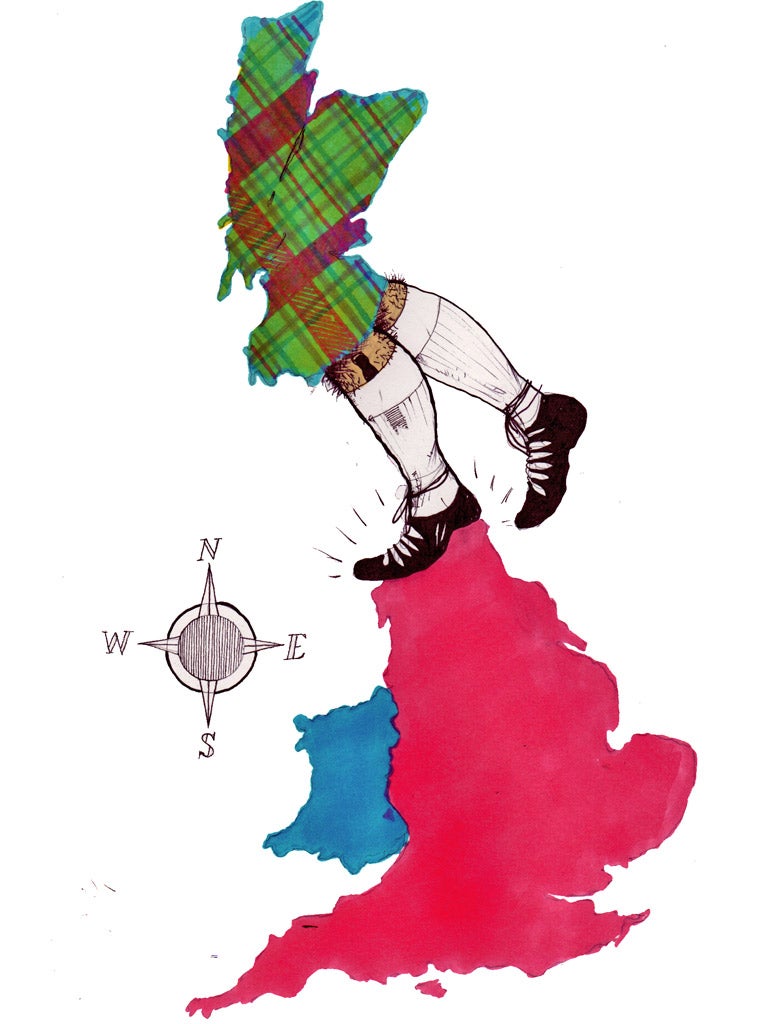
If Scotland voted for separation a few months before a general election, Cameron would face a full-scale constitutional crisis, as well as the economic one that will still be raging, and the awkward management of the ending of the Coalition. When Jim Callaghan failed to secure the required majority in the referendum on devolution in 1979, the defeat led directly to the collapse of his government in similar circumstances, a hung parliament and economic gloom. But a vote for independence in 2014 would be a thousand times more convulsive compared with that relatively timid reaffirmation of the status quo, the outcome in 1979. As well as being the Prime Minister who presided over the break up of the United Kingdom, Cameron would face immediate nightmarish questions. Which UK parliament should ratify the new constitutional settlement, the one that was about to end with an imminent general election or the next one? What would happen to Scottish MPs elected in the next parliament if Scotland has voted for independence? These are two of the more straightforward dilemmas.
One of the themes of my Rock'n'Roll Politics show at the Edinburgh Festival was that most of the time our leaders are trapped on a crammed political stage with virtually no room to move. We assume they are mighty and arrogant, when most of the time they are fragile and insecure. The referendum will leave either Cameron or Salmond with no room to move at all.
No wonder Salmond is pressing for some form of "devo max" as an option on the ballot paper, offering more powers for the Scottish parliament without formal separation. Such an option provides him with a protective shield in the event of a "No". Some senior figures in the pro-union campaign tell me they believe the likelier compromise is that Cameron will agree to reduce the voting age to 16 and that Salmond will accept a straight Yes/No question on the ballot paper. Such an agreement would mean that the stakes remain unbearably high for both of them.
If I were Cameron, I would allow the devo max option on the ballot paper in some form or other. Otherwise, an already tense and complex build-up to the next general election risks becoming, for him, the most hellish in modern times.
Join our commenting forum
Join thought-provoking conversations, follow other Independent readers and see their replies