Tom Chatfield: Smartphones lock us in to our own lives – art can release us again
Look around next time you’re on a train. How many people are stroking their devices’ screens?
If the 21st century is supposed to be turning us all into remote agents – plugged into the net at all times, unplugged from each other and public space – someone has obviously forgotten to tell public transport. Picture the rush hour scene on any given weekday in the London Tube: crushed bodies, flickering gazes, the ceaseless politics of permission, politeness and assertion. To wait for a train with blood banging in your ears at 6pm – poised in the precise spot a door is due to open, rehearsing in your mind's eye the squeeze-and-slide ballet of entry – is to be in no doubt of the intractably embodied nature of the human condition.
For five years of my life, I walked into and out of one station on the Central Line – Tottenham Court Road – at least twice a day, five days a week, 46 weeks a year. Well over 2,000 visits. Except, of course, the one place you never actually visit is a Tube station itself. Tube time, as the masses who will use this transit system for the first time during the Olympics will find, is dead time, liminal time – a threshold between worlds.
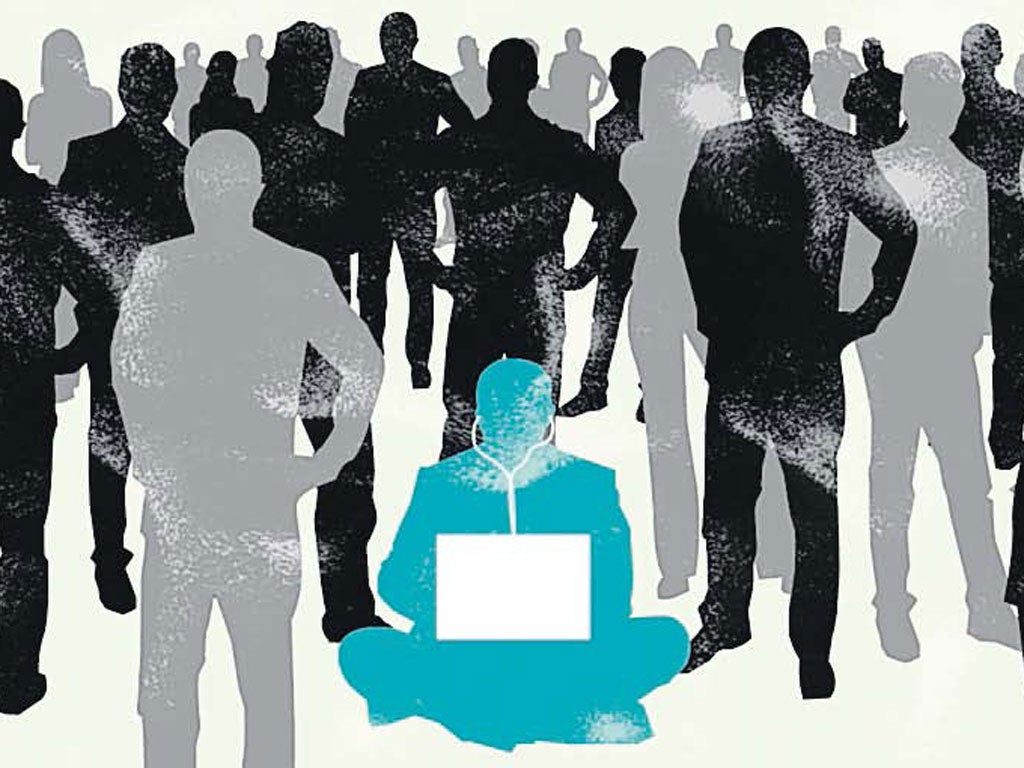
It's also time perfectly matched for another threshold in modern lives: one between not different kinds of space, but different kinds of experience. For there is a new etiquette aboard even London's heaving wagons. Look around you the next time you're on any train. How many people are plugged into smartphones, tablets and e-readers? How many people are literally plugged in, linked by earpieces and wires to a socket? And how many are not simply soaking up media content, but interacting with it: stroking their devices' screens carefully, solicitously; playing; writing updates to share the moment they rise back into the overground light of full 3G reception?
The last time I asked this question my answer was just over 50 per cent of the 30-odd people in my carriage. Our attention distributed across individual elsewheres, we were barely present to each other. Read a book, and you give yourself to another self-contained world. Use a smartphone, though, and the other world you enter isn't an authorial creation. It's your life, arranged as you want it to be: library, office, playground and living room rolled into one.
We are increasingly the curators of our own experience – a power that's the perfect antidote to the indignity of helplessness that travel forces on us. Moving by train between A and B, we can't control how we move or who we are moved with. But we can control what it feels like to experience this process. And so, multitasking citizens, we respect the integrity of each others' media bubbles – of the mutual illusion that we're not, actually, sharing this particular space or process of conveyance at all.
This is the necessary etiquette of mass interactive media, just as moving down the carriage is the etiquette of overcrowding. Witness the wrath in regular commuters' eyes when any wretched tourist fails to observe it. Witness the angry bemusement of a plugged-in traveller when the fourth wall of their absorption is broken by the nuisance of human interaction.
Perhaps this is why the idea of installing art in the Underground seems to me more, not less, radical than it did when launched in London 12 years ago: because it insists that you are in a place, not just a space. And it asks you to give something to this place that we dispense to fewer and fewer objects (and people) in our lives – a moment of undivided attention.
Consider Michael Landy's Acts of Kindness to be found at Chancery Lane and Holborn among other stations. In it, Landy has gathered individual stories told in a paragraph by Tube passengers and staff. An old man falling over and being helped; a pretty lady giving up her seat for an elderly woman; a man drenched from storms being handed an umbrella by strangers – Landy offers a compendium of exceptional acts lurking within the ordinary; human fractures in the surface of travel.
Of course, like the people they connect, communications technologies are incapable of standing still. Wifi is coming beneath the ground: an Olympic special treat, at first, but certain to become just another feature. Like timetables, clocks, maps and escalators, it's a technology whose absence we are learning to consider unacceptable: an indignity akin to this week's "rehearsal" of Olympics restrictions at five major London stations, when the whole edifice of interference-free travel came crashing down amid a mess of queuing systems and PA announcements. Any inconvenience – any interruption – is becoming too great a burden to bear.
What does this new level of media access mean for art and for other people? When every one of us has the entire resources of the internet at our fingertips even half a mile beneath the surface, the idea of someone else having the temerity to choose any kind of experience for us can seem an alien one. Art doesn't want us to decide exactly who and what we consume. And this can make it a hard sell in huge cities of increasingly electronically empowered selves. What art can do, though, is remind us of a quality of time and experience that technology increasingly risks removing from our lives.
I no longer commute to work on the . Gradually, I've become desensitised to the routines: slower to move down the carriage, less savvy about the ideal waiting slot on platforms. I even try striking up a conversation with fellow travellers from time to time.
It doesn't usually work. If mass communications means one thing, it's that we tend to save our words for those we want – or need – to talk to, rather than squandering them on strangers. One common bond that can break through is complaint: the shared eye-rolls, the conspiratorial whinge. Another is the kindness that Landy made his subject. A third is the appalling specificity of real crisis.
Art, though, offers connection in a different sense. Because when I meet an artwork, I'm entering into a conversation with someone who isn't there – but who has, carefully, set out to offer me far more than I am accustomed to receive.
There's a line from Alan Bennett's play The History Boys describing the power of written words to reach out across time and space. "The best moments in reading," Bennett notes, "are when you come across something – a thought, a feeling, a way of looking at things – which you had thought special and particular to you. And now, here it is, set down by someone else, a person you have never met, someone even who is long dead. And it is as if a hand has come out, and taken yours."
The same is true of the artwork on Underground walls, waiting for us to pass. They reach out – and ask us questions it's easy to think modernity exempts us from. Where, exactly, are we? Who is sharing, or has shared, this space with us? What does it mean to be here, today, together, passing through – and what might it come to mean, if we let it?
Tom Chatfield is the author of four books exploring digital culture – most recently 'How to Thrive in the Digital Age' (Pan Macmillan)
Join our commenting forum
Join thought-provoking conversations, follow other Independent readers and see their replies
Comments