Leading article: The welcome return of the Union Jack
The flag has been rescued from the connotations of lost Empire or unpopular Union
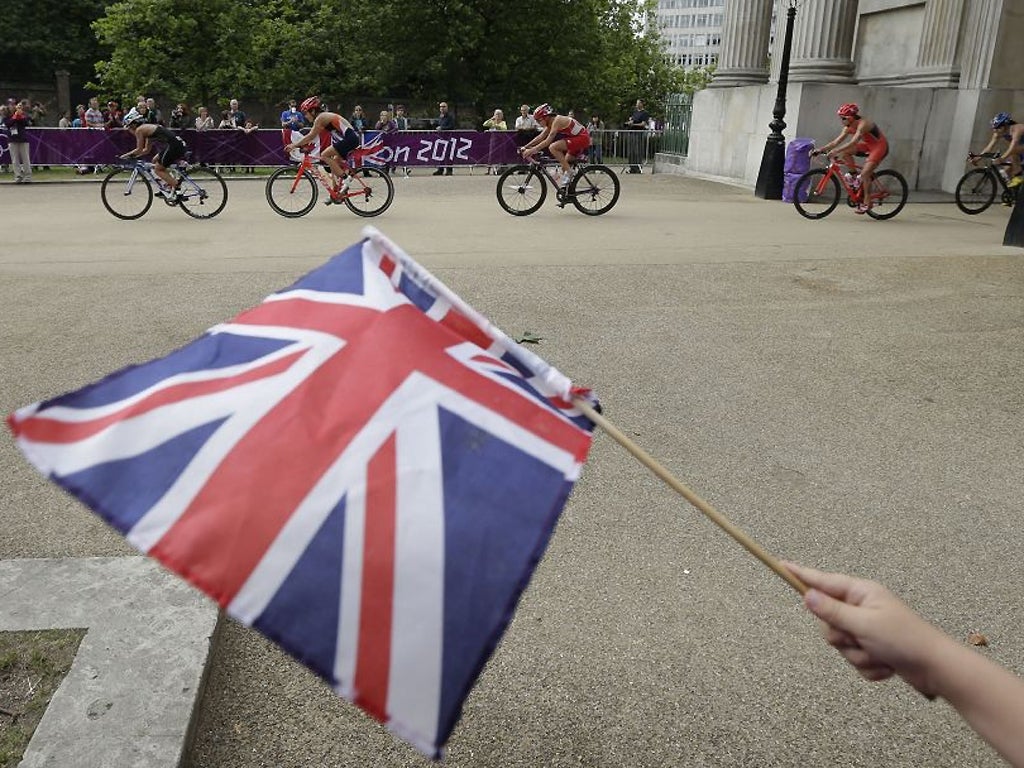
An abiding image of the Olympic Games will be the fluttering frenzy of the red, white and blue of the Union Jack. Spectators have waved it, medal-winning competitors have draped themselves in it, and Britons everywhere have displayed it – on dresses and suits, shirts and tablecloths, plastic bowler hats and fingernails. And, of course, it was there in the parachute as our 86-year-old sovereign appeared to leap from a helicopter at the Opening Ceremony. Just as the Cross of St George was reclaimed from the grip of far-right political extremists, so the Union Jack has been rescued from the old connotations of vanished Empire and has become a vibrant, colourful symbol of contemporary British identity.
There is politics to this, as Gordon Brown, that great enthusiast for a new definition of Britishness, knew. One of his first acts on becoming Prime Minister in 2007 was to decree that the Union Jack should be flown more often from government buildings. Fast-forward to the flag-waving Olympic crowds, and it is Scotland's First Minister who will be somewhat disconsolate. Alex Salmond was trying to use the Games for his own brand of nationalism before they began. Even before champion cyclist Sir Chris Hoy won his spectacular sixth gold medal yesterday, Mr Salmond had sent him a message of congratulation for being chosen as the flag-bearer for Team GB – but without mentioning the team by name. Indeed, he even, somewhat bizarrely, coined the phrase "Scolympians" in an attempt to stop millions of Scots cheering on a team that represents the Union. It did not work, however. Instead, Scots debated whether his neologism sounded more like a nasty skin disease or a race of alien villains from Star Trek.
As enthusiasm for the Games has mounted even Mr Salmond's nationalist cabinet members have bowed to common sense and disregarded the rule to not mention the British team. Quite right, too. The Union Jack – which, in its current form, dates from the 1800 Act of Union – superimposes all four members' national flags as a representation of unity that leaves the symbols of the individual countries intact. Being comfortable with the concept of a dual identity lies at the heart of Britishness, as epitomised by Scotland's Andy Murray's gold-medal-winning singles triumph which warmed the heart of the nation.
Some years ago, Murray irritated English commentators with an off-the-cuff comment about supporting "anyone but England" when it came to football. Yet Murray couldn't have been more British the day he became the Olympic tennis champion, wrapping a Union Jack around his shoulders. He obviously cherished his roots, but he was proud of representing his country, he said, shrugging off any previous patriotism row. He even sang along to at least some of "God Save the Queen".
British athletes winning gold medals in the Olympics will – irrational though it may seem – be a boost for unity when and if Mr Salmond offers Scots a vote on independence. Indeed, a new YouGov poll in The Scotsman suggests that support for independence has fallen by three points to just 30 per cent, with 54 per cent preferring to remain joined with the rest of the UK.
Political moods can, of course, be ephemeral. But the spirit has changed in a way which is bad news for Mr Salmond. In the past, the arguments in favour of unity had seemed merely economic. All the arguments on emotional identity belonged with the pro-independence camp. The scenes of patriotic jubilation that have accompanied each Team GB win suggest something different. There is emotion too in the idea of a nation united. A tide may have turned.
Join our commenting forum
Join thought-provoking conversations, follow other Independent readers and see their replies
Comments
Bookmark popover
Removed from bookmarks