Everything the Blair documentary got wrong about the man I know
Channel 4’s documentary seemed obsessed with trying to get the former prime minister to admit Iraq was a mistake, but John Rentoul, who has written a biography of Blair and who teaches a course about his government at King’s College London, senses a change in how he is remembered


In the early years of the course on the Blair Years that I have been teaching with Professor Jon Davis since 2008, students wanted to understand more about Tony Blair’s decision to join the American invasion of Iraq.
Like Michael Waldman, the maker of this week’s Channel 4 documentary about Blair, they seemed obsessed with how Blair came to do something that was so obviously wrong, and why he would not accept, in hindsight, that he had made a mistake.
In recent years, though, students have been much more interested in how he was such a good prime minister. They want to know how he improved public services, how he communicated optimism, and how he won elections and kept winning them.
Yet Waldman succeeded, I think, because he painted a fuller portrait than most have done. This was despite his subject resisting the probing of his inner life more bluntly than I have seen before.
Blair told Waldman, “It’s very important to understand about me that I’m not into psychoanalysis. There’s far too much of it and people spend far too long constantly analysing why they do what they do. I know why I do what I do, because I believe in it. If people don’t accept that, I’ll just get on with doing it.”
Others can speculate, however, about the influence of his father, Leo, adopted by working-class parents in Glasgow, who became a barrister and law lecturer, was active in politics and wanted to become an MP. Leo was a Conservative, having renounced the Communism of his youth and becoming a proto-Thatcherite in the early 1960s.
When his ambition was thwarted by a stroke, it may have been taken up by Tony, aged 11, although he both rebelled against his father, adopting a politics of the compassionate left, and wanted to succeed on his behalf. The other thing his father gave him, though, was an instinctive understanding of the “stand on your own two feet” mantra of Margaret Thatcher, when she laid waste to the Labour Party in the 1980s.
By chance, Charles Moore, Thatcher’s biographer, came to talk to our students at King’s yesterday, and said that she was just as resistant as Blair to questions about her early life and motivations – although she deflected them in a different way. When he asked her about her mother, with whom she had an emotionally distant relationship, Thatcher said she did wonderful voluntary work: “And that’s the thing about the women of Britain. They do marvellous voluntary work, not like the French women.” Moore said: “And off she went into a generalisation which she was happier with, rather than the particular about herself.”
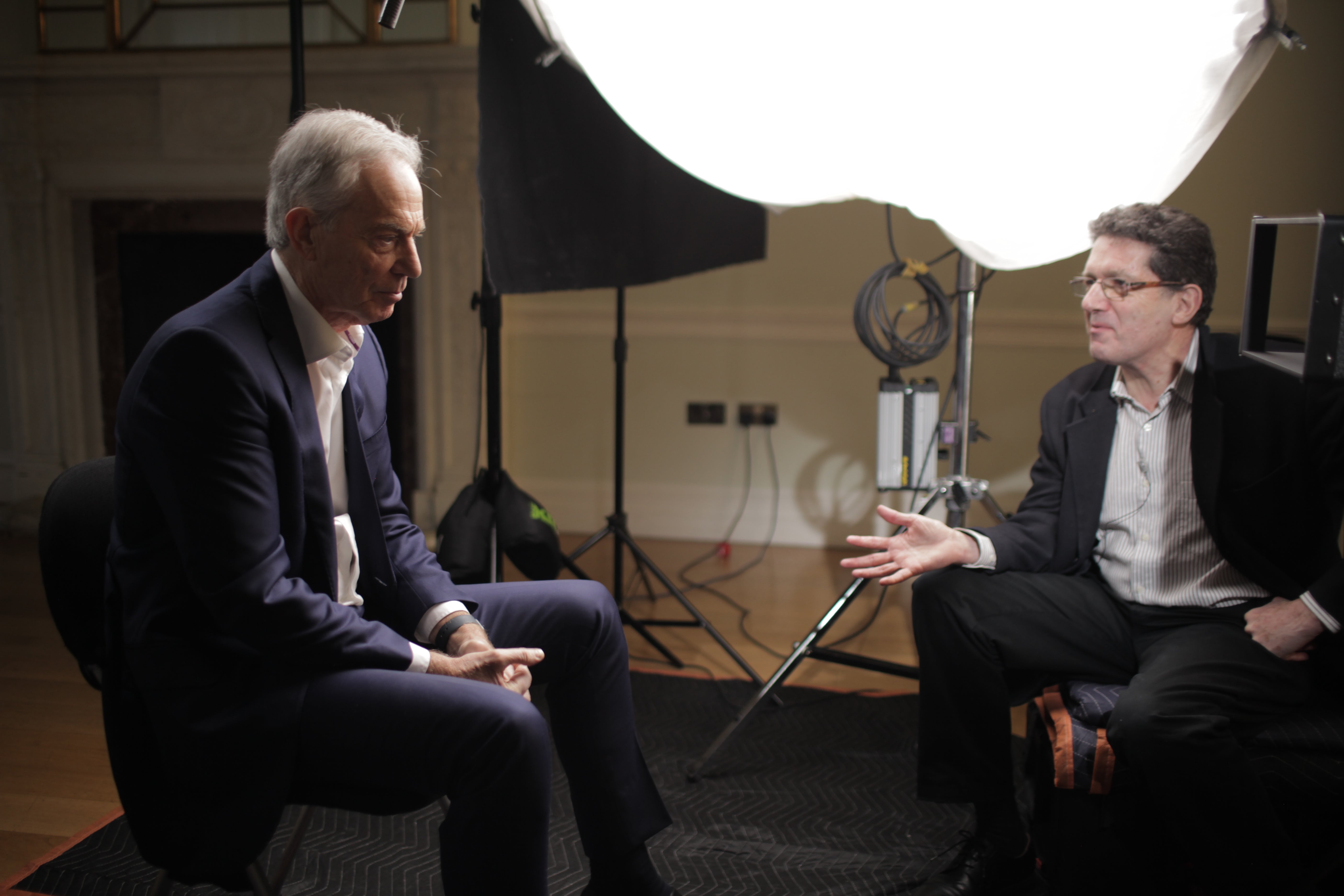
Waldman’s questions about what Blair thought about “in the middle of the night” were met with a more knowing deflection. When Blair said he wouldn’t answer that question, Waldman protested: “Why not, you’re no longer a politician?” Blair said, “You’re always a politician.”
And it is true in his case that he is still active in politics in the broader sense. This week, he attended the first meeting of Donald Trump’s Board of Peace to try to find a way forward for Gaza. As his daughter Kathryn says in the documentary: “He’s just not finished.”
It is the first time that Kathryn has been interviewed about her father, and the footage of her, brothers Euan and Leo and mother Cherie is the most valuable part of the film. They confirm that the Blair family was not just a public relations exercise, with Blair the first prime minister of the TV age to have young children in Downing Street. They are a real family.
Once, when I was having an off-the-record conversation with Blair in his No 10 office, the prime minister’s great thoughts were interrupted by Leo, aged four, coming to say goodnight. Two decades later, Leo is now being interviewed on TV about what it was like growing up in Downing Street for the first seven years of his life. He said, “I remember being very sad” when the family had to move out in 2007.
Nor is Cherie yet reconciled to the family’s departure. Her hostility to Gordon Brown remains undimmed by the passage of time. What did she say when Tony thought about standing down before the 2005 election? “No. Don’t do it.” Did she think Tony made a mistake in handing over to Brown two years later? “I do.”
I remember a discussion with Cherie about the children’s privacy, I think, after they appeared at the door of No 10 after the 2001 election. She rejected the idea that they should be hidden away. “They want to be part of it too,” she said. And they still do.
Euan revealed some of the family dynamic as his father became more unpopular after Iraq: “There was this mutual understanding. We would never let him see it affecting us too much. He would never let us see it affecting him too much.”
I thought the film provided a valuable corrective to Blair’s tendency to present himself as a man of destiny, removed from the world. It rooted him in the family he grew up in and in the family he and Cherie created.
The responses to the documentary were telling. Blair’s “lack of introspection is baffling”, said one reviewer. Others could not understand how he still defends the toppling of Saddam Hussein, and found his “history goes on a long time” line annoying.
But the more interesting responses were more obvious. Every year, it becomes easier to explain Blair’s strengths as a prime minister to students, as each of his successors in one way or another demonstrates them by their contrasting weaknesses. “The right needs its own Tony Blair,” said one Conservative reviewer. So does the left.
Join our commenting forum
Join thought-provoking conversations, follow other Independent readers and see their replies
Comments
Bookmark popover
Removed from bookmarks