Cooling towers: Will you miss them when they're gone?
Love them or loathe them, they are becoming ever more rare as the demolition squads move in. And tomorrow another set will vanish forever
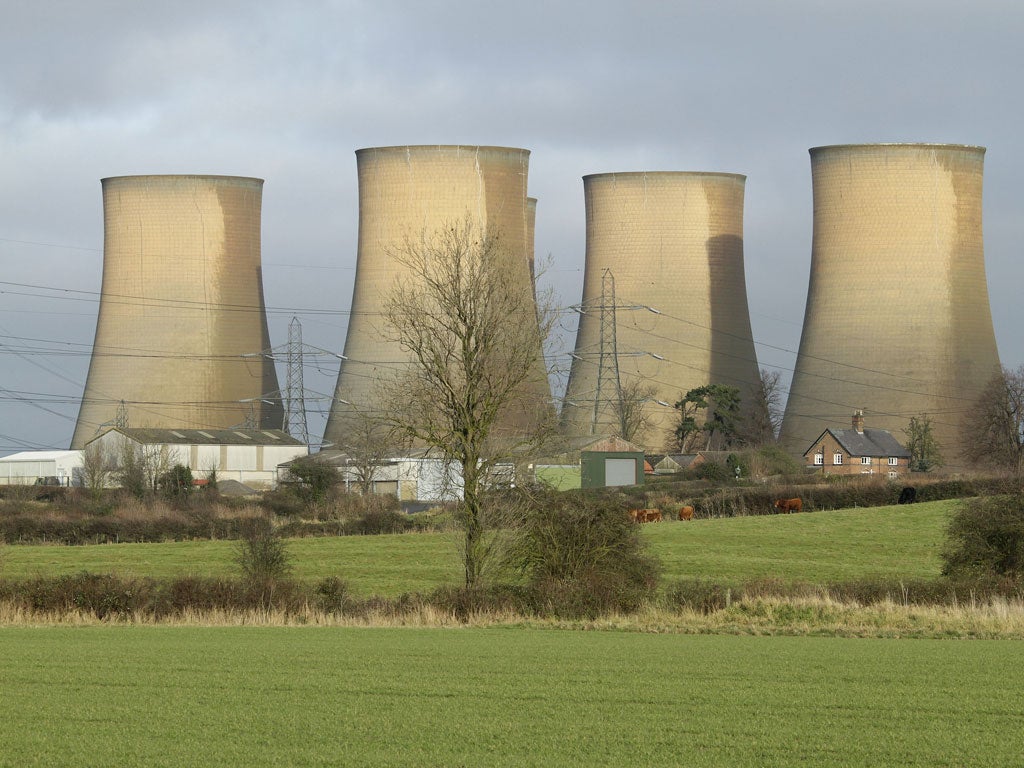
To some, they're foreboding eyesores. Other consider them sublime and awe-inspiring symbols of the country's industrial heritage. Either way, the colossal, curved cooling towers that once dotted the British landscape are gradually vanishing from the skyline. Tomorrow morning, a small group of engineers will meet near the river Trent in Nottinghamshire, overshadowed by the cooling towers of the power plant where they used to work. At 10am they will be among a select crowd allowed to watch as a series of explosions rip through the 52-year-old structures and reduce them to rubble in just 15 seconds.
The towers, which stand more than 100 metres tall and are the last relics of the decommissioned High Marnham power station, will become the latest of at least 19 of the structures to have disappeared from the British landscape in the past six years.
Cooling towers are used to safely remove excess heat created in power plants. Their curved shape aids evaporation and was first used by two Dutch engineers in 1914. The structures became common throughout Britain in the 1950s. Neil Riley, head of Generation Development at Eon UK and the man in charge of tomorrow's demolition, is philosophical about the passing of Britain's industrial history: "You've got to look at how long these things have been around. A lot of them were built in the Fifties and early Sixties. They've been loved, cherished and maintained.
"I think [demolition is] just a natural consequence of their design. It's just part of their natural life cycle."
The writer Germaine Greer is among those who feel a deep attachment to the structures, describing them as "fabulous creatures" and "art objects" that deserve to be preserved.
Another is Tom Keeley, 29, who led the unsuccessful campaign to save the Tinsley Towers in Sheffield. He watched with crowds as the salt and pepper pots, as they were known, were demolished in 2008.
"It was a shame because the towers were lit up with floodlights – the demolition was done at night – so for their last gasp they looked really beautiful." Mr Keeley said. "It was quite brutal, one half was left standing for a while and people were cheering; it was almost like a hanging."
He added: "There's a lot of shame attached to the energy industry; it has an association with dirt and power and heat. That isn't necessarily one that people want to celebrate and maybe rightly so. But I think there's too much of a rush to destroy all traces of a building rather than thinking what it could become. I don't think the solution is just to knock it down and pretend it never happened."
Mr Riley said: "The towers have a sort of fascination for some and are seen as ugly by others. But for someone who's worked in the power industry and spent time on a site [with cooling towers] they're not seen as ugly at all. People feel a great deal of emotion towards them."
The towers at High Marnham will fall one after the other at intervals of three seconds tomorrow, leaning slightly before breaking up and folding in on themselves as though made of fabric. Eon UK, the company behind the two Tinsley Towers and the five towers at High Marnham, admits that tomorrow's demolitions will be met with sadness. But for energy companies, paying to keep disused towers standing is not viable.
Richard Green, professor of sustainable energy in business at Imperial College London, said: "At some point somebody will have to provide a large amount of money to make sure they stay safe. If that's only going to be [for the sake of] a large public sculpture then, for all that places with public sculptures are pleasant, you have to think how much does this enhance the landscape compared to what else we could do if we weren't having to maintain the towers?"
Tony Pearson, who runs a pub in Pegwell Bay in Kent, says he is glad the three towers at Richborough power station, which were demolished in March, no longer spoil his view. "Looking out the window now, even though it's horrible weather, it does enhance the day not having them there," he said."There's a seal colony that live here, so we're looking at a really beautiful part of the countryside and when it had three great big cooling towers stuck in it, your eyes were drawn straight to it," he added.
But as Britain's coal and gas-fired power stations crumble into disuse and vanish, colossal white fans take their place as a symbol for the future of energy production.
Mr Pearson can see wind turbines out at sea from his pub. "Again, they're not pleasant to look at; they don't do anything for the landscape. But they are clean energy," he said.
Expert guide: How to blow up a cooling tower
Bringing five enormous towers to the ground takes a team of up to 25 people several weeks. This is what happens
* Holes are drilled round the base and up the side of each tower.
* The holes are stuffed with explosives and covered over with thick wire mesh or rubber, which stops debris from flying outside the blast zone.
* Before detonation the structures are sprayed with water to keep the ensuing dust cloud as small as possible.
* The explosives are detonated in a fixed order. The charges at the base go first, causing the tower to lean. A fraction of a second later the charges running vertically are detonated, weakening the tower's structure and causing it to fold in on itself.
* The rubble can take months to clear, and can be used to fill the holes which served as water pools for each tower.
* Another demolition method, which was used to bring down the Thorpe Marsh towers in Doncaster, is to drag wires along the base of the structure.
* The cables cut into the concrete until the tower can no longer support itself. This method is quieter than using explosives but involves additional work to demolish what is left of the base.
Join our commenting forum
Join thought-provoking conversations, follow other Independent readers and see their replies
Comments
Bookmark popover
Removed from bookmarks