Glasgow and Edinburgh: the architectural rivalry
The cultural rivalry between Glasgow and Edinburgh has been reignited by two striking new museums. But who gets the bragging rights? Jay Merrick finds out
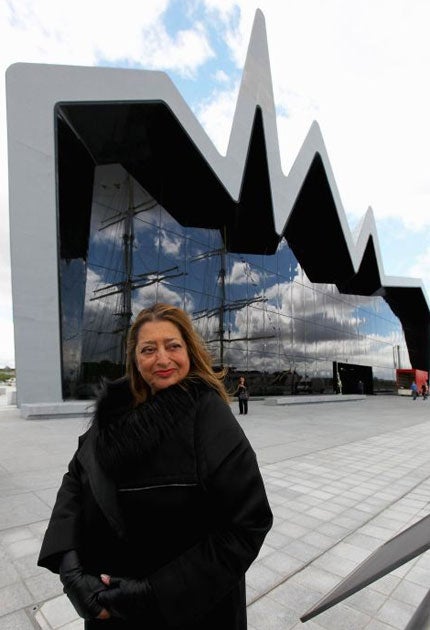
Two new museums in Scotland, a vast zinc-coated amoeba on the edge of Glasgow, and a transformed temple of High Victorian knowledge in Edinburgh, have renewed the eternal cultural rivalry of these two great cities, just 47 miles apart. Glasgow claims immediate bragging rights because the Riverside Museum of Transport and Travel was designed by Zaha Hadid and cost more: £74m. And yet Gareth Hoskins Architects' £46m modernisation of the 145-year-old home of the National Museum of Scotland makes it hard to deny the vivid power of big, classically inspired set-piece spaces awash with natural light.
Those braced for high drama on Clydeside can unbrace. There is only one look-at-me moment: the roof edges of the two main facades are like languid architectural scribbles above the gleam of the glazed ends. Here, at Pointhouse Quay, where the Kelvin river flows out of Partick to join the Clyde, this architectural soft machine is anything but a big, big toy for big, big boys.
The museum doesn't obviously express Hadid's key creative stimulants: Russian Suprematist and Constructivist art, Arabic calligraphy, and her fundamental desire to shatter preconceptions about architectural space, and how we experience it. Only her interest in denuded landforms and watercourses seems to apply to the Riverside. Despite 6,000 square metres of exhibition area, the museum is an oddly gentle presence on the quayside where A&J Inglis built ships from 1861 to 1962. From some angles, the museum's beautifully applied 24,000 zinc scales give it the look of a coiled, battleship-grey python.
The back story of the design is the heart of the matter, and two aspects in particular: the socio-economic strategy of Glasgow City Council's nine-year development of the project; and the strong curatorial and demographic leads imposed by the Transport Museum itself, which was previously housed in Glasgow's Kelvin Hall, where only half of its 3,000-object collection could be shown.
The completion of the Riverside marks a key moment in the Glasgow Harbour regeneration project, which is why the council paid two-thirds of the museum's cost, the rest coming from the Heritage Lottery Fund and local corporate and public donations. Architecturally, the museum is the least disturbing of the new developments in the Clydeside areas around Partick and Govan. The Riverside forms an almost flaccid break-point to the grim go-faster stripe of big new blocks of flats that have introduced "lifestyle living" to this stretch of the north bank of the Clyde. It is a lifestyle bereft of any engaging sense of place or history – just another dreary chunk of British boom-bust urban legacy.
Inside the museum, a cornucopia of historic artefacts of transportation is spread out or hung in huge pleated caverns the colour of Golden Delicious apples. The highlights include the Wall of Cars, rather like a two-storey high presentation box of used Dinky toys. There's a heroically mammoth, wildlife-crunching South African Railways locomotive; a charmingly skew-whiff vehicle-loaded shelf that rises up one wall in mimicry of the steep road in Argyll known as Rest and Be Thankful, where manufacturers used to test cars; and a brilliantly contrived moving conveyor belt that parades selections of the museum's 708 ship models.
Does the Riverside work as a welcoming place for the 650,000 visitors expected in its first year, with up to 800,000 coming to see the Glenlee tall ship moored next to it? There is certainly a distinct tension between the architecture, and what it contains. In flowing, column-free spaces like this – with a sharp, cathedral-like high point of about 100ft – it's obvious that it will take some time before the curators discover what segments best suit particular configurations of exhibits. Apart from the fact that the Riverside Museum's café-restaurant seems far too small, Hadid's creation seems highly suitable for Britain's only remaining heavy industry – heritage tourism.
But all thought of things blobbish and avant garde seems trifling on a stroll up The Mound and North Bank Street in Edinburgh. This densely engaging scene reminds you of the emotional and intellectual importance of historic architecture – not all of it superb – in relation to changing times. St Giles' Cathedral, the city's Presbyterian High Kirk, bristles like a dark mound of thistles in sandstone. A little further south, at the corner of Chambers Street, the 1998 postmodernist extension of the National Museum of Scotland, designed by Benson and Forsyth, seems overwrought.
In comparison to this tricked-up blancmange, Hoskins and his co-director, Chris Coleman-Smith, have positively knelt at the altar of the Grade A- listed museum's original architect, Francis Fowke, who also designed London's Albert Hall.
The crucial design move has been to return the magnificent atrium and three levels of galleries in the Grand Gallery to something very like their original condition; in addition, the long stone-vaulted basement space beneath it has been opened up for the first time: it's now the main entrance to the museum, an atmospherically compressed introduction to the building which leads visitors straight up into the Grand Gallery.
As architectural segues go, it's pretty gripping. Yet, considered detail by detail, the Grand Gallery is not in the least astonishing. The iron columns, the arched windows, the glazing – they're all quite unremarkable. But the way the bones of this space are set out, their shifts of scale and perspective, proves that you don't need brilliant architectural refinements to produce a really wonderful space; you can't help smiling when you walk into this one.
The greatly enlarged 16-gallery domain covers 6,800 square metres – slightly more than at Glasgow's Riverside Museum, incidentally – and retains something of the aura of the 18th-century Scottish Enlightenment and of the far-flung Scots of the 19th century who gifted the museum with extraordinary artefacts from the days of empire. More than 8,000 objects will be displayed in a building that now has 50 per cent more public space.
Coleman-Smith has treated the museum – previously constipated at key points by clumsy ad hoc interventions that blocked views and made circulation difficult – with kid-gloves; the new modernist details are restrained. "Previously, people regarded the building as a problem," admits the museum's director, Dr Gordon Rintoul. "Now, the building's almost the main exhibit."
It's a telling remark. How do you get the balance between a museum's exhibits and its modern (or modernised) form right? You can, as in Jean Nouvel's hallucinatory Musée du Quai Branly in Paris, create a building in which the ethnographic exhibits totally dominate. In Glasgow and Edinburgh, in two utterly different buildings, there remains a lingering sense of a complicated contemporary stand-off between historic objects and the way they're presented.
At the Riverside, there is a sense of exhibits being too tightly packed together. And even in Edinburgh, where the renowned Ralph Appelbaum designed the exhibition narrative, the National Museum of Scotland is keen to highlight the large number of interactive displays. History and historical objects are inevitably being reduced to museum entertainments that require greater footfall but shorter dwell-times. Thank heavens for Francis Fowke's Grand Gallery, which defeats that insidious vibe in a way that the Riverside Museum, despite its beautifully crafted shell, cannot.
The winner of this museum design bout is Edinburgh – it just shades its slick opponent, on historical points.
The National Museum of Scotland, Chambers St, Edinburgh (0300 123 6789) opens 29 July. The Riverside Museum of Transport and Travel, 100 Pointhouse Place, Glasgow (0141 287 4350) open now
Join our commenting forum
Join thought-provoking conversations, follow other Independent readers and see their replies
Comments
Bookmark popover
Removed from bookmarks