St Petersburg's tower to the sky fails to get off the ground
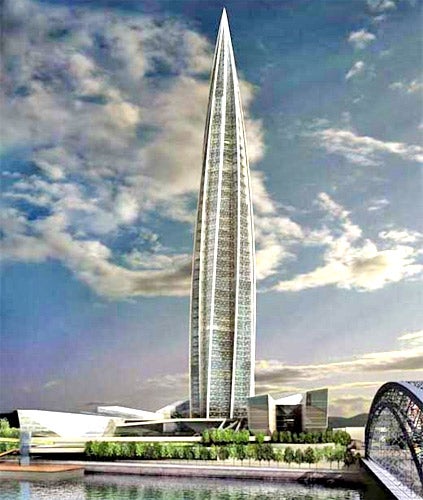
Dreamed up in the heady days of ever-rising oil prices, before the financial crisis struck, it represented the optimism and swagger of the new cash-rich Russia.
A twisting, 400m-high skyscraper, to be built overlooking the historical centre of St Petersburg, the building was to house the headquarters of the state gas monopoly, Gazprom. Architectural preservationists howled that it would destroy the city forever, Unesco said it would be a travesty, but the authorities insisted that the project was going ahead.
This week, after months of uncertainty and contradictory statements from high-ranking Russian politicians, the final nail seems to have been hammered into the coffin of the project. A St Petersburg court ruled that limits on the height of new buildings on the embankment of the Okhta River, just outside the historical city centre, would be reintroduced.
They had controversially been lifted by the city authorities to smooth the path for the Gazprom project. Now, no new structures in the area will be able to exceed 40m in height.
This means that there is no place for the Okhta Centre, designed by British architectural firm RMJM. The sleek, glass-clad structure, at 403m high, would have been the tallest building in Europe and more than 10 times over the new maximum height.
St Petersburg was seen as a symbolic choice for the HQ of Gazprom – a behemoth of a company that more than any other has been the driving force behind Russia's resource-based economic boom.
Many of the leading figures in the Russian government come from St Petersburg, including Prime Minister Vladimir Putin and President Dmitry Medvedev – who, before taking over in the Kremlin in 2008, was chairman of the board at Gazprom. Alexei Miller, the group's chief executive, also hails from Russia's northern capital. Mr Medvedev said earlier this year that Gazprom should think carefully about building such a tall building in St Petersburg, and the U-turn appears to be a rare victory for public pressure over the authorities.
The building has been controversial from the start. The British architect Norman Foster walked out of the panel that decided on the design of the tower, and street demonstrations were held when the project was first given the go-ahead.
Unlike central Moscow, where Tsarist-era mansions sit alongside Soviet tower blocks and modern glass business centres, the centre of St Petersburg is a largely homogenous collection of neoclassical buildings, set on a grid of canals. It is also, for the most part, a low-rise city, and leading cultural figures from St Petersburg argued that in an urban environment, where the only tall buildings are churches, it does not seem appropriate to dwarf the rest of the city with the headquarters of a gas company.
Mr Miller said this week that several other cities have shown an interest in building the skyscraper, including Omsk in Siberia and Vladivostok, Russia's main Pacific port. Although both cities contain oil and gas infrastructure, it is unlikely that Gazprom would want to base its headquarters so far away from Moscow – Vladivostok is an eight-hour flight from the Russian capital. There have also been suggestions that it might be built somewhere in the region surrounding St Petersburg, where it would not be visible from the city centre.
A spokesman for the Edinburgh-based RMJM declined to comment yesterday, but the project's chief architect, Filipp Nikandrov, told The Moscow Times that he hadn't received any proposals for alternative locations. "We have created the Okhta Centre specially for this place, and I believe that it would look great at this place. It wouldn't damage the city skyline and would complete it perfectly," he claimed.
However, it seems that the project in its current form will not go ahead. "It is not a temporary retreat," Mr Miller told Russia's Itogi magazine this week. "There will be no Okhta Centre on the Okhta Cape."
Join our commenting forum
Join thought-provoking conversations, follow other Independent readers and see their replies
Comments