Bridge over troubled water: Zaha Hadid's latest architectural creation
The new design by starchitect Zaha Hadid is a graceful and dynamic wonder that spans a political controversy. Jay Merrick reports from Spain
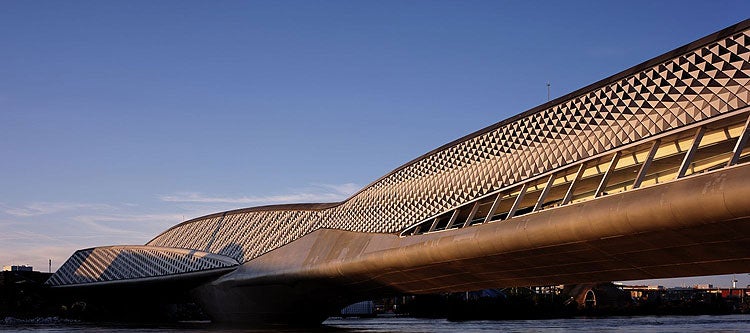
Zaha Hadid's latest architectural creation, the 270m-long Bridge Pavilion across the Ebro river in Zaragoza, Spain, has brought the ghost of the legendary 1920s Russian artist Kazimir Malevich to a conservative city that once garrisoned Franco's troops and was marched on by the 2,000 anarchists of the legendary Durruti Column during the civil war. So is the bridge's architecture revolutionary, or anarchic, or something else entirely?
Zaragoza hosts the 2008 Expo (theme: "Water for Life") and the bridge's metaphorically liquid form links the river's south bank to the Expo site on the north side with a bundle of trajectories that are pure virtuosity. The sinuous narratives dissolve into one another to form internal vistas suggesting, by turns, warped force fields, lubricious flesh, and something of Malevich's Tektonik, a 14-level bridge across the Thames that was Hadid's final-year project at London's Architectural Association in 1976.
That implacable instinct for architectural forms that are, in effect, spatial and formal artefacts was first implanted by Malevich's Suprematist art and ideas. The Expo Bridge Pavilion imitates, or at least refers to, Russian Suprematist or Constructivist art. Constructivism – as in structures and space that suggest a virtually uncontrolled dynamism – certainly springs to mind when looking at sections of the bridge's internally revealed steel frame; their triangulations would be unremarkable were they not skewed in plan.
In Zaragoza, Hadid has produced an architectural hybrid, a Post-Modern Ponte Vecchio inhabited not just by Expo visitors but by space itself; space sculpted within the shells of the three elongated steel pods whose differing trajectories carry the 7,000-ton bridge across the Ebro in a languid shimmer, like flexed muscle sheaths. The real six-pack, incidentally, is under the bridge in the form of 68m-deep central piles, the deepest structural foundations in Spain.
The architectural flow of the bridge may have been refined by sophisticated computer drawing and imaging software, but the stronger sense here is of the expressive human touch. As a result, Hadid's craving for a new sense of space seems less obviously revolutionary. Nor is it avant-garde in any retro sense. Why? Because nothing feels hidden, or abstruse.
Furthermore, there is a genuine play of materials. The underside of the mezzanine level has the sheen and texture of pristine plasticine; against it, the brusque cross-bracing of sections of exposed steel structure look pastel-soft, like a brilliant drawing at risk of being smudged into incoherence by an impetuous thumb.
Hadid describes the architecture as a narrative – "clean water above dirty water". The Zaragoza bridge flows in three graceful metallic and spatial currents over a river whose waters have become a muddied political issue: Barcelona, on the verge of water rationing, wants to take some of the Ebro's volume; Zaragoza, with temperatures of more than 40C in the summer, does not wish to concede a drop.
Walking through the bridge from the Ebro's north bank, in the company of the project architect, Manuela Gatto, the clean-water metaphor was succeeded by others. Furniture, for example, and Hadid's Moraine sofa, in particular, a bifurcated form whose force lines seem similar to the bridge's.
What a pity, then, that the Pavilion Bridge was built in such a hurry: some of the detailing is rather slipshod. There are shades here of the cost-cutting and dumbing down of the design of Hadid's Olympic Aquatic Centre in London. Even so, the bridge remains seminal and, in Zaragoza, it's in good architectural company. Ricardo Bofill's Delicias railway station is marvellous; the Convention Centre on the Expo site, by Nieto Sobejano, has a brilliantly articulated façade; and, in the Plaza de la Seo, the Cathedral of Salvador, with its extraordinary mix of Romanesque, Moorish, Baroque and Gothic elements, would perhaps even satisfy the thirst for "unprejudiced invention" of Patrik Schumacher, Hadid's practice partner.
Expo Zaragoza 2008 runs to 14 September (www.expozaragoza2008.es)
Join our commenting forum
Join thought-provoking conversations, follow other Independent readers and see their replies
Comments
Bookmark popover
Removed from bookmarks