Tate that: Serota defies his critics
It's worth every penny to keep the champion of modern art as the Tate's director, says Paul Vallely
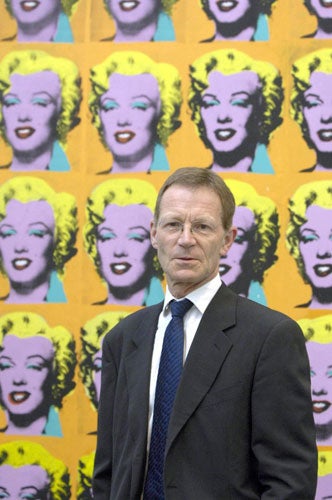
Charles Thomson, leader of the art movement known as the Stuckists, and 244 others will be disappointed. They number the signatories of a petition on the Downing Street website urging the Prime Minister not to give his approval to any reappointment of Sir Nicholas Serota as director of the Tate Gallery. (Anyone can start a petition about anything there, it appears). Anyway, Gordon Brown has clearly not heeded their admonition. Serota, we hear, is to be reappointed as director of the Tate when his present contract expires in August 2009.
I'm a figurative man myself, but I instinctively recoil from the campaign against conceptual art that brings together, in unlikely alliance, artists such as the Stuckists and forces of social reaction such as the Daily Mail. The paper afforded Serota one of his favourite quotes in the annual barrage of outrage that, with weary inevitability, follows the announcement of the Turner Prize, which was until recently chosen by a panel chaired by Serota: "For 1,000 years art has been one of our great civilising forces. Today, pickled sheep and soiled bed threaten to make barbarians of us all."
Nicholas Serota is, without doubt, the greatest single champion of modern art in Britain, and has been so for the past three decades and more. He is, as one wag put it, "the man who put the mode in modernism" who has raised the profile of contemporary art in Britain to levels unimaginable a few decades ago.
Of course, far from everyone has approved of this explosive use of public money. The plummy-voiced art critic Brian Sewell speaks for many whose vowels are a good deal less rounded when he rails against "the hocus-pocus and mumbo-jumbo by which the false intellectuals of the art world are able to 'hey presto!' anything into art, be it the dung of elephants, the video of a medical camera's examination of an artist's uterus, anus and digestive tract, an erect cucumber projecting from a stained mattress, or a dead horse suspended from a dome".
Damien Hirst's dead shark and Tracey Emin's dormitory detritus do little for me. And I did smile at Thomson's satirical painting Sir Nicholas Serota Makes an Acquisitions Decision, which shows a smiling Serota inspecting a large pair of red knickers on a washing line, asking: "Is it a genuine Emin (£10,000) or a worthless fake?" Yet I also admired Serota's cool response to the Stuckist détournement, by turning his enemies' weapons against them: he became the least likely visitor to The Stuckists Punk Victorian show at the Walker Art Gallery in Liverpool where he met the artists and described their work as "lively" – though he rejected their offer to donate their work to the nation on the grounds that it was not of "sufficient quality in terms of accomplishment, innovation or originality of thought to warrant preservation in perpetuity in the national collection". Touché.
I took my eight year old to Tate Liverpool last week. Serota's nurturing of that gallery along with his opening of Tate St Ives and his creation of the masterpiece of Tate Modern have – far more than the annual cavalcade of controversy of the Turner Prize – been key elements in what has established contemporary art as a living thread in modern living throughout the British Isles in recent times.
In the foyer of Tate Liverpool, just by the café and the shop, stands Rodin's The Kiss; it made almost as much impression on my young son as the exhibition on the sinking of the Titanic in the Maritime Museum next door. It led him to engage, admittedly briefly, with the sculptures and paintings of the 20th century: how it looked and how it felt led him to request a visit to the Walker up the road after I had steered him carefully away from the Tate's Klimt exhibition, which was too rude for anyone not old enough to spell pudenda.
But his enthusiasm offered me a direct personal example of the appetite which Serota has stimulated, year by year, a new audience for modern art. He has overseen high-profile initiatives such as the establishment of Tate Modern, for which he tapped private sources for £98m of the £150m the project cost, a mere third of which was funded from the National Lottery and the public purse. And he has made the place the most popular museum of modern art in the world, attracting more than four million visitors each year, 60 per cent of them under the age of 35.
But he has also promoted art in far less publicised ways. When he was previously director of the Whitechapel Gallery, one of the first things he did was appoint a community education worker who promoted contact with local schools and hospitals, a revolutionary appointment that reflected a passionate advocacy of the need to attract new kinds of audiences to art.
There have, of course, been controversies along the way. Critics have complained of conflicts of interest, as in the fact that the Tate under his tutelage has purchased works by every one of the artists serving as its trustees. There have been questions raised over his recent decision to work in an advisory capacity for Daria Zhukova's Centre for Contemporary Culture in Moscow – an institution that may well bid against the Tate in the future in battles over the acquisition of new works of art.
But Serota, who was knighted for his services to art in 1999, is a canny operator. He clearly has his eye on winning the favour of one the Moscow outfit's supporters, the Russian billionaire Roman Abramovich. Earlier this year the Chelsea owner, not previously known to be an art lover, spent £60m on two paintings, by Lucian Freud and Francis Bacon. His is an obvious target in the search for sponsors to back Serota's latest plans for a £215m TM3 extension to Tate Modern which is still £100m short of funding.
The man, whose critics may call him cold, intense and unnervingly inscrutable, is undoubtedly an operator. But he is also an enthusiast and an innovator who has clearly not run out of ideas or the drive to bring them to fruition. He deserves another seven years. We will all reap the benefit of them.
Join our commenting forum
Join thought-provoking conversations, follow other Independent readers and see their replies
Comments
Bookmark popover
Removed from bookmarks