Ten people who changed the world: Ai Weiwei, Chinese artist became a truly global force
Whether in the cut-throat field of politics or the fashion industry's corridors of power, this year they left our planet a better place. Celebrate 10 of the best, nominated by Independent writers
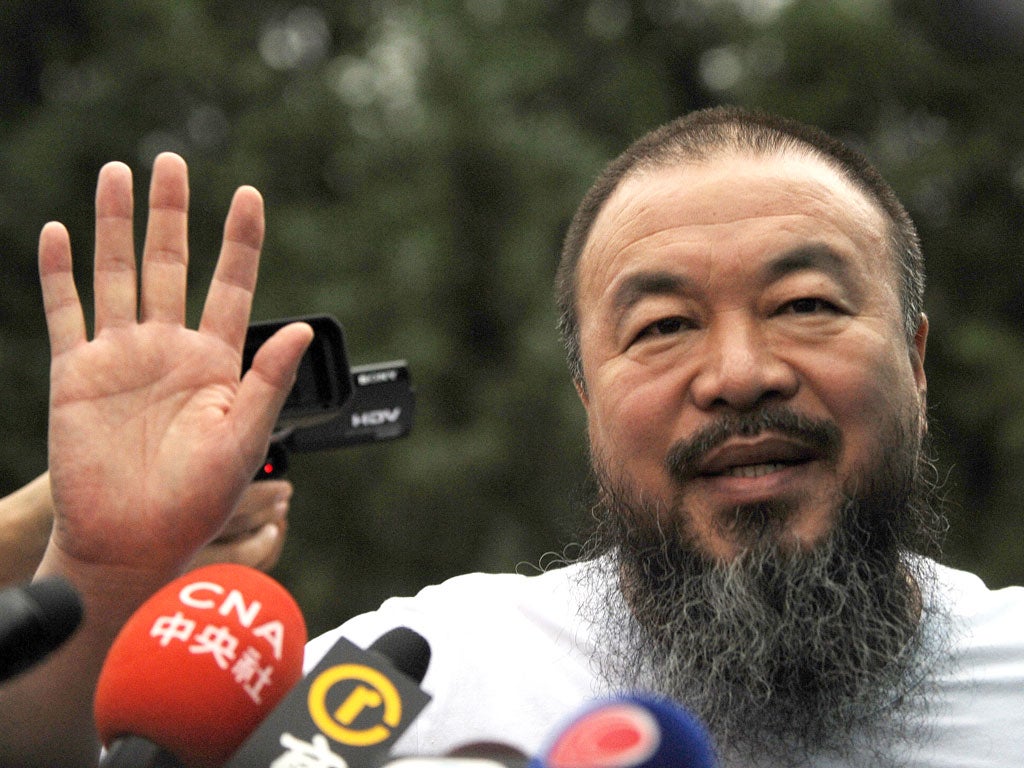
For an illustration of Ai Weiwei's unique position of influence in the art world, you could do worse than look at his tax bill. In November, when the Chinese authorities stung the dissident artist with trumped-up charges of 15 million yuan (£1.5 million), members of the public lined up outside his Beijing home to hand over cash. Some of them folded banknotes into paper aeroplanes or scrunched them around fruit and lobbed them over the wall, straight into his courtyard. Within a fortnight, he had raised well over half, enough to pay off the deposit and begin to contest the bill. Like the eight million or so tiny porcelain sunflower seeds with which he carpeted the Tate Modern's vast Turbine Hall, his many supporters had come together to stunning effect.
The idea of people queuing up to hand over money to an artist, and getting nothing in return, seems a little quaint in today's ritzy, glitzy, multimillion-grossing art world. Isn't modern art all about yachts and oligarchs, parties and record-breaking auctions? Well, no. Even Charles Saatchi, arguably the man who did most to shape the mores of today's scene, admitted earlier this month that he now finds the whole business "indisputably vulgar, Euro-trashy and masturbatory". With Saatchi's influence now on the wane, it is Ai's model, with its focus on art and ideas, on public engagement and social networking over financial transactions and high-society hobnobbing, which looks like the future.
Indeed, in October, Art Review declared Ai, aged 54, the most powerful figure in art in their annual Power 100 list. The accolade is all the more remarkable for coming at the end of a year in which the Chinese government did everything in its power to stamp out Ai's influence – in the most violent and sinister way. In January, his newly built studio in Shanghai was demolished overnight. Then, on 3 April, the artist was arrested at Peking airport, vaguely charged with "economic crimes", and disappeared. His accountant, studio partner, driver and assistant also vanished. He was released, 81 days later and 10kg lighter, having been interrogated over 50 times.
The imprisonment was the darkest point of a lengthy intimidation campaign. The son of a poet, Ai Qing, who was denounced by the regime in 1958, Ai grew up in the shadow of the labour camps – a born radical. In 2008, he was still considered a safe and prestigious enough pair of hands to collaborate on the Bird's Nest stadium for the Beijing Olympics. Since then, he has become an increasingly vocal critic of the regime, supporting an investigation into cover-ups around the Sichuan earthquake and publishing a list of the students killed on his blog. The authorities responded by beating him, hacking his computer and bank accounts, closing down his blog, before eventually "disappearing" him altogether.
The attempt to silence him, of course, had precisely the opposite effect. Ai became the loudest arts story of the year and an internationally recognised symbol for China – the face of both its creative potential and its human rights abuses. From the Tate to the Guggenheim, major galleries organised protests, petitions and installations around his arrest, while a wave of graffiti, Mao-style billboards and impromptu performances hit the streets. If Ai Weiwei isn't allowed to make art, they seemed to say, we'll make it for him. "It's never about me," said the artist. "My supporters use me as a mark for themselves to recognise their own form of life: I become their medium."
This collective spirit informs all of his work, as witty and irreverent as it is subversive and radical. The ideas conjured up by his Tate installation – mass-production, the Communist state, the individual vs society – are typical. "I spend very little time just doing 'art as art'," he says. In other words, his art lives far beyond the walls of the traditional white cube, whether he's shipping in 1,001 Chinese villagers to wander around the world's biggest contemporary art exhibition, in Germany, or, most famously, employing the citizens of Jingdezhen to produce millions of sunflower seeds for the Tate.
Ai's art is about community, locally rooted but globally significant. The internet is as much one of his tools as paint or clay. When his blog was shut down, he adopted Twitter with gusto, tweeting over 60,000 times in 18 months. Better than most, he understands how to mobilise people-power, making him an artist entirely in tune with a year characterised by mass uprisings and internet revolutions.
As 2011 draws to a close, the government continues to persecute him. Last month, it magicked up pornography charges, but this time his supporters were ready. Within hours, they had taken to the internet, flooding Twitter with naked self-portraits – some with pictures of Ai strategically positioned over their genitals. Which other artist could provoke such an outpouring? Ai Weiwei is now the world's biggest artist. Wherever he is in the world, the world will be watching what he does next.
Join our commenting forum
Join thought-provoking conversations, follow other Independent readers and see their replies
Comments