Ultimate pop art - Why gig posters are a sound investment
Posters have always been sentimental souvenirs of a concert. But now they are being seen as art, and an investment.
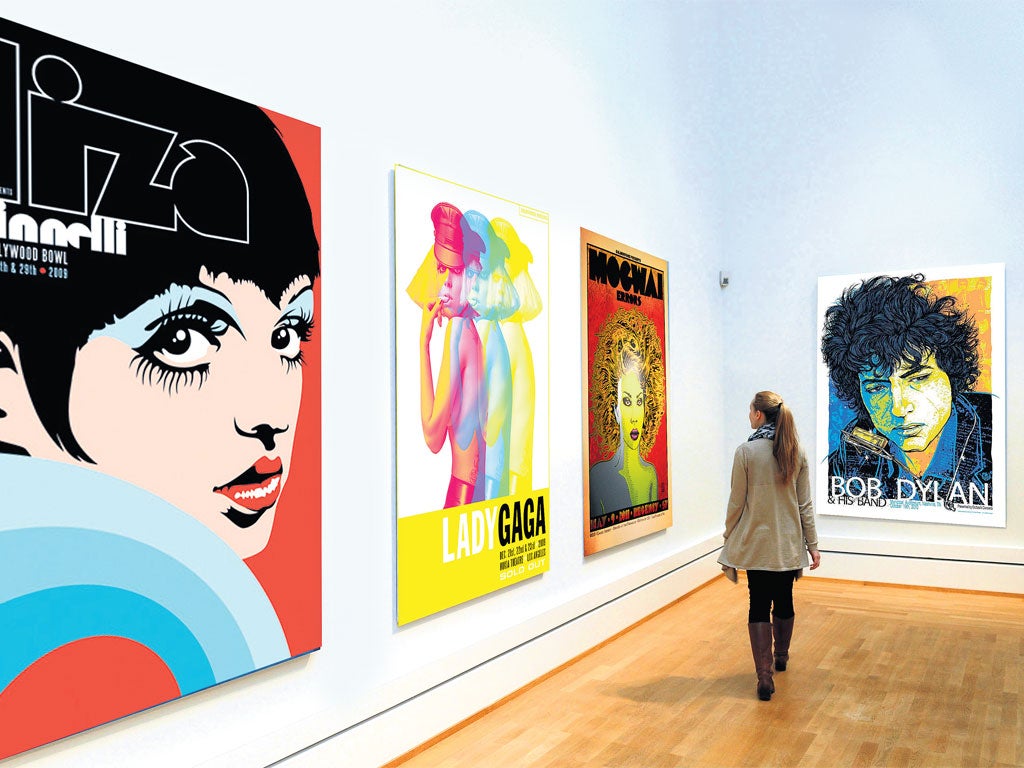
The beautiful psychedelic gig posters that helped define the 1960s San Francisco rock scene are no longer a lost, joss-stick-scented tradition. Musicians from Arcade Fire and PJ Harvey to Bob Dylan and Liza Minnelli are using limited-edition posters to accompany shows, as an often strikingly original counterpoint to their music. Just as in the old days, the artists silk-screen print by hand in batches of a few hundred.
The revival began with the artists who rose alongside the late 1980s US indie boom, culminating with Nirvana. Each subsequent generation has become bigger, with refugees from the skateboard, graffiti, hot-rod, tattoo and comics art scenes referencing pop culture. "A lot of the artists we deal with are still playing in bands and connected with music in quite an earthy way," says Chris Marksberry, owner of the Flood Gallery, London's first specialist dealer in this burgeoning field. Gig posters hold two aces in the wider art scene: their rock subjects' enduring potency, and affordability. "Affordability's something the artists are very conscious of," says Marksberry. "They're trying to fill a place in the lives of people who aren't trying to get into the art world as such, but want something special. It's meant to be street-level, accessible art. Some of the more popular artists do evolve into other areas and exhibit in high-end places, ultimately. But the gig poster scene will always stay affordable. The top people sell in the US for $75 a piece, and the less established ones for $20-30. The most expensive we've sold is a £350 White Stripes poster by Rob Jones. Its usually the artist that makes it collectible."
"I'm an art enthusiast," says Ron Vinion, a 60-year-old from Chicago with a 2,000-strong collection. "You get the satisfaction of a good painting, but you can afford a more frequent fix."
Gig posters' unusually democratic nature as collectible art does take a battering once it enters US collectors' hands. California's D. King Gallery's most expensive current item is a $5,000 poster from a 1973 Rolling Stones gig. Current, collectable US artists such as Emek ($850 for a 2003 Neil Young print, $300 for PJ Harvey) and Jones's White Stripes work (up to $500) also leap out from the gallery's $25-35 norm. Marksberry watched a piece the Flood Gallery commissioned from popular San Francisco artist Chuck Sperry balloon in value. "It was an edition of 50 that we sold at £90 per print, and sold out within half an hour online. The next day they were available via trading sites or eBay for $400, and I've seen one for $1,000."
"A lot of these printers [a term for the artists] really dislike the people who 'flip' the posters onto eBay before they even have them in their hands," Vinion admits. "I can't see any point getting ticked off, because it's a commodity. The most I've paid is $1,000 for a Willie Nelson poster by Geoff Peveto that was printed on steel, with bullet-holes put through it like a country road-sign. Jim Pollock travelled with [hard-touring US 'jam band'] Phish and did posters in the parking lot for each show, and some of them are going for I'd say $5,000. But typically, good stuff direct from the artist is $10 up to $100."
Though artists sometimes hold back a few prints for a slightly higher, later price, or use variants in the colour and paper of prints to fuel their collectability, these are by-products of the scene's purpose. "Art and art collecting are unfortunately very elite pursuits, culturally and economically," says Dan MacAdam of Chicago trade organisation the American Poster Institute. "The gig poster's an antidote to this. Music is essential to the identities of a great many people who wouldn't otherwise think themselves consumers of art. The posters let people of modest means put something on their wall that represents a part of themselves."
The posters also offer a return to the tangible fantasy world fans have always built around bands, resisting the retreat to music as a digital, invisible experience. "Bands don't have a 12-inch gatefold sleeve now," says the Flood Gallery's manager Tom Warner, "they have a 600 x 600 pixel picture on iTunes. Posters give them an outlet."
"Music's always been about eye as well as ear, hasn't it?" Marksberry suggests. "When I got into Led Zeppelin at 15, the image of the band was really important – the art of albums, the posters of Jimmy Page. You buy into a band for more than just the music, because of some connection with your lifestyle. I couldn't have learned to love my favourite bands in the same way without seeing how they looked, and how they move and their art. That iconography is visual. You could sensibly connect the poster scene and the rise of vinyl, which are both going through the roof in America. A lot of the artists have commented to us that the poster scene has been a way of bringing something beautiful back to a digital world."
Denver's John Vogl, at 25 part of the scene's cutting-edge, agrees. "Digital is slick and condensed, as everything seems to be going, but there's always that demand for something tactile," he tells me from his Denver studio. "Posters are large. They fill your wall. When you can see the charm of the printing, it's completely opposite from an MP3 player."
The work on display at the Flood Gallery when I visit often strengthens its subjects' iconic stature, such as Rhys Cooper's poster of Neil Young in front of a favourite vintage car in a wheat-field, and his wild-eyed young Dylan, harmonica sparkling. Vogl applies his trademark woodcut-style, natural imagery to Robert Plant, while Arcade Fire's Hyde Park show last year is illustrated by anarchist-style tattered flags. "Some of the posters don't appear to have any significant connection to the band," Marksberry says. "They're almost a vehicle for these artists' best visual ideas."
"I always start with the music," Vogl counters. "I look at lyrics, song titles, and just listen. It's a gut reaction to the music, as far as what image comes up."
One aspect is non-negotiable. "The scene talks as one about the importance of it being limited-edition," says Marksberry. "No one's trying to create a poster that'll sell a million, the Take That moment. It's a counterpoint to the mass market, as well as digital." For Vogl, self-printing is vital. "When I'm mixing colours by hand, and laying it down on a special type of paper, it changes into something new," he says. This has inevitably reduced gig posters' use in actually promoting gigs. "There's less and less tacking the silk-screen posters on telegraph poles," Vogl admits. "Bands purchase the rights to reproduce the artwork on cheaper paper, and sell actual posters at the show."
"Some artists – Queens Of The Stone Age, Arcade Fire – are very interested in their posters, and get involved in commissioning," adds Marksberry. "Most famously, the ones Rob Jones produced for a White Stripes tour were incredibly iconic, and had a strong affect on the band's artwork. That relationship added a dimension to how the band are perceived." Vogl's experience hasn't been so satisfying. "I did do a poster for St. Vincent and I got to meet her after the show. She said, 'Thank you for not drawing me with huge knockers.' I didn't really know how to respond."
There have been two big recent changes: a parallel boom in original film posters, and the scene's globalisation, leading to British artists banding together in London's UK Poster Association, Brighton's BRAG Collective and Liverpool's Screenadelica. "When I started in 2003, I was about the only UK person doing it," Manchester's Nick Rhodes believes. "There's about 20 of us here now, which is great. People make careers out of it in America. In this country you've got no real chance. Band managers are a brick wall I've hit many times. They'd rather use a photo. But touring bands who go to the States are twigging on there's a really big market. Mogwai, Get Cape, Wear Cape, Fly! and Gallows are really into the poster scene."
Ron Vinion ponders where the scene which consumes all his spare time and money may end. "My wife, who's a nurse in a mental hospital, thinks I'm crazy for doing this," he laughs. "I tell her it's too soon to know if I'm insane or a genius."
The Flood Gallery, 8 Greenwich Market, SE10 (thefloodgallery.com), and exhibits at the Greenwich Summer Festival, Greenwich Park from 4 July
Join our commenting forum
Join thought-provoking conversations, follow other Independent readers and see their replies
Comments