Was Wyndham Lewis the greatest portraitist of his time?
Wyndham Lewis was heralded as the greatest portraitist of his time – or any other. Not quite, says Tom Lubbock, but a new exhibition makes a highly convincing case
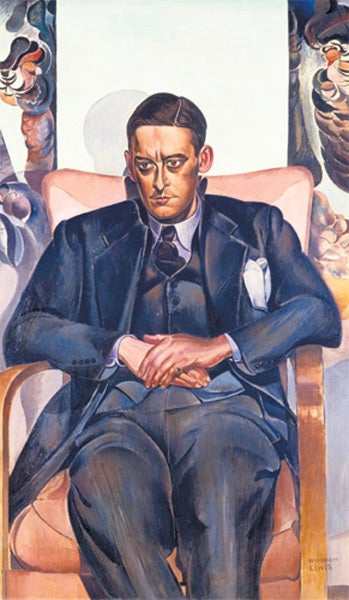
"The greatest portraitist of this or any other time", Walter Sickert once called Wyndham Lewis. Blimey. It's a rare artist-to-artist compliment, and the National Portrait Gallery makes much of it at the entrance to "Wyndham Lewis: Portraits". Not entirely wrong, though. He's certainly one of the the greatest.
This is a small but essential show, just three rooms, with 16 canvases and a lot more drawings. Lewis's portrait output was small, and almost all the key paintings are here: the portraits of his inter-war artistic contemporaries Edith Sitwell, Ezra Pound, Stephen Spender, Naomi Mitchison, with two of his wife, Froanna, and two of himself.
Crucially there's his masterpiece in the genre, the portrait of TS Eliot, which was rejected by the Royal Academy with much controversy in 1938 and hasn't been shown here for more than 25 years. Lewis's art has a history of misfortunes, often self-inflicted. He is the dominant figure in English modern art, our most inventive artist of the first half of the 20th century. But his pictorial genius was distracted by his literary talents, and stymied by his willingness to offend the small section of society that might have supported it. Luckily his work keeps on being exhibited in piecemeal bulletins, and it keeps its power to amaze.
Meeting the first work in "Wyndham Lewis: Portraits", you might wonder if he's really a portraitist at all. Mr Wyndham Lewis as a Tyro was made at the start of the 1920s. It's Lewis's earliest surviving face painting, and his most extreme. This self-portrait is more like a painted poster-cartoon. On a mustard yellow ground, a monstrous, phallic, rictus-grinning head rises before us, tightly constructed from scoops and spikes, in a violent parody of a cubistic idiom. It's clearly a character study, though, not some neutral formal variation on the human face. And it manages to be an affront to modern art, with its aversion to "human interest", and equally to the psychological sensitivities of traditional portraiture. It strikes the right opening note.
Lewis practices a kind of anti-portraiture. He doesn't believe in two things that may seem to be fundamental to this genre: flesh and sympathy. When I say "flesh", I mean everything about the body that is sensuous or frail, vivacious and mortal, the whole life-and-death drama with which Rembrandt imbues a human figure. And when I say "sympathy", I mean something that centres on the eyes and allows us to feel we're looking into them and through them and sharing in the inner life of the portrayed.
Lewis believes in individuality. His portraits are devoted to coining an image that will stand for this unique entity, make each character into a distinct pictorial creature, and give it definitive shape. It's not an accident that his most successful images are of his most strongly individuated sitters. Shape-making is one of the fortes of English art, with William Blake to the fore. But Blake has no interest in individuals. Lewis shares his shaping impulse, and is the stronger draughtsman. His portraiture casts its human subjects into shapes as archetypal as Blake's visionary images.
He is making immortals. But they can only be fashioned out of their own mortal appearances. Lewis is not in the business of painting spirits or symbols. His portraiture is rigorous in its respect for likeness. The shape he gives to the man or woman is a version of their own bodily shape.
It's a dilemma. How can the permanent and unique person be represented by the contingent and changeable body? But then, how else could it be? By some fluid and amorphous blur, some disembodied Cheshire Cat gaze? It's a dilemma we all encounter when we think of our true selves as being somehow "inner", or when we try to imagine surviving in a non-physical after-life. How to picture a soul that is you or me?
Lewis takes the dilemma by the horns. As in Blake, there is geometry – geometry, with all its implications of the essential, eternal, transcendent. Lewis's remark about "burying Euclid deep in human flesh" is often quoted. But human flesh is often a pretty shallow grave for Lewis's geometrical constructions. Arcs, ogees, ellipses, straight lines and sharp angles divide and rule the human frame. Sitwell is built from arches of gem-like bricks. The dreaming Pound is one long diagonal. The forms of body, costume and furniture interlock. The drawings of Pound and Joyce and Mitchison take this further, turning the person into a perspicuous formula of itself, or going off on marvellous analytical improvisations.
Few portraitists are so faithful to particulars. The purified forms of Brancusi's portrait-sculptures show how a subject can be sublimated into beautiful blankness. Lewis's trick is to deploy geometry at both a macroscopic and a microscopic level – to structure the whole figure, and also to characterise the detail. Look at the heads of Pound and Spender. See how each part is moulded into distinctness. Lewis's shaping picks out the arch of an eyebrow, the curl of a lip, the twist of a lock of hair, and establishes its identity.
His portraits portray every bit of a person: not only their head and hands, but their incidentals and accessories: hair, hat, collar, lapels, cuffs all get individual treatment. Hairstyles, and the cut of a suit or dress, especially inspire Lewis, probably because he saw hairdressing and tailoring as arts with affinities to his own – shape-making that renders the fallible human figure into something iconic.
All these forces come together in the great Eliot portrait of 1938. The poet is the image of a doomed man. He sits, in a three-piece suit, slumped low in his chair, staring out but diverting his gaze into the middle distance. His lamp-lit head casts a doppel-silhouette on the screen behind. His face is shaded in blacks, which read variously as shadow, five o'clock shadow, under-eye dead-tiredness, and sheer wretchedness. Everything about him is defined. There is the long curving trajectory of his jacket, the elephantine architecture of his trousers, the neat line of his hair-parting, the distinct forms of his prominent left ear.
Like the best Lewis portraits, it is somewhere between icon and caricature. And it raises questions that go deeper than truth or flattery, cruelty or sympathy. It asks what it is to be a self. It holds a lesson for our own, desperately identity-seeking, age.
Consider a caricature. It may be insulting, but it can also be experienced as empowering. Caricatures are often relished by their "victims", not only because to be caricatured is a measure of fame, but because it gives them a firm identity. It makes them a distinct individual, even if that individual is a grotesque.
The profundity of Lewis's portraiture is that it sees both sides of the question – the power and the bondage of an identity. Eliot once called Lewis "the most fascinating personality of our time". Lewis returned the compliment, giving Eliot, in this image, an inescapable identity. But if the portrait were to have a motto, it might be Eliot's famous lines from his essay "Tradition and the Individual Talent": "Poetry is not a turning loose of emotion, but an escape from emotion; it is not the expression of personality, but an escape from personality. But, of course, only those who have personality and emotions know what it means to want to escape from these things."
'Wyndham Lewis: Portraits', National Portrait Gallery, Charing Cross Road, London WC1; from 3 July to 19 October
Join our commenting forum
Join thought-provoking conversations, follow other Independent readers and see their replies
Comments