After 35,000 years, erotic art for cavemen discovered

For free real time breaking news alerts sent straight to your inbox sign up to our breaking news emails
Sign up to our free breaking news emails
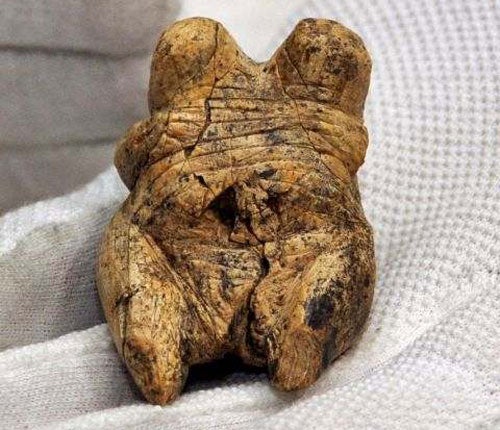
With its grotesquely exaggerated features, this could easily be the work of one of the 20th century's great figurative artists. But this voluptuous Venus was carved out of a mammoth's tusk more than 35,000 years ago.
The two-and-a-half-inch statuette was found buried 10 feet below the floor of the Hohle Fels Cave in the Schwabian region of south-west Germany, where archaeologists have already discovered a gallery of early art objects dating to the same period of the Stone Age. Carbon dating has shown that the female figurine predates other similar Venus carvings by about 5,000 years.
"This figurine was produced at least 35,000 calendar years ago, making it one of the oldest known examples of figurative art," said Nicholas Conard of the University of Tubingen, who describes the statuette in Nature. He added that it "radically changes our views of the context and meaning of the earliest Palaeolithic art".
The oldest known works of art are abstract engravings – geometric designs in red iron oxide – found at a cave site in southern Africa and dated to about 75,000 years ago. Figurative cave paintings in southern France of Stone Age animals such as bison, horses, deer and rhinos, have been dated to about 37,000 years ago.
But the Venus figurine unearthed from the cave in Germany is the oldest known statuette depicting the human form. As the earliest example of three-dimensional figurative art, it could represent the birth of true sculpture in the global artistic tradition, according to scientists who have studied the piece.
The carving was made from a solid piece of mammoth ivory and depicts a naked woman with grossly protruding breasts, swollen thighs and belly, and a greatly enlarged and explicit vulva. A disproportionately small head was probably used to hang the figurine, according to Paul Mellars, of Stony Brook University in New York.
"The figure is explicitly – and blatantly – that of a woman, with exaggerated sexual characteristics... that by 21st-century standards could be seen as bordering on the pornographic," said Dr Mellars. "As if to emphasise the sexual characteristics, the figure's arms and legs are severely reduced to the form of a carefully carved ring, evidently to allow the figure to be suspended from a string or thong."
Similar Venus figurines with exaggerated sexual features and diminutive arms and legs have been found at a range of Stone Age archaeological sites stretching from the Pyrenees to southern Russia. These examples of early figurative art have been linked with the so-called Gravettian toolmaking culture dating to 25,000-29,000 years ago.
The latest Venus figurine is also adorned with enigmatic and possibly symbolic markings in the form of repeatedly incised lines that might conceivably represent the depiction of clothing, according to Dr Mellars. Other Venus figurines from the later period also show criss-cross designs or patterns etched on to their surfaces.
"The feature of the newly discovered figure that will undoubtedly command most attention is its explicitly, almost aggressively, sexual nature, focused on the sexual characteristics of the female form," said Dr Mellars.
Europe, 35,000 years ago, was in the process of being colonised by anatomically "modern" man, Homo sapiens, who had migrated from Africa via the Middle East. This species was gradually replacing Europe's Neanderthal man, a species that had inhabited the continent for thousands of years.
Four sites in southern Germany have produced a total of 25 mammoth-ivory carvings depicting a range of animals, from mammoths and horses to bison and cave bears. "The same sites have also yielded numerous small, carved ivory beads or pendants and the world's oldest unmistakable musical instruments," said Dr Mellars. "These take the form of perforated flutes manufactured from segments of bird wing bone."
The cave paintings of southern France may be older than the Venus figurine, "but the cornucopia of small, carved ivory statuettes from the south German sites must be seen as the birthplace of true sculpture in the European artistic tradition," added Dr Mellars.
Subscribe to Independent Premium to bookmark this article
Want to bookmark your favourite articles and stories to read or reference later? Start your Independent Premium subscription today.
Join our commenting forum
Join thought-provoking conversations, follow other Independent readers and see their replies