Art for the young at heart
The Tate's first interactive exhibition is back – 40 years after injuries forced its closure. Chris Green reports
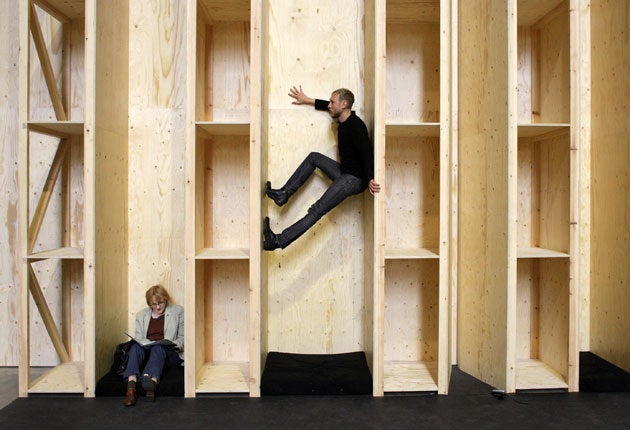
In 1971, the first interactive artwork ever hosted at the Tate Gallery (now Tate Britain) was closed within five days after 16 people were injured by, in the director's words, the "exuberant and overexcited behaviour of some members of the audience".
The British public's enthusiastic and occasionally destructive reaction to the exhibition astounded its creator, the American artist Robert Morris, who was convinced his maze of wooden ramps, tunnels and see-saws would fail to engage people.
Yesterday, Britons were once again invited to throw themselves into Morris's work – provided they followed a new set of health and safety guidelines – as an identical recreation of his original exhibition was unveiled in the cavernous surroundings of the Tate Modern's Turbine Hall.
Thirty-eight years ago, women had to have splinters from the rough plywood surfaces extracted from their bottoms, and newspapers reported an "intoxicated" public "jumping and screaming" around the neo-classical splendour of the Tate's Duveen Sculpture Galleries.
Yesterday though, the organisers were taking no chances. As the first visitors arrived, they were greeted with a sign instructing them to wear "sensible footwear" and refrain from running. "Visitors under the influence of drugs or alcohol are not allowed to participate," it warned.
Despite the new regulations, and the occasional intervention of red-shirted gallery assistants – "only four people at a time, please" – a motley array of families, tourists and art students were soon tackling the exhibits with gusto, rolling back and forth in a giant wooden tube, balancing with varying degrees of success on a wire tightrope and clambering over the steep ramps.
"I just saw a woman try to walk up a ramp in high heels," said Greg Stevenson, 47, from New York. "It's kind of a cross between a playground and art, but today's audience seems a lot more peaceful than they were in the 1970s. I think art's become more accessible since then – you wouldn't have seen kids here 25 years ago."
The exhibition, entitled Bodyspacemotionthings, does indeed feel like a glorified creche at times. Along one wall, a woman is seen calling to her young daughter, who has managed to shimmy up between two wooden blocks until she is 10 feet off the ground. "That's enough showing off – now how are you going to get down?" she demands.
Although people have had four decades to get accustomed to the joys of interactive art – Carsten Höller's slides in the Turbine Hall in 2006 proved to be one of the gallery's most popular shows – Morris's piece, which forms part of the Tate's four-day Long Weekend festival, does not feel dated.
"I think it still retains its edge and its resonance," said Kathy Noble, the exhibition's assistant curator. "Most people who have come in started off being quite reticent. Even I wasn't sure how it would work, and once I went on a few things it was actually quite daunting."
In one corner, Amy Lineham and Millie Mulvey, a pair of 15-year-old GCSE art students, sit cross-legged hugging sketch pads. Both have already been told off for climbing up a ramp with their school bags, and Millie has already managed to skin her wrist sliding down one of the tunnels.
"Health and safety can become restrictive, and if it got any more than it is now I don't think you'd be able to enjoy yourself," said Amy. "But as it is, it's quite subtle."
Join our commenting forum
Join thought-provoking conversations, follow other Independent readers and see their replies
Comments