How the Tate made a £1bn mistake over Rothko
When the artist offered 30 paintings to the Tate, trustees feared he would want them hung permanently, Arifa Akbar writes
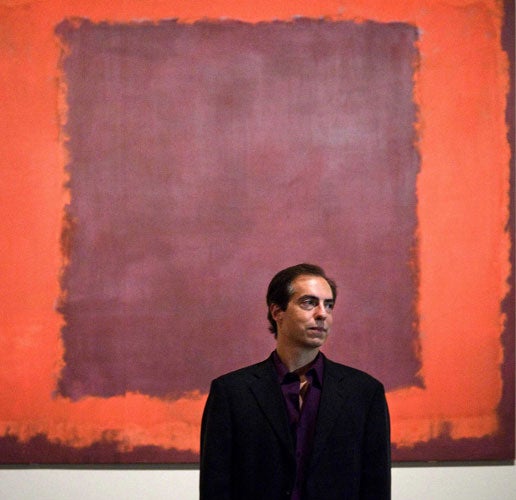
Mark Rothko, the late American painter whose work commands multimillion-pound prices, offered Tate Gallery a gift of 30 paintings which was not accepted because trustees feared he would expect to see them on permanent display.
An investigation into Tate's archives reveals how the generous 1967 offer included work from the artist's 1961 retrospective at New York's Museum of Modern Art and his mural paintings from 1958. If the Tate had accepted the work, it would most likely be worth $1bn in the current art market.
The Tate's then director, Norman Reid, who became friends with the artist after visiting his studio in October 1965, eventually accepted nine of the 30 paintings by Rothko, who was known to be particular about where his work was hung. The offer included pieces from his commission in 1958 to create a series of mural paintings for New York's Four Seasons restaurant. But Rothko pulled out of that project after he deemed the restaurant as "a place where the richest bastards of New York will come to feed and show off".
The nine works gifted to Tate led to the creation of the gallery's "Rothko Room", which is one of the most popular visitor spaces. Tate Modern is running a special exhibition of Rothko's work, which further illustrates its enduring public appeal.
The investigation by The Art Newspaper also reveals that, according to Reid's notes, the artist had pledged to donate other works over the years before his suicide in 1970.
Reid, who died last December aged 91, wrote: "Over the years, his paintings became darker and darker in tone and he seemed pleased when I told him I liked the dark ones. 'If this room is a success', he said, 'I will give you another room of the light ones'." The original suggestion of a gift seemed to falter in August 1966, when Rothko made a visit to London to speak to Reid. Rothko felt that Tate trustees avoided discussing his offer in detail and he returned to New York feeling slighted. He wrote to Reid: "Your complete personal neglect of my presence in London and your failure to provide adequate opportunities for these discussions posed for me the following question: was this simply a typical demonstration of tradition English hospitality, or was it your way of indicating to me that you were no longer interested in these negotiations?"
Reid composed a masterful reply to soothe his ego, which pointed out that only Turner, Picasso and Matisse had dedicated rooms at the gallery, an argument which won over the artist. It was shortly after this letter, in February 1967, that Rothko offered to give Tate a total of 30 works, with up to 10 paintings coming as an immediate gift and the remainder as an irrevocable bequest.
But trustees feared the artist would expect all the works to be hung permanently, so they accepted nine because they could easily be displayed in one room. Reid later recalled in a private note: "He [Rothko] touched on the possibility of giving all the paintings to the Tate but my trustees thought this would raise considerable problems so we stayed with the idea of a single room."
Eight of the nine paintings were then valued at $330,000, a hefty sum at the time. Today, their price would be higher, especially in light of the auction records his paintings have set and broken. In November 2005, Homage to Matisse, painted in 1953, broke the record selling price of any post-war paint ing at auction at $22.5m. In May 2007, his 1950 painting White Center (Yellow, Pink and Lavender on Rose), broke this record again, selling at $72.8m.
Rothko's gift to Tate arrived on the same day as Rothko took his own life, 25 February, 1970. A spokeswoman for the Tate said that the gallery had never "formally" turned down the offer of 30 paintings. Discussions had moved on to a more "focused" gift of nine paintings which could be displayed in a dedicated room.
The reject list: Sensational art that failed to impress
* In 1921, the Tate Gallery rejected Cézanne's Mountains in Provence.
* The Queen Mother is said to have turned down Walter Sickert's A Conversation Piece at Aintree in 1939 but she bought it for the Royal Collection in 1951.
* The artist Tom Wood's portrait of the playwright Alan Bennett vacuuming was rejected by the National Portrait Gallery in 1992 and a second, more flattering portrait was accepted.
* The New Adam, a nine-panel painting by Harold Stevenson long considered to be one of the great American nudes, was made for a 1962 show of Pop Art at the Guggenheim. But when the show's curator, Lawrence Alloway, saw the work he apparently "went into shock" and removed it.
* MoMA in New York is also believed to have rejected Mark Rothko's offer of 30 paintings in the 1960s.
* In 2000, The Louvre reportedly refused to exhibit Damien Hirst's shark in a show because it was said to be decaying.
Join our commenting forum
Join thought-provoking conversations, follow other Independent readers and see their replies
Comments
Bookmark popover
Removed from bookmarks