Naked displays of nationalism at opening of Venice Biennale
Steve McQueen makes waves as Britain's representative at arts festival
Ever since the Venice Biennale was launched more than a century ago it has become the world championships of the art world, with purpose-made pavilions built by nations to showcase their best works in a bid to win the top prize, the Golden Lion.
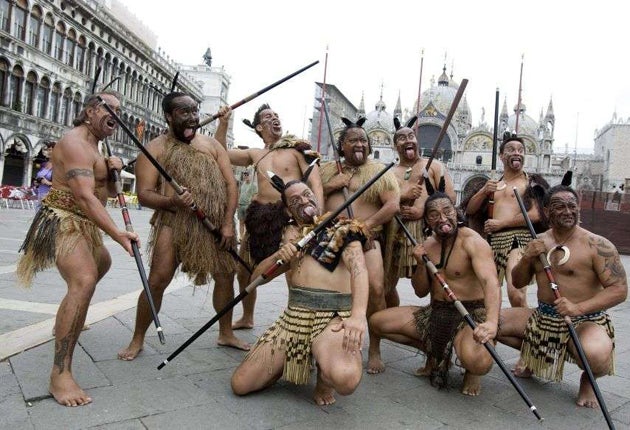
Yesterday, the most nationalistic art competition was back in town with a bang; the Danish pavilion was a gay haven filled with pretty men, graphic pornography and a mocked body of a middle-aged art collector floating face down in a swimming pool outside; The French had transformed theirs into a giant prison cell with flags; the Germans had filled theirs with kitchen furniture and a cat sitting on the top (courtesy of the British artist, Liam Gillick), while the New Zealand pavilion was opened by a Maori tribe replete with menacing grimaces and warrior attire.
But Steve McQueen, 40, the artist and award-winning film-maker representing Britain for the Biennale, which is administered by the British Council, offered the public a glimpse of the seedier side of the central garden where the competition has taken place since 1895.
In his 40-minute film shot in the middle of winter, called Giardini, McQueen depicts the Venetian gardens – normally awash with the glamour and glitz of cutting-edge art – as it is when the Biennale is not in town.
It depicts a derelict wilderness with abandoned buildings, scavenging dogs, overgrown fauna and a possible gay 'cruising' hang-out by night. McQueen said he wanted to show the other side of the Giardini, especially its illicit, nocturnal "happenings".
"When you go back in the winter, the Biennale site is like an abandoned graveyard. It's a parallel existence ... with its nocturnal happenings, maybe its drug dealing, and the other illicit things that happen in a public space," he said.
His film captures the American pavilion as a shabby looking building with its fire alarm going off, while he filmed scavenging dogs outside the Israeli pavilion and a gay cruise ship.
In showing this dark side of the biennale, McQueen said he wanted to explore the idea of nationalism that abounds in the biennale as 77 nations vye for the top prize.
He said of his filming of the American pavilion, which yesterday unveiled sculptures of disembodied heads and hands by Bruce Nauman: "[In the film] the American pavilion looks like a real façade, it was not particularly solid, it had boarded windows, there was a siren going off. It was derelict. But see it now (at the biennale) and its all new and shiny," he said.
But he denied the film was an outright attack on nationalism. "These lines are always blurred. The idea of nationalism is imposed on us. At certain moments, these lines are blurred, and sometimes they don't exist."
This is the first film McQueen has made since he won the Camera d'Or at the Cannes Film Festival last year – one of the film festival's biggest prizes for a debut feature film. The film, Hunger, was about the IRA hunger striker, Bobby Sands.
His work created one of the biggest waves at the biennale along with the Danish offering. This year, countries offering up their first shows are the United Arab Emirates, Afghanistan and Pakistan.
For more information, see www.britishcouncil.org/venicebiennale
Join our commenting forum
Join thought-provoking conversations, follow other Independent readers and see their replies
Comments
Bookmark popover
Removed from bookmarks