On sale: the last work by a contented Van Gogh
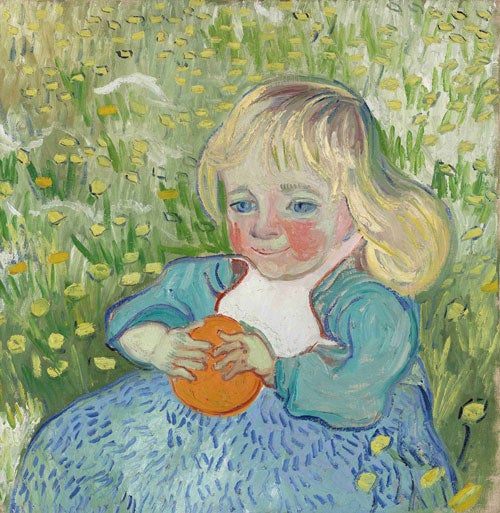
In the final weeks of his troubled life, Vincent Van Gogh swung between emotional extremes. Lengthy periods of tortuous depression were punctuated by bursts of joy and creativity. The result, notably different in tone from the angst-ridden material he produced immediately before his suicide, was a set of child portraits that radiate the optimism and purity of youth.
Now, for the first time in more than 90 years, one of the most acclaimed of these works is to go on sale. L'Enfant à l'Orange (The Child with an Orange), a painting inspired by Van Gogh's fascination with a child who lived near his inn in the village of Auvers-sur-Oises, will be offered at the European Fine Art Fair in Maastricht next month for £15.3m. It has been placed on the market by the Swiss couple, Arthur and Hedy Hahnloser, who bought it in 1916.
The portrait of Raoul Levert, the baby son of a local carpenter, was painted at the end of June 1890 at the Auberge Ravoux, where he had been a lodger. It marked the artist's short-lived period of contentment before depression and mental illness led him to shoot himself in the chest in July of that year.
Just before Van Gogh moved to Auvers in May 1890 after a year in a mental hospital in St Remy, near Arles, he spent several days with his brother, Theo, sister-in-law, Johanna, and their son, Vincent, named after his uncle, in Paris.
Theo and Johanna were surprised by how well he appeared and Johanna later recalled: " I had expected a sick man but here was a sturdy, broad-shouldered man, with a healthy colour, a smile on his face and a very resolute appearance."
After moving to Auvers, the village's picturesque charm and his pleasure at having seen his baby nephew proved to be the catalyst for a sudden explosion of artistic energy in the last few weeks of his life.
Van Gogh was ecstatic at being in this new environment. While there, he wrote: "Here one is far away from Paris for it to be the real country, but nevertheless how changed it is ... but not in an unpleasant way, there are many villas and various modern middle-class dwellings, very radiant and sunny and covered with flowers. And that, in an almost luxuriant region just at this time, when a new society is developing within the air, is not at all disagreeable: there is a lot of well-being in the air."
In the 70 days that Van Gogh was in the village, he frenetically painted more than 80 works. On 5 June he wrote to his sister, Wilhelmina, about his passion for the "modern portrait", saying: "What impassions me most – much, much more than all the rest of my metier – is the portrait, the modern portrait."
The portraits he worked on during these last weeks included several pictures of children inspired by his affection for the young Vincent, although he had become convinced that living in Paris was undermining the boy's health and so portrayed the country youngsters in his last portraits as happy, rosy-cheeked children who were testaments to the benefits of rural life.
James Roundell, a director at Dickinson's art dealers, which is representing the sale, said the painting was among a series of "vibrantly alive and joyful portraits" which he undertook in the last month of his life.
"The characteristically energetic brushwork and the rich colour scheme imbues the picture with a joie de vivre which does not hint at the tragedy which was to follow. Van Gogh, content and happy to be once more in the north, exulted in the landscape and the inhabitants of Auvers," he said.
Raoul Levert, the two- year-old son of Vincent Levert, is shown wearing the traditional child's smock of the time in L'Enfant à l'Orange, with a broad smile in soft and vibrant colours. The identity of the child was confirmed by the late Adeline Ravoux, the daughter of the innkeeper, who was photographed standing next to Raoul outside the Auberge Ravoux in 1890.
Van Gogh became close to the Levert family. The carpenter was believed to have made wooden stretching frames for his paintings, perhaps including this one.
The artist's interest in his nephew was an almost constant theme of his letters and his brother's visit to Auvers in June doubtless stimulated his desire to paint young children. Johanna said of the visit: "Vincent came to meet us at the train, and he bought a bird's nest as a plaything for his little nephew and namesake. He insisted on carrying the baby himself and had no rest until he had shown him all the animals in the doctor's yard... Vincent was planning to do a portrait of Gachet's daughter."
After Van Gogh's death, his body was placed in a decorated room at the Auberge Ravoux in a tribute by local people. Remembering the village commemoration shortly before her death, Mme Ravoux said: "Theo had placed all around canvases that Vincent had left there: The Church of Auvers, Irises, The Child with an Orange... At the foot of his coffin his palette and brushes were laid out. Our neighbour, M. Levert, the carpenter, lent the trestles. The child of this latter, two years old, had been painted by Van Gogh in the painting, The Child with an Orange. It was also M. Levert who made the coffin."
Inside the artist's tortured mind
Though it remains unclear precisely from what type of depressive medical condition Van Gogh suffered what is known is that his work was a window into his troubled life. As an Expressionist, his moods were frequently portrayed in his artworks, which he used to "rise again". Writing to his beloved brother Theo, the artist said: "Well, even in that deep misery I felt my energy revive, and I said to myself: in spite of everything I shall rise again, I will take up my pencil". Several paintings depict Van Gogh's frequent bouts of despair, including Starry Night Over The Rhone, above, marked by dark colours and flickers of light. Van Gogh's mood is believed to have gradually declined after moving to Paris in 1886 at the age of 33, and mingled with the artistic elites. He had an exceptionally delicate nervous system, not helped by excessive drinking of absinth, pipe-smoking and a bad diet which occasionally even included tasting his own paints.
Psychologists who have studied Van Gogh's works believe that he plunged into depression after perceived threats to the difficult but loving relationships with those to whom he was closest, several of which revolved around Theo, whose marriage the artist saw as a threat.
Join our commenting forum
Join thought-provoking conversations, follow other Independent readers and see their replies
Comments