Shot down - Capa's classic image of war
For decades the authenticity of these classic Spanish Civil War photographs has been debated. But a new study claims to have settled the argument
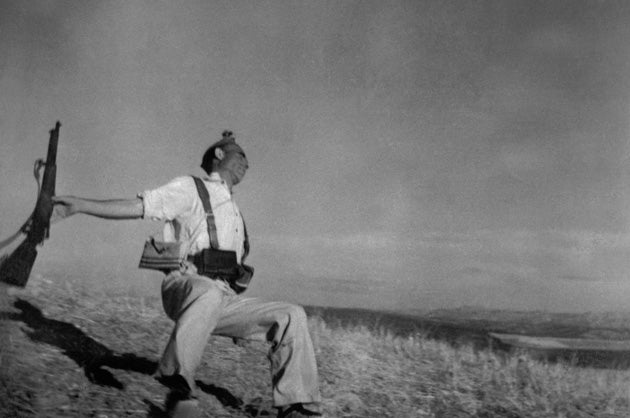
The photograph of a soldier falling to his death after being shot on a grassy hillside is probably the best known image of the Spanish Civil War, the photographer hailed as the founder of modern photojournalism.
But the authenticity of Robert Capa's dramatic photo has been repeatedly disputed since it appeared in September 1936, with regular efforts made to establish exactly where it was taken, and of whom.
New evidence revealed this week suggests that the young Hungarian hailed as one of the world's finest war photographers may have staged his classic picture after all.
The so-called "falling soldier" was not photographed near Cerro Muriano in Andalusia, as has been claimed, but about 50km to the south-west, near the town of Espejo far from the frontline on a day when there was no military action, a Catalan newspaper claims.
"Capa photographed his soldier at a location where there was no fighting," wrote the daily El Periodico on Friday. The paper carried out a detailed study of Capa's pictures taken in September 1936, three months after the conflict broke out.
"The real location, some 10km from an inactive battle front, demonstrates that the death was not real," the paper says.
The claim is backed with photos taken very recently on a hillside near Espejo that show a mountainous skyline that appears to match exactly that of Capa's photo. The background to the falling soldier never pointed conclusively to its location. The key to unlocking the decades-long mystery rather lies in two other photos taken by Capa in the same series, which is currently on show in Barcelona.
One shows a militiaman lying on the ground, and the next, a line of kneeling soldiers aiming rifles. The background landscape threads continuously across the three photographs, and this is the skyline echoed in the new photos. Capa's photos purport to show movements of a group of young milicianos in action against Franco's troops who rebelled against Spain's republic. "But the location proves beyond reasonable doubt that the sequence was a flagrant fake, a setup," Ernst Alos, who wrote the report, told The Independent yesterday.
The Capa photos form part of the acclaimed exhibition "This is War" that opened recently in Barcelona, having travelled from New York and more recently from London.
There was fighting in Espejo only on 22 and 25 September, nearly three weeks after Capa and his companion Gerda Taro had left Cerro Muriano. The photo of the falling soldier had by then appeared in the French magazine Vu. Franco's troops were at least 15 miles away, in Montilla, near Cordoba, and the hillside in the shot faced areas still under republican control, Mr Alos said.
It seems "unlikely" that those in the photo could have received enemy bullets, especially since no deaths or injuries were reported by combatants there until the end of September. That would scotch the theory ventured by Capa's biographer, Richard Whelan, that militiamen on manoeuvres were "playing around" for the camera, and were picked off by a sniper.
A resident of Espejo, who was nine in 1936, offers a damning reminiscence: "Not a shot was fired around here until the end of September... The militiamen strolled around the streets and ate the best hams in the village," Francisco Castro, 82, recalled. Capa built his reputation as a fearless war photographer by putting into practice his maxim: "If the photo isn't good enough, it's because you're not close enough." The motto has inspired generations of young admirers to pursue the definitive image of conflict.
Before going to Spain, he changed his name from Endre Friedmann, and went on to cover historic moments of war in China, Tunisia, Italy, France, Germany and Israel before he fatally stepped on a landmine in Indo-China in 1954.
This week's Catalan whistleblower denies trying to destroy Capa's reputation. The Spanish Civil War marked his debut as a young freelancer, El Periodico says in an editorial: "It's possible that this novice of 22 needed to sell the material from the first conflict he portrayed." His "youthful peccadillo" was more than cancelled out by countless authentic photos for which he risked, and eventually lost, his life, the paper says.
A suitcase containing thousands of Capa's photographs of the civil war reappeared in Mexico recently after being lost for 70 years. The collection had been taken from Nazi-occupied Paris to Mexico by a diplomat in 1940. Capa fled France in 1939, leaving the contents of his darkroom behind, and always assumed all his work, including the suitcase, was destroyed.
But after protracted negotiations the flimsy cardboard case was acquired last year by New York's International Centre of Photography, founded by Capa's younger brother Cornell. The Mexican suitcase included previously unknown images of the Spanish war, some of which appear in the Barcelona exhibition. But they date from 1937 and focus on the conflict's closing stages. Researchers were disappointed to find that none formed part of the "falling soldier" sequence.
Cynthia Young, a curator of the latest exhibition, and of the ICP, says: "The ICP is open to new interpretations." And she agrees the three crucial Capa photographs, two of which were found in the centre's archives, were taken in the same place.
But she remains unconvinced of the case for Espejo: "It is an interesting comparison. I see a few hills that could replicate that, but I am not sure. We are anyway still left with an extraordinary photograph."
The critics: What they said
"To insist upon knowing whether the photograph actually shows a man at the moment he has been hit by a bullet is both morbid and trivializing, for the picture's greatness ultimately lies in its symbolic implications, not in its literal accuracy as a report on the death of a particular man." - Richard Whelan, Capa biographer
"It is irresponsible and itself trivializing [to say that the true story behind the photo does not matter]. Would the photograph really have effectively, affectively, the same symbolic implications if Capa had hired an actor for his shot?... We take the force of it because we take the photographer's word for it." - Christopher Ricks, cultural critic
"The Falling Soldier, authentic or fake, is ultimately a record of Capa's political bias and idealism... Indeed, Capa would soon come to experience the brutalizing insanity and death of illusions that all witnesses who get close enough to the 'romance' of war inevitably confront." - Alex Kershaw, Capa biographer
"If these photos were posed, Capa would hardly have been the first or the last photographer who sought to improve reality in the interest of achieving the perfect image... Surely, though, at least the more famous Falling Soldier could, after all, be simply be that – a picture of a soldier who, in the course of charging or pretending to charge out of his sheltering trench, happened to slip and fall?" - Bunny Smedley, critic
"His most famous photograph shows a Spanish Loyalist partisan, gun in hand, caught in the very moment of dying; it became the iconic war, and antiwar, image of the 20th century. Yet Capa was a war photographer who was not primarily interested in atrocity, physical torment, or death. What did he show instead?... Men who view war as a grievous necessity rather than a splendid adventure." - Susie Linfield, critic
Join our commenting forum
Join thought-provoking conversations, follow other Independent readers and see their replies
Comments
Bookmark popover
Removed from bookmarks