The portrait that Van Gogh did not want the world to see

For free real time breaking news alerts sent straight to your inbox sign up to our breaking news emails
Sign up to our free breaking news emails
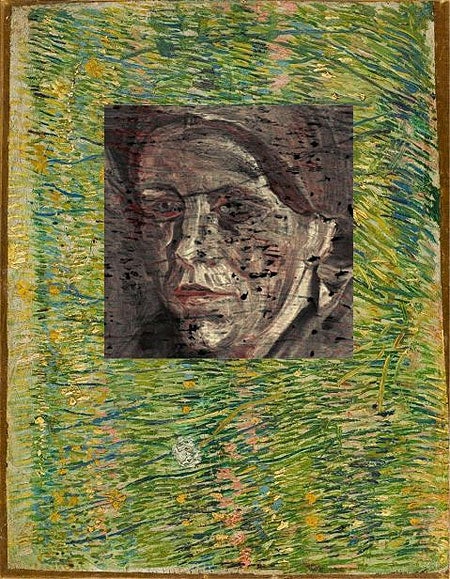
For more than 120 years, the image of the peasant woman lay undiscovered. Her creator, the Dutch master Vincent van Gogh, must have assumed she would be hidden forever.
However, now a remarkable new X-ray technique, using a particle accelerator, has recovered her image – which Van Gogh painted over with his 1887 landscape Patch of Grass – in remarkable detail. An international group of scientists applied the process, known as "X-ray fluorescence spectroscopy", for the first time ever on a painting to recover the original portrait.
Art researchers had previously been aware of the woman's existence. However, the technological limitations of existing methods, including standard X-ray and infrared, meant that only the outlines of the head could be detected.
The new technique can differentiate between the colour pigments, revealing not only the strokes but the original colours used.
Van Gogh's need to recycle his canvases because of poverty has led scholars to believe there are other similar hidden examples of his work: experts estimate that around one third of his works were painted over.
The scientists, introducing the study in yesterday's Analytical Chemistry journal, said: "Van Gogh would often re-use the canvas of an abandoned painting and paint a new or modified composition on top... Our approach literally opens up new vistas in the non-destructive study of hidden paint layers, which applies to the oeuvre of Van Gogh in particular and to old master paintings in general."
They added: "These hidden paintings offer a unique and intimate insight into the genesis of his works. Yet current museum-based imaging tools are unable to properly visualise many of these hidden images."
In order to reveal the underlying peasant, the team – led by Professor Koen Janssens from the University of Antwerp and Dr Joris Dik from Delft University of Technology – used a particle accelerator to stimulate the atoms on the canvas. These then produced their own X-rays, with each element having its own distinctive signature, which were picked up by a florescence detector. The scan took two days, despite the small area of the canvas taken up by the portrait.
The scientists could create a 3D image of the different chemicals used in each of the layers, which were then separated and stripped away in a computer model. The analysis showed that one such layer was solely lead, which was used as a primer so that the canvas could be used again.
In order to reconstruct the colour, scientists used the distribution of antimony and mercury to "colour in" the image. Antimony, when heated with lead, makes the pigment "Naples yellow" which appears to have been used for the lighter areas.
The portrait itself resembles a series of pieces painted by Van Gogh while he lived in the Dutch town of Nuenen. The most famous of his works from the period was his 1885 painting The Potato Eaters. By the time Van Gogh painted Patch of Grass two and a half years later he had moved to Paris, and was becoming more and more influenced by the impressionist style.
The painting is owned by the Kroller-Muller Museum in the Netherlands.
Hidden works of art
Henry Wriothesley, 3rd Earl of Southampton
Art historians from Bristol University uncovered a painting of William Shakespeare's only known patron, Henry Wriothesley, right, by an unknown artist under a portrait of his wife, Elizabeth Vernon, a maid to Queen Elizabeth I.
Arthur Streeton
Last year Australian art experts found a nude female figure and the words "Florry Walker's my sweetheart" under a painting by one of the country's most famous artists, Arthur Streeton. The gallery managed to find family of the woman who confirmed that there had been a romance.
Banksy
Banksy's work may provide similar discoveries for art historians in the future. Last month a stencil in north London of two girls with a Kalashnikov was whitewashed by the local council, while his mural of an Israeli soldier checking a donkey's ID papers in Bethlehem was painted over by locals.
Subscribe to Independent Premium to bookmark this article
Want to bookmark your favourite articles and stories to read or reference later? Start your Independent Premium subscription today.
Join our commenting forum
Join thought-provoking conversations, follow other Independent readers and see their replies