Villagers campaign against Kent's giant white horse
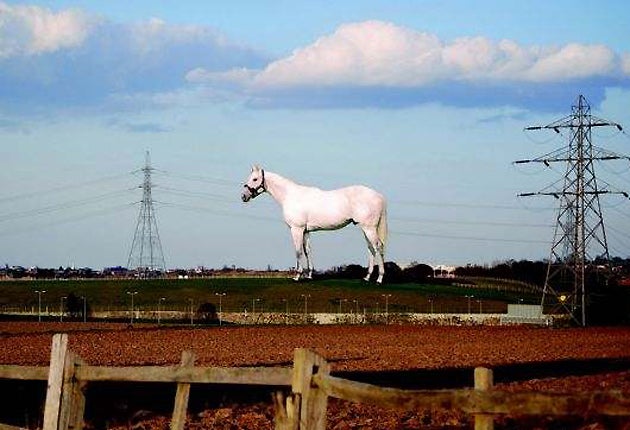
When a vast white horse as tall as Nelson’s Column was unveiled a year ago as the art work chosen to become England’s “Angel of the South”, critics eulogised the boldness and beauty of the gargantuan sculpture to be placed on a scrubby Kent hillside towering over the ancient route between London and Dover.
Unfortunately, the magisterial grace of Turner Prize-winning artist Mike Wallinger’s winning design is lost on a significant number of those who, rather than casting an admiring glance as they slip past the huge concrete and steel equine en route to continental Europe via road and rail, will instead live permanently within its gaze.
The planning application for the White Horse, which will sit at Ebbsfleet beside the A2 trunk road and the Eurostar high speed line to the Channel Tunnel, was submitted this week and was seized upon by a growing number of local detractors who hope to stop the scheme – one of the biggest public art schemes in the world – when it is debated by Gravesham Borough Council in March.
The horse, which at 50m in height is 33 times the size of a normal horse, was chosen last February by a panel of experts from five designs by leading artists. A rearing white horse is the county's emblem and the design was chosen to symbolise Kent’s identity as the “gateway to England”. The statue will be visible from 20 miles away and is regarded as the south’s version of the Angel of the Northbeside the A1 in Gateshead.
But while the Wallinger project found favour among commentators, residents in the two north Kent villages that will be overlooked by the statue – Swanscombe and Northfleet – complain that it has little or no significance to the area and promised a campaign for a replacement.
Bryan Read, secretary of the Swanscombe and Greenhithe Residents Association, told The Independent: “The horse would not have been the choice of anyone living locally. The problem is that this is an art work that is supposed to represent this part of Kent and what has been chosen doesn’t really mean anything to anyone here.
“We are now in the planning process. This is the opportunity for people to come forward to express their discontent and I believe they will in large numbers. I just wish they’d thought a bit harder about the history of the area. The local symbol is a Viking longboat. Why don’t we have one of those on the hill?”
John Hayes, a councillor and the mayor of Swanscombe, added: “A lot of people feel it doesn’t depict Kent at all. It just looks a nag running in the 3.30 at Kempton.”
The discontent will be a blow to the company behind the project, which is backed by Eurostar, London & Continental Railways, which operates the High Speed One railway line to the Channel tunnel, and Land Securities, the property giant which is building a new development in the Ebbsfleet Valley adjacent to the site of the White Horse.
The statue was chosen after a consultation exercise with local historians and an exhibition in the nearby Bluewater shopping centre. A spokesman for the project, which is as yet unfunded and will exceed its initial cost estimate of £2m, said: “The decision will be made by the planning authority. The White Horse will generate debate and that is a good thing. As with the Angel of the North, we hope people will learn to love it over time.”
The location of the horse next to the ancient Roman road, Watling Street, that was used for centuries by horse-borne traders and pilgrims is held up by supporters as proof of a tangible link with Kent’s past.Wallinger, who part-owns a racehorse and whose work is suffused with equine themes, said: “The horse is the work of continuous collaboration between man and nature. It is beautiful. And if the scale makes it uncanny, perhaps this is because it is also something quite plain and simple – a horse in a field.”
All of which may of little comfort to one Northfleet resident whose home will overlook the statue. He said: “I don’t call looking out of my window at a horse’s backside a thing of beauty.”
Join our commenting forum
Join thought-provoking conversations, follow other Independent readers and see their replies
Comments