A century of blasting and blessing: The history of hectoring
For the past 100 years, artists and writers have launched manifestos to sell new ideas and kill the old. Did they change the world, or make a noise? Alex Danchev looks at the history of hectoring
NO MORE WORDS. No more manifestos," runs a Dada manifesto. Artists' manifestos are nothing if not contrary. The Dadaists bottled this spirit; indeed, they patented it. "DADA MEANS NOTHING," explained Tristan Tzara, capo and impresario of the movement, in the Dada Manifesto of 1918. "I write a manifesto and I want nothing, yet I say certain things, and in principle I am against manifestos, as I am also against principles (half-pints to measure the moral value of every phrase too too convenient; approximation was invented by the Impressionists). I write this manifesto to show that people can perform contrary actions together while taking one fresh gulp of air; I am against action; for continuous contradiction, for affirmation too, I am neither for nor against and I do not explain because I hate common sense."
In his autobiography, written at the age of 27, Tzara dramatised his own unreliable character, bad faith, depressive morbidity and "melancholy thirst". He had a way with words, and the right combination of the imperious, the splendiferous and the vainglorious. He was a manifesto virtuoso. His Dada Manifesto is a kind of meta-manifesto. "To put out a manifesto," it begins, "you must want:"
"ABC to fulminate against 1, 2, 3 to fly into a rage and sharpen your wings to conquer and disseminate little abcs and big abcs, to sign, shout, swear, to organize prose into a form of absolute and irrefutable evidence, to prove your non plus ultra and maintain that novelty resembles life just as the latest appearance of some whore proves the essence of God. His existence was previously proved by the accordion, the landscape, the wheedling word. To impose your ABC is a natural thing – hence deplorable. Everybody does it in the form of crystalbluffmadonna, monetary system, pharmaceutical product, or a bare leg advertising the ardent sterile spring. The love of novelty is the cross of sympathy, demonstrates a naive je m'en foutisme, it is a transitory, positive sign without a cause."
Here is encapsulated much of the manifesto-mania of the modern age – an age in which the artists' manifesto became a new craze, effectively a new genre, a continuation of art by other means. To manifesto was to slip the bounds of convention, tradition, decorum; to break free of the rules of spelling and syntax, sense and sensibility. Tzara caught that wave. In the stew of the sacred and the profane, the nonsense words and the non-sequiturs, the messianic strain and the delirio-critical synthesis (as Salvador Dalí used to say), there is already a soupçon of Surrealism.
When André Breton produced the first Manifesto of Surrealism six years later, in 1924, he took his cue from a line in Lautréamont which describes a young boy "as beautiful as the chance meeting of an umbrella and a sewing machine upon a dissecting table". After that, all bets were off. "Beauty will be CONVULSIVE or it will not be," announced Breton.
Beauty turned out be a fur cup, a lobster telephone, a four-legged doll. The Surrealists were at once transcendental and tribal. They liked to assert their "complete non-conformism", but their leader was a strict disciplinarian. It is no accident that Breton was dubbed the Pope of Surrealism.
The enlightened few performed acts of ABSOLUTE SURREALISM, in Breton's parlance; the rest were excommunicated. His message was a potent mix of mysticism and my gang. "Surrealism is the 'invisible ray' which will one day enable us to win over our opponents. 'You are no longer trembling, carcass.' This summer the roses are blue; the wood is of glass. The earth, draped in its verdant cloak, makes as little impression upon me as a ghost. It is living and ceasing to live that are imaginary solutions. Existence is elsewhere."
The art movements of the avant-garde were all profoundly sectarian. The Futurists, the Dadaists, the Surrealists, their brothers and sisters and splinters – the Cerebrists, the Vorticists, the Suprematists, the Creationists, the Instantanists, the Constructivists, the Destructivists, the Purists, the Everythingists, the Rayonists, the Dimensionists, the Concretists, the Stridentists, the Inventionists and the Situationists, to mention only a few – all used the manifesto to stake their claim. Typically, this meant an assertion of primacy, originality, and fecundity unmatched in the annals of human history, together with a scathing dismissal of the opposition, past and present, to be regarded as crapulent, decadent and obsolescent, if not already defunct.
The template for this procedure is the founding Manifesto of Futurism (1909), written by the irrepressible FT Marinetti. Marinetti was not an artist, but he was a figure. The pioneers of Dadaism (the next big thing) were full of admiration for Apollinaire, Kandinsky and Marinetti as "the greatest figures in modern art". For all his Fascist fellow-travelling and light-fingered borrowing, he was a true original. Not only did he instigate something that could credibly be called an artistic movement. As mobiliser, organiser and proselytiser, he was as important in the history of European modernism as Trotsky in the history of the Russian Revolution.
For Marinetti, the secret of the successful manifesto lay in its violence and its precision, to which we can add its eloquence – sometimes its bombast – and its wit. The art of making manifestos, as he put it, required a certain rigour, a verve (or perhaps a nerve), and a sense of style, or form, analogous to the work of art itself.
Futurist manifestos may indeed outdo Futurist paintings. The founding manifesto continues to provoke. "Futurism, as preached by Marinetti, is largely Impressionism up-to-date," responded Wyndham Lewis, witheringly, in his journal BLAST. "To this is added his Automobilism and his Nietzsche stunt." That was good, but it was not convincing. "The Futurist is dead," cried Tzara, with more force. "Of what? Of DADA."
"Dada" did mean something after all – something different – in French, German, Italian, Romanian and Russian. It is a found word, like a found object, found in a dictionary but free of any particular association or prescriptive meaning. It is also a nonsense word. It very utterance makes the point: dada is almost infantile; it is syllabically unserious.
It is in fact the perfect appellation for the anarchic, eclectic, transgressive performance that it became. Dada made a spectacle of itself: a kind of stand-up comedy. Cabaret Voltaire, Dada-central, was dedicated to "artistic entertainment" – "our kind of Candide against the times", said its founder Hugo Ball, in 1916, in a reference to Voltaire's celebrated satire ("If this is the best of all possible worlds, then what must the others be like?").
In the shadow of Verdun, Dada dared to imagine all possible worlds, fantastically. This was at the same time a revolutionary and a variety act: in Dada, everything goes. The Dada drummer Richard Huelsenbeck read a "declaration" sending up the The Communist Manifesto (1848), the ur-manifesto of the modern age. It proposed to replace the famous slogan "WORKERS OF THE WORLD, UNITE!" with "WORKERS OF THE WORLD, GO DADA!"
"For my generation," reflects Andrei Codrescu (born 1946), author of The Post-Human Dada Guide, "Dada became a way of life" – the DADA-DNA of life. Something of the same held true for Futurism and Surrealism. The manifestos of these movements were important documents: proofs of identity, declarations of principles, cards in the game, outlines of mental worlds, glimpses of utopia – passports to the Promised Land.
What of their successors? One hundred years to the day after the founding manifesto of Futurism was splashed across the front page of Le Figaro, The Founding Manifesto and Rules of The Other Muswell Hill Stuckists was published online. As their moniker might suggest, The Other Muswell Hill Stuckists have a sense of humour.
They believe in painting, as opposed to conceptual art. "Running is not art. Scrunching up a sheet of paper into a ball is not art. Sticking blu-tack on the wall is not art. People who think it is need to get out more."
If Damien Hirst's dead sheep is truly the Stuckist bête noire, Tracey Emin's unmade bed runs it a close second. The Stuckists mobilised against the Young British Artists ("YBA means you'll believe anything"), the Turner Prize, and the Tate. As a body, or a cause, they may be irremediably marginal, not to say parochial, yet from time to time they have been surprisingly effective. Their very existence is a tonic.
Wyndham Lewis was once said to be a kind of British (or English) rearguard action against the Futurist incursion – the arrière-garde against the avant-garde. The Stuckists seem to show that there is space for an English arrière-garde after all.
More significantly, the artists' manifesto is going solo. Georg Baselitz's Pandemonium Manifestos were originally issued in the early 1960s. The second concludes, pithily, "All writing is crap." Baselitz has been inspired by the disturbing insights emanating from the psychotic world of Antonin Artaud.
Not coincidentally, Artaud himself wrote manifestos – "there are too many manifestos and not enough works of art," he complained in 1932, "too many theories and no actions." His First Manifesto for a Theatre of Cruelty appeared soon afterwards; a second swiftly followed.
Cruelty, for Artaud, was a physical, gestural unmasking, a stripping-away, an absolute determination to shatter the falsity that "lies like a shroud over our perceptions". This is Baselitz's programme. "About EMBARRASSMENTS! With a final truth in discharge, having broken with all those unable to wrap art in a SMELL." Georg Baselitz's world is upside-down – "Upside-Down Lenin" is a recent addition – turned on its head, as if to invert, or subvert, or empty. Baselitz is an ironist. Perhaps that is the only -ist he is.
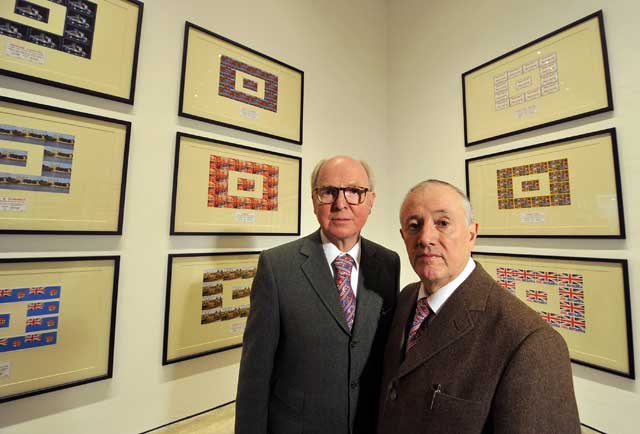
The old -isms have lost their sway. The revolution has been postponed. Mobilisation is out; introspection is in. The way of life has turned inwards. "True art comes from three main life forces," say the self-styled living sculptures Gilbert and George. "THE SOUL, THE HEAD and THE SEX." According to André Breton, every night before he went to sleep Saint-Pol-Roux used to have a notice posted on the door of his house. It read: THE POET IS WORKING. The artist manifestoist knows exactly what he means.
Alex Danchev is professor of international relations at the University of Nottingham. His latest book is '100 Artists' Manifestos' (Penguin Modern Classics)
Join our commenting forum
Join thought-provoking conversations, follow other Independent readers and see their replies
Comments