Digging deep for inspiration: Tracy Chevalier unearths the world of female fossil hunters
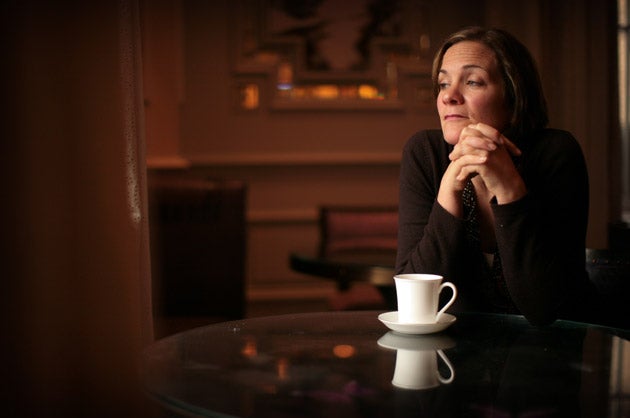
Tracy Chevalier dips a hand into her bag to pluck out a circular black rock which, in the centre of her palm, glitters like the giant eyeball of a Jurassic Cyclops. The rock, she explains, is a fossil, an ancient bone of a prehistoric creature ("Look, it was a big, big animal" ), which she discovered while scouring the beaches of Lyme Regis, famed among 19th-century "dinosaur hunters" for paleontological treasures which were known to nestle like primordial undergrowth beneath centuries of seaside shingle.
Fossils have, for the past two years, become Chevalier's greatest passion. The hulking cartilage which now sits on the table, emanating the salty sea air of a prediluvian age, is, I am assured, a rich reward for her itinerant weekend beach-combing. Her hikes to Lyme Regis were sparked by a photograph of a 19th-century female fossil hunter, Mary Anning, which she stumbled across in one corner of a dinosaur museum in Dorchester, which she was visiting with her ten-year-old son, Jacob.
Celebrated as a historical novelist with a penchant for painterliness, she has cast artists as central figures on more than one occasion: the Dutch painter Vermeer in her bestseller, Girl with a Pearl Earring, and the Romantic poet and engraver, William Blake, in Burning Bright. She had no intention of using a little-remembered figure from the obscure world of paleontology as the prime subject of her latest book, Remarkable Creatures (HarperCollins, £14.99). But just as Mary Anning is introduced as the miracle baby who is hit by (and survives) a lightning strike, Chevalier had her own lightning-bolt moment at the museum.
"She was an 11-year-old working-class girl who went on never to marry and was prickly and eccentric. I'd never heard of her and never thought about writing about science or fossils, but I thought 'what a great character'," says Chevalier.
Anning, both in life and in Chevalier's fiction, was marked out as a loner, an uneducated working woman who ventured into as muscular a profession as fossil-hunting, and with it, the extraordinary geological discoveries which dislodged the Christian theory of Creationism from its central axis, and opened the way towards Darwinism. She is known to have forged an unlikely friendship with the middle-class spinster, Elizabeth Philpot, the novel's second narrator, who, while older and more refined, is just as eccentric.
Together, they represent the first rumblings of a modernism that left old theology ruptured and which, in Elizabeth's words, "contributed to a new way of thinking about the world". More unusually, they also represented the 'other life lived' by women who didn't, or couldn't secure themselves a husband.
Elizabeth accepts her fate, albeit with a heavy heart - "I'm not the sort of lady a man chooses to marry, for I am too plain and too serious" - while her ever-hopeful sister Margaret holds on to the romantic dream. The person responsible for this giddy delusion, Elizabeth suggests (as does Chevalier), is Jane Austen, a contemporary whose fiction of love and marriage is charged with leading women like Margaret astray. The stories of these two spinsters, says Chevalier, need to be told, to redress the rose-tinted vision of 19th-century amours created by Austen, who herself lived a spinster's life, yet wrote stories that espoused the opposite ideals. "We are so steeped in Jane Austen. This story is, in a way, about her not only physically but in spirit. She never married and died when she was 41. I was looking for women who don't end up married.
"It was a sad thing but there was a freedom in their spinsterhood. I'm suggesting that for some women at the time, if they didn't marry, there was another life of intellectual pursuit, as well as their female friends, their sisters - Austen was very close to her sister, Cassandra. This is a novel that addresses questions of independence and being alone. In a way, Austen sidesteps these issues," claims Chevalier.
Mary and Elizabeth, however odd they appear to their contemporaries, are as dynamic as they are fulfilled - perhaps more so than Austen's heroines. "Maybe some people look for a happy, 21st-century ending," quips Chevalier. "These women remained unmarried but they led very interesting lives. I don't often write about romance. I'm too realistic for that. I didn't grow up thinking about it. It's not the only thing in life."
A desire for romance and adventure may have brought Chevalier from her home town of Washington DC to London, aged 22, but weightier things keep her here. "I originally planned to come for six months. First it was for fun and then it was for romance, which didn't work out. I thought, just because the romance hasn't worked doesn't mean I have run home with my tail between my legs. So I got a job in publishing and stayed."
The limits of the British class system is a preoccupation for Chevalier, both in daily life and in this book. Just looking at the social groupings in her son's London playground, she says: "We are not living in one big melting pot. Kids go towards kids of the same class. It's becoming more democratised now but at the time that Mary and Elizabeth were alive, the class system was much more rigid, which is what makes their friendship so surprising."
Elizabeth feels her working-class friend can afford to be freer "with her contempt for society's workings in a way that a woman of my class could not." But Mary feels her escape leaves her in limbo, isolated from other working women. "I weren't like other working people (either). I was caught in between, and always would be. That brought freedom, but it was lonely too."
Chevalier says it was not just their biographies which interested her but how their discoveries - viewed as dark and dangerous by the Church - changed the course of 19th-century science. What these women were unearthing in Lyme Regis had an immense impact on scientific theory in Europe, culminating with Darwin's theory of evolution and natural selection some decades later. Mary's discoveries of the dinasaur remains of ichthyosaur and plesiosaurs formed key pieces of "evidence" proving that extinction had taken place. When Mary makes the finds, she briefly and bewilderingly questions the Church doctrine that every creature has been made to "perfection" (could these fossils be classed as "God's mistakes" if they are now extinct, she wonders), but quickly dismisses the sacreligious repurcussions of these quarried remains.
"It's a theme that I think is relevant again in our world," says Chevalier, reflecting on the return of Creationist debates among modern educationalists and evangelicals.
So which little-remembered historical figure will Chevalier excavate for us next, I ask her. Perhaps it is time to turn away from the past, she broods. She has tried her hand at contemporary fiction before, and may do so again.
After finishing her first novel, The Virgin Blue, she wrote a draft for a contemporary novel which she showed her publisher. "At the same time, I had the idea for Girl with a Pearl Earring and my publisher said this contemporary novel's not working, I think you should set it aside and do the Vermeer book... Looking at my options now, the press say I'm a historical writer. But do I add to that or break out?"
A great idea for the next novel usually strikes Chevalier while she is still in the midst of writing the current one ("It's usually because I'm trying to escape what I'm doing because I'm at a difficult stage), but not this time. Now that the curious life of Mary Anning is done and dusted, Chevalier is waiting for another bolt of lightning to strike.
Join our commenting forum
Join thought-provoking conversations, follow other Independent readers and see their replies
Comments